Your area Not set — showing everywhere
Meeting report · Affordable Housing Trust
Creating this report cost real money. Help fund coverage →

Affordable Housing Trust — May 21, 2026

The meeting featured a high level of public engagement and lively debate among both trustees and community members regarding the financial and practical realities of housing policy.
Date Thursday, May 21, 2026 Duration 1.2h Speakers 12 Public comments 7 Decisions 2 Lively
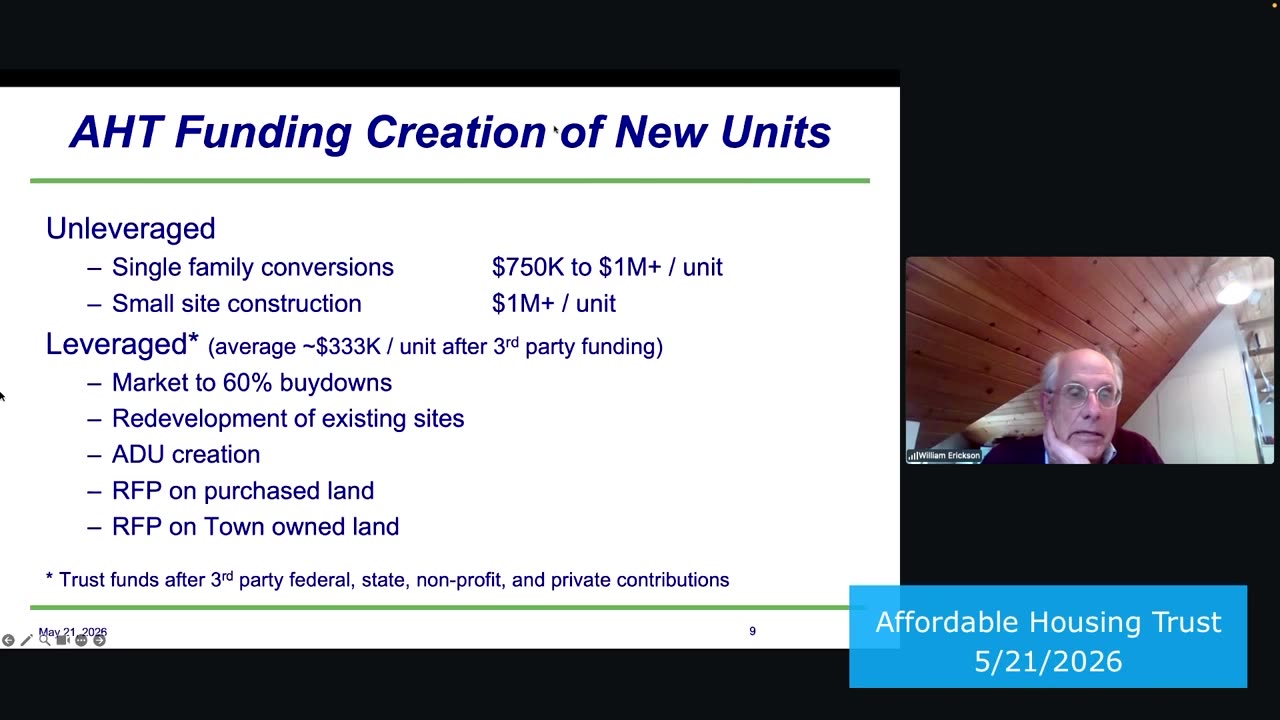
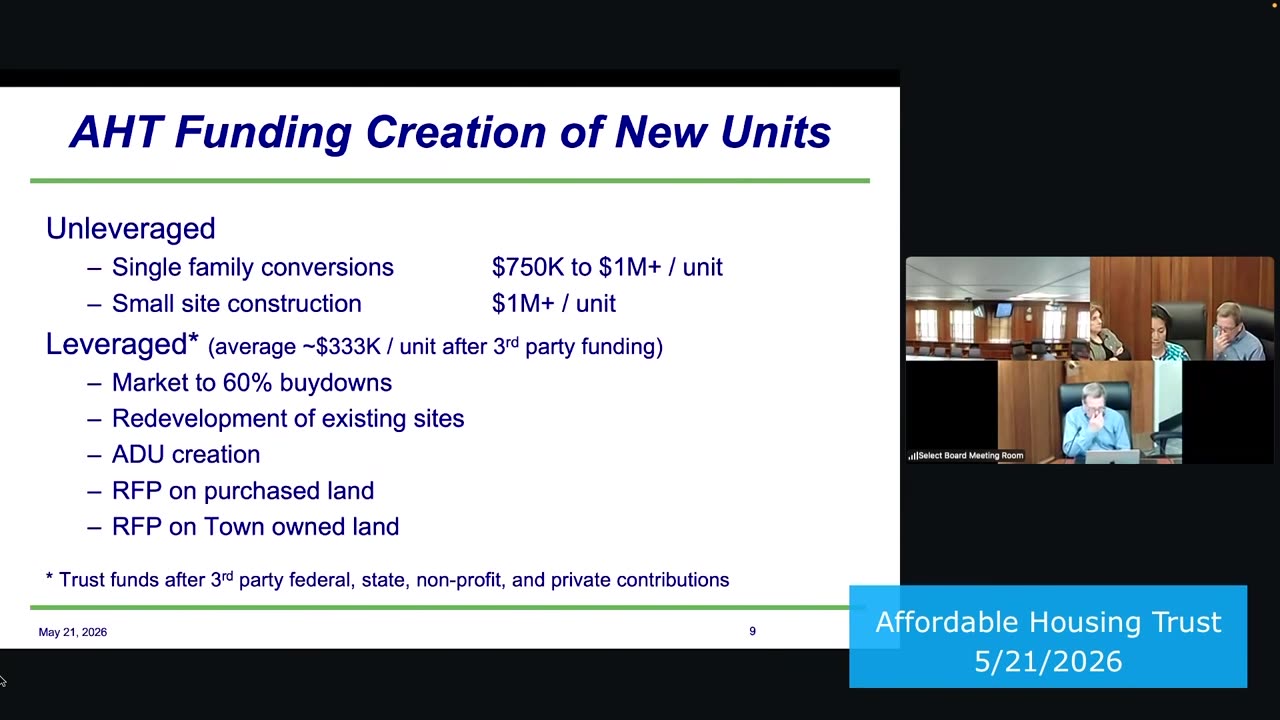
AHT funding options for new affordable housing units with costs Video still
AHT funding options for new affordable housing units with costs Frame from meeting video ▶ 30:30

Public ⁠impact

Issues from this meeting with documented community impact.
01

Strategic Plan and Housing Capacity

Determines the long-term priority and funding strategy for all affordable housing initiatives in town. Affected: All residents of Lexington, particularly those seeking affordable housing or impacted by zoning and development.
See more
What was discussed

The board discussed whether to prioritize creating new units or deepening existing affordability, and how to use matching funds to maximize impact. They also addressed the role of zoning overlay districts in unit creation.

What happened

The board agreed a strategic plan is necessary and will focus the next meeting on defining specific, achievable goals.

What's next

The next meeting will focus specifically on defining the Trust's goals.

other high impact
02

Pilot Rental Assistance Program Delay

Delay in the availability of new rental assistance resources. Affected: Low-income renters in Lexington seeking financial stability.
See more
What was discussed

The rollout of the new rental assistance program has been delayed due to the need for further revisions to program documents following trustee feedback.

What happened

The program will not launch as originally scheduled.

What's next

The Trust hopes to resolve document revisions and potentially launch in early June.
service reduction

Decisions ⁠logged

Every recorded vote, with timestamps and dissents.
Motion to move into executive session to discuss MBTA buy downs under Exemption 6.
The motion was made by Elaine Tung and seconded by Bill Erickson.
Unanimous
Authorization for Mark Sandeen to sign a letter of support for the Economic Development department's 'one stop for growth' application.
The board approved the motion to allow Mark Sandeen to sign the letter on behalf of the Trust.
Unanimous

Topics ⁠discussed

Click a topic to expand quotes and full context.
▶ 01:27 Executive Session Motion

A motion was made to enter executive session to discuss MBTA buy downs.

Speakers: Elaine Tung
See more
What was discussed

Elaine Tung proposed moving into executive session under Exemption 6 to discuss MBTA buy downs, arguing that open session discussion could negatively affect the Trust's negotiating position.

What happened

The motion was seconded and passed unanimously.

▶ 03:00 Agency and Partner Reports

Updates were provided regarding the Lexington Housing Authority (LHA), the Housing Partnership, and the MAPC.

Speakers: Elaine Tung, Mark Sandeen, Bill Erickson
See more
What was discussed

The LHA is transitioning Countryside Village to Section 8 and preparing for a capital needs assessment. The Housing Partnership presented goals to the Select Board, including a 10% affordable housing goal, and requested more direction. The MAPC is releasing a white paper regarding affordable housing trusts.

What happened

Trustees were informed of current partner activities and upcoming funding requests.

What's next

Trustees are asked to review and comment on the MAPC white paper draft by the end of June.

▶ 10:03 Pilot Rental Assistance Program Update

An update on the status of the new rental assistance program documents.

Speakers: Elaine Tung, Mark Sandeen
See more
What was discussed

The rollout of the rental assistance program has been delayed due to the need for further revisions to program documents following feedback from trustees.

What happened

The program will not launch as originally scheduled.

What's next

The Trust hopes to resolve document revisions and potentially launch in early June.

▶ 11:58 Strategic Plan Development
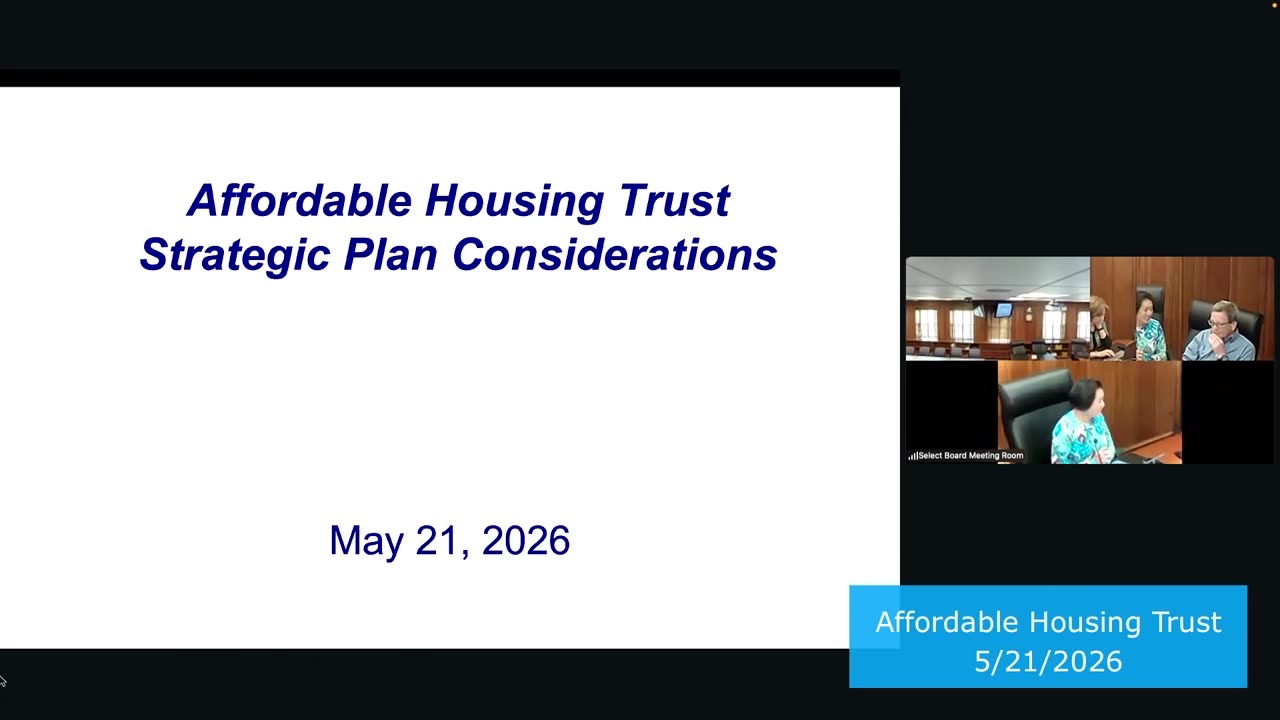
Affordable Housing Trust Strategic Plan Considerations title slide Video still
Affordable Housing Trust Strategic Plan Considerations title slide ▶ 13:58

A detailed discussion on creating a long-term strategic plan, focusing on goals, leverage, and prioritization.

Speakers: Mark Sandeen, Elaine Tung, Bill Erickson, Linda Prosser, Bob Creach
See more
What was discussed

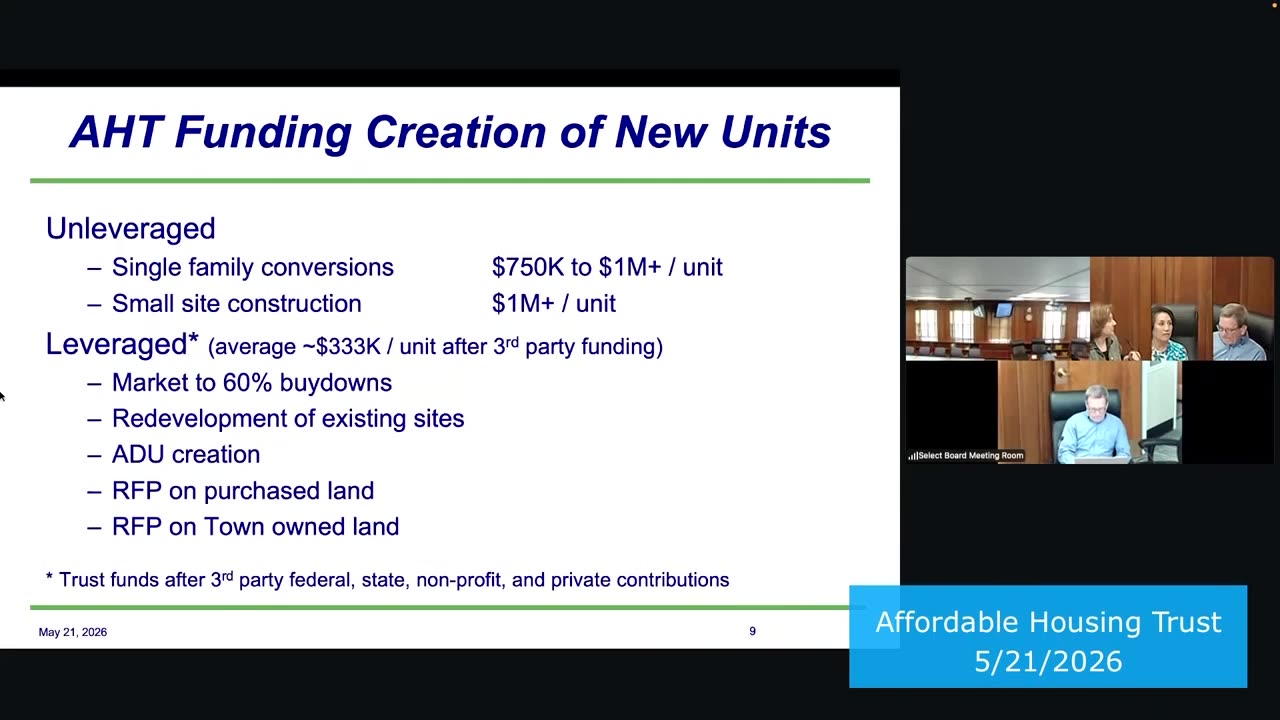
Mark Sandeen presented various strategic plan models (Arlington, Southborough, etc.) and emphasized the need for SMART goals. A significant debate occurred regarding whether to focus on creating new units versus deepening existing affordability, and how to maximize limited funds through leverage (matching funds). There was also discussion on whether to include a 'preservation' goal, which members distinguished from 'maintenance' or 'assistance'.

What happened

The board agreed that a strategic plan is necessary but must prioritize achievable goals rather than 'analysis by paralysis.'

What's next

The next meeting will focus specifically on defining the Trust's goals.
▶ 1:10:48 Economic Development Support
Strategic Plan Goal: data-driven affordable housing development priorities Video still
Strategic Plan Goal: data-driven affordable housing development priorities ▶ 26:10

Discussion regarding a support letter for a study on parking and multimodal circulation.

Speakers: Mark Sandeen, Linda Prosser
See more
What was discussed

The Economic Development department is applying for a 'one stop for growth' application to study how parking and multimodal circulation impact housing capacity. The board discussed whether to support this application.

What happened

The board unanimously voted to authorize Mark Sandeen to sign a letter of support.

Controversy & ⁠dissent

Where the board, the community, or the agenda diverged.

Potentially controversial issues

01

Strategic Plan: Goals vs. Funding Reality

There is a significant debate regarding whether the Trust should pursue ambitious housing targets (like the 10% goal) or focus on achievable, leveraged projects given limited funds. This impacts how public money is allocated and the long-term viability of the Trust's mission.
Board position: The board signaled a desire to move toward action and avoid 'analysis by paralysis,' but acknowledged the need for realistic, achievable SMART goals.
high concern
02

Definition of Housing Preservation

Community members and trustees debated whether 'preservation' should strictly mean maintaining affordability or expand to include individual resident assistance, such as home modifications for aging in place.
Board position: The board distinguished between 'preservation' (maintaining unit affordability) and 'assistance' (helping individuals with stability/repairs).
medium concern

Community vs. board tension

Action ⁠items

Who owes what, by when.
Review and provide comments on the MAPC white paper draft.
Assigned: Trustees · Due: End of June 2026
Sign the letter of support for the Economic Development department application.
Assigned: Mark Sandeen · Due: Immediate

Notable ⁠statements

I am absolutely advocating for maybe we just need to move on from trying to do analysis by paralysis, and just use the money that we have to actually develop units. — Mark Sandeen · Discussing the utility of conducting a highly detailed gap analysis versus direct investment in housing units. ▶ 25:43
We can't have the town set a goal that is unachievable... If you say, 'Uh, we're not gonna entertain anything that's not leveraged,' you're basically putting, as it's currently structured, LexAhab out of business. — Bill Erickson · Commenting on the tension between the 10% affordable housing goal and the financial reality of the Trust's funding. ▶ 1:21:00

Member ⁠positions

3 issues · 1 explicit · 2 inferred
Elaine Tung
Chair
Present
Executive Session Motion YES
Economic Development Support YES ~
Present
Executive Session Motion YES ~
Strategic Plan Development
Urged moving past 'analysis by paralysis' to focus on developing units.
Economic Development Support YES

Positions marked ~ are inferred from context and may not reflect the member's explicitly stated position. UNCLEAR means the vote was split but the record did not name how this member voted — it is not a “yes.”

Public ⁠comment

What residents said — verbatim, with timestamps.
7
Total speakers
5
Addressed
1
Partial
1
Not addressed
Bob
Not addressed
Bob shared insights from a Housing Partnership meeting regarding zoning issues and the potential for buydowns involving deeper affordability. He also noted that a hardworking member of the housing partnership was dissatisfied with the Select Board's reaction to their work. Key concern
Zoning articles and the dissatisfaction of the Housing Partnership with the Select Board.
Board response
The board did not provide a direct response to his specific commentary on the Select Board, but the discussion shifted into the strategic planning agenda.
While his points about zoning and partnership dissatisfaction were heard, the board did not engage with the concern regarding the Select Board's reaction or provide a specific response to his zoning observations.
Unidentified speaker
Addressed
The speaker suggested that preservation should include assisting residents with home modifications like ramps to allow them to age in place. They also questioned whether resident/tenant assistance should be categorized under preservation or a separate assistance program. Key concern
Inclusion of resident assistance and home modifications within the scope of housing preservation.
Board response
The board (specifically Mark and Linda) engaged in a detailed discussion to clarify the difference between 'preservation' (maintaining affordability) and 'assistance' (helping individuals with repairs or stability).
The board members engaged in a lengthy debate to define these terms and determine where such programs would fit within a strategic plan.
Bill Erickson
Addressed
Bill praised the thoroughness of the strategic plan presentation but cautioned against setting unachievable town goals like the 'true ten percent' without adequate funding. He expressed frustration with chasing 'dreams' if there is no consensus or appetite for the necessary funding. Key concern
The need for realism regarding town housing goals versus available funding and community values.
Board response
The board acknowledged his comments and continued the discussion on how to balance goals with limited resources.
The board members' subsequent discussion focused heavily on the tension between high goals and the reality of limited funds/leverage.
Unidentified speaker
Addressed
The speaker agreed with Bill that the Trust cannot reach the ten percent goal alone and must focus on maximizing current funds. They also inquired how affordable housing overlay districts might contribute to unit creation and if they require funding. Key concern
Prioritizing fund maximization and the role/cost of affordable housing overlay districts.
Board response
Linda responded by explaining how overlay districts work (providing zoning relief) and noted that they would likely still require subsidy funds to ensure affordability.
Linda provided a technical explanation of how overlay districts function and their impact on development costs.
Unidentified speaker
Addressed
The speaker argued against using the word 'ensure' in the strategic plan because it is an impossible standard. They also noted the complexities regarding the Cotten Woods development and its expired restrictions. Key concern
The use of overly strong language ('ensure') in official planning documents.
Board response
The board members discussed the legal and practical implications of the word 'ensure,' with several members agreeing it was too strong.
The board engaged in a group discussion specifically about the semantic and legal risks of using the word 'ensure' in their goals.
Unidentified speaker
Partial
The speaker noted that while there are ways to maintain a rental to prevent conversion, the process is extremely complicated. Key concern
Complexity of preventing condo conversions in affordable housing.
Board response
The board acknowledged the complexity but moved to conclude the discussion.
The speaker's point about complexity was acknowledged as part of the broader debate on preservation/maintenance.
Unidentified speaker
Addressed
Bob Creach provided detailed information on the Cotten Woods permit and the high school field project. He also shared observations on available land parcels in Lexington and the difficulty of the Trust competing with private developers for land. Key concern
Land availability, development competition, and specific project details (Cotten Woods/High School).
Board response
The board listened to his detailed report on land and project specifics.
The board took note of his insights regarding land acquisition and the difficulties of competing with developers.

From the meeting

AHT funding options for new affordable housing units with costs Video still
AHT funding options for new affordable housing units with costs ▶ 43:09
Lexington Affordable Housing Trust mission and goals statement Video still
Lexington Affordable Housing Trust mission and goals statement ▶ 45:23
AHT funding options for new affordable housing units with costs Video still
AHT funding options for new affordable housing units with costs ▶ 47:02
Support coverage

Creating this report cost ⁠real money.

MeetingWatch attended, transcribed, and analyzed this meeting on its own dime. If this work is valuable to you, chip in to keep covering Lexington.

Report composed by grok-4.3, gemma-4-26b, grok-4.20-0309-reasoning, grok-4-fast · analyzed 2026-06-10.