The meeting featured lively debate over regulatory loopholes and the long-term architectural and character impacts of new zoning and development proposals.
Date Tuesday, June 23, 2026Duration 1.6hSpeakers 21Public comments 7Decisions 5Lively
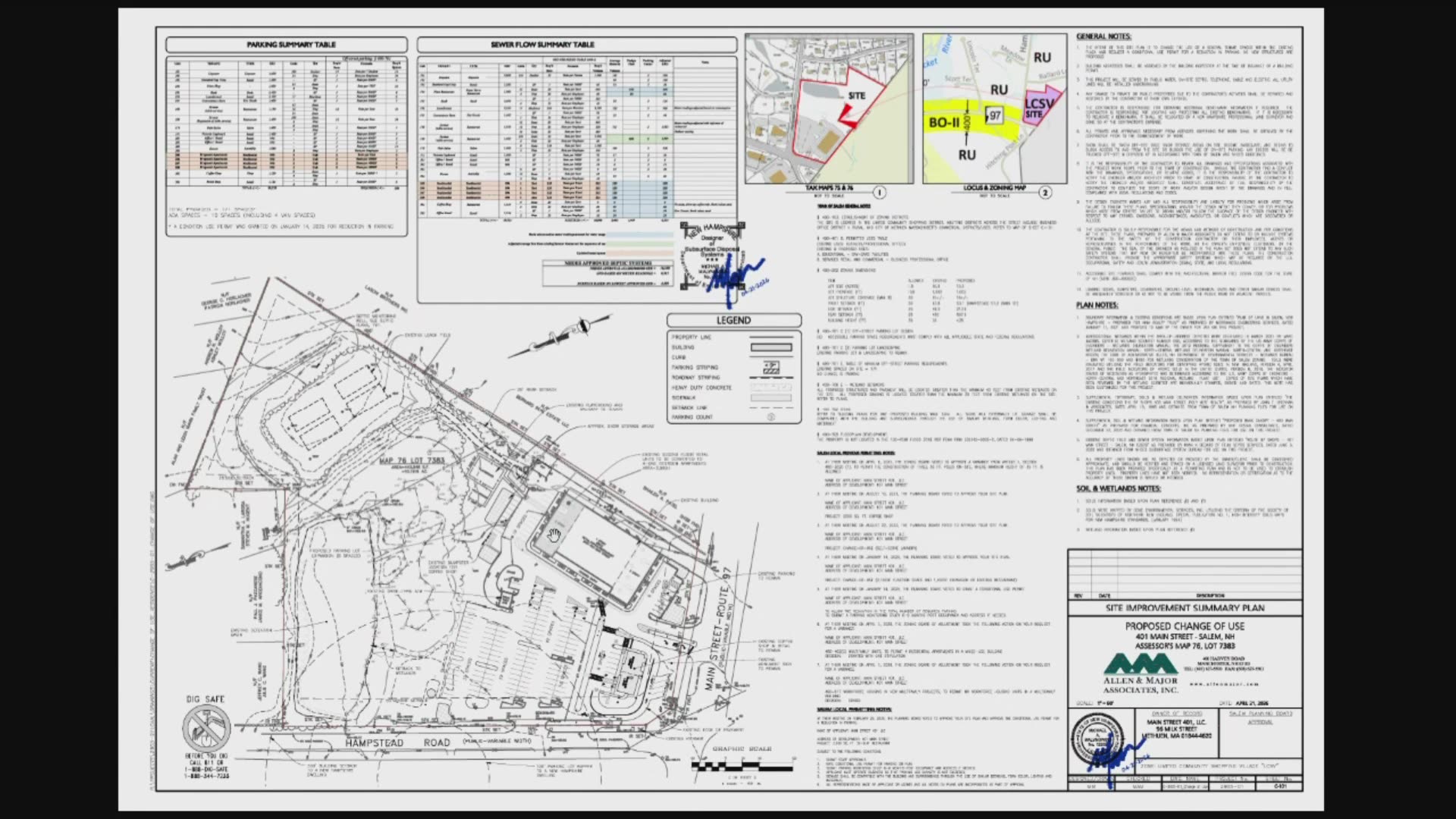
Site improvement plan map with parking/sewer tables and zoning detailsFrame from meeting video▶ 29:43
⚡
Lively discussion: The meeting featured lively debate over regulatory loopholes and the long-term architectural and character impacts of new zoning and development proposals.
SummaryAI-generated to surface controversy & community impact without bias — always verify against the actual meeting before relying on it.
At the June 23rd Salem Planning Board meeting, a decision was made that could allow developers to circumvent standard fees intended to support our community.
The Board discussed the use of a vacant 'flex space' near the Tuscan beer garden. Rather than requiring the owner to obtain a permanent Certificate of Occupancy—which would mandate the payment of impact fees—the Board reached a consensus to allow the space to be used through a series of individual, temporary event permits.
During the discussion, concerns were raised that this approach allows owners to 'play between the lines' to avoid the financial responsibilities that come with permanent commercial use. While the Board stated they would monitor the frequency of these events to ensure they don't become a 'de facto' permanent business, the decision sets a precedent for bypassing the standard regulatory and fee-paying process.
Additionally, the Board is moving forward with zoning amendments that could change building height limits and mixed-use definitions in our Historic District and Main Street. A public hearing is scheduled for July 14th. Residents should attend to ensure development aligns with Salem's long-term character rather than just short-term interests.
Jun 23, 20261.6h long21 speakers7 public comments5 decisionsLively
❝ Notable statements
↔ DragSwipe to browse
“Salem has seen wide utilization of our open space subdivision... We do try to promote it as much as we possibly can, we just don't have too many [parks].”
— Jim Harvey · Commenting on the success and limitations of open space subdivisions during the Master Plan discussion. ▶ 15:35
“I appreciate you providing it [affordable housing] in general. I just imagine the other units will probably have to make up for the loss of the affordable unit.”
— Paul Pelletier · Commenting on the impact of the ZBA's requirements for affordable housing on the Main Street 401 LLC project. ▶ 33:00
“To me, it feels like they're skirting the process... I don't want them to play between the lines, and I don't think it's right.”
— Unidentified speaker · Expressing concern that using temporary permits for a vacant space might be an attempt to avoid paying impact fees for a permanent Certificate of Occupancy. ▶ 1:03:03
“Living walls won't work in this climate.”
— Unidentified speaker · Responding to the applicant's proposal to use living walls in place of windows on a building facade. ▶ 1:11:06
“I want to say that we had talked about this, and that the area closest to the depot along Main Street, we envisioned four stories, but as you get further down towards the historic district, I think the intention was that to fall down a little bit.”
— Unidentified speaker · Discussing appropriate height limits for new mixed-use developments in different sub-districts of the town. ▶ 1:23:07
This meeting — choose a section
Public impact
Issues from this meeting with documented community impact.
What was discussed
Changes to mixed-use definitions and building height restrictions.
What happened
The board moved to schedule a public hearing for July 14th.
What's next
Staff will refine definitions and post the hearing for the next meeting.
What was discussed
Establishes the framework for future land protection and natural resource management.
What happened
The board unanimously adopted the plan.
What's next
The board will use the report's recommendations, such as the open space preservation zoning ordinance, to guide future decisions.
Topics discussed
Each topic expands to quotes and full context.
Speakers: Joe Feole, Karen Ruebaker, Jen Rodden, Jim Harvey
What was discussed
A public hearing regarding the adoption of the 2026 Open Space Master Plan, which serves as a natural resource inventory and provides a framework for future land protection.
What happened
The Planning Board unanimously voted to adopt the 2026 Open Space Master Plan.
What's next
The board is encouraged to use the report's recommendations, such as the open space preservation zoning ordinance, to guide future decisions.
Speakers: Joe Feole, Suzanne Brunelle, Jacob Lafontaine, Paul Pelletier
What was discussed
A site plan public hearing for a change of use to convert 3,960 square feet of office units into four residential apartments at 401 Main Street.
What happened
The board granted conditional approval for the site plan subject to eight specific conditions.
What's next
The applicant must meet conditions—including paying impact fees, recording an affordable housing covenant, and replacing dead trees—prior to obtaining building permits and occupancy.
Speakers: Jacob Lafontaine, Paul Pelletier, Jocelyn
What was discussed
A discussion regarding unauthorized exterior modifications at 357 South Broadway during its conversion from a cigar lounge to a function center.
What happened
The board accepted the update under public matters, noting the changes do not impact the footprint or square footage.
What's next
The applicant must submit revised elevations and signage details for review.
Speakers: Jacob Lafontaine, Paul Pelletier
What was discussed
An update on construction progress at the Salem Grand Casino, specifically regarding a temporary curb cut and site circulation.
What happened
The board acknowledged the temporary nature of the condition.
What's next
Staff will monitor the situation; the temporary curb cut will be removed and landscaping restored upon completion of construction (estimated mid-2027).
Speakers: Jacob Lafontaine, Paul Pelletier, Jim Harvey
What was discussed
Updates on seasonal programming and amenities at Tuscan Village, including container bars and holiday shop activations.
What happened
The board expressed support for the programming subject to staff ensuring necessary amenities (like restrooms) and approvals are in place.
What's next
Staff will coordinate with the developer to ensure amenities are present before operations begin.
Speakers: Unidentified speaker
What was discussed
Discussion regarding the use of a vacant 'flex space' near the Tuscan beer garden for periodic temporary events rather than a long-term lease.
What happened
The board reached a consensus to allow the space to be used on a rotating basis via separate temporary event permits, provided the board monitors the frequency to ensure it does not become a de facto permanent use.
What's next
Staff will notify the applicant that the approach is acceptable subject to monitoring.
Speakers: Unidentified speaker
What was discussed
Review of a request to replace windows with living walls or grates on a building in the Southern Jewel area.
What happened
The board expressed a strong preference for maintaining the windows or using spandrel glazing rather than a living wall.
What's next
Staff will report back to the applicant regarding the preference for spandrel glazing/retaining windows.
Speakers: Unidentified speaker
What was discussed
Deliberation on proposed changes to the permitted use table, mixed-use definitions, and height restrictions in response to pending state legislation.
What happened
The board decided to proceed with posting a public hearing for the amendments to ensure they are on the books, regardless of the Governor's pending action on state house bills.
What's next
Post the amendments for a public hearing on the July 14th meeting agenda; staff to refine definitions of mixed-use to explicitly include residential components.
Controversy & dissent
Where the board, the community, or the agenda diverged.
•
Board unity: While the board reached consensus on most votes, there were spirited discussions regarding zoning heights and the potential for developers to bypass impact fees via temporary permits.
Potentially controversial issues
01
Temporary Occupancy of Corner Shops Space
A member of the public raised concerns that using individual temporary event permits for a vacant space might allow the owner to circumvent the formal Certificate of Occupancy process and avoid paying required impact fees.
Board position: The board reached a consensus to allow the temporary use but committed to monitoring the frequency to prevent it from becoming a permanent, unpermitted use.
medium concern
02
Zoning Ordinance Amendments (Mixed-Use and Height)
The proposed changes involve significant debates over building height limits in the Main Street and historic districts, weighing the desire for density against the preservation of existing town character.
Board position: The board decided to move forward with a formal public hearing to ensure the amendments are legally established.
medium concern
03
Building 1030 Facade Alterations
The developer's proposal to replace windows with 'living walls' was met with skepticism regarding the aesthetic and practical viability of such features in the local climate.
Board position: The board expressed a strong preference for maintaining windows or using spandrel glazing instead of living walls.
low concern
Community vs. board tension
⚖
Corner Shops Space Permitting Community wants: The public expressed concern that the town might be allowing a developer to 'play between the lines' to avoid impact fees. Board response: The board acknowledged the concern and opted for a monitoring strategy rather than denying the permits.
Ready to share? AI-written accountability posts about this meeting's controversies.
Introduced the Open Space Master Plan prepared by the Conservation Commission and the Rockingham Planning Commission. She explained that the plan serves to update natural resource inventories, identify open space priorities, and implement protection tools like easements.
Key concern
Presentation of the 2026 Open Space Master Plan for adoption.
Board response
The board listened to the presentation and subsequently moved to adopt the plan unanimously.
The board followed the presentation by discussing it and voting to adopt the plan as presented.
Presented the details of the Open Space Master Plan, including natural resource inventories and community priority scoring. She discussed various methods for preserving land, such as easements, purchases, and current use programs.
Key concern
Detailing the methodology and recommendations of the Open Space Master Plan.
Board response
The board asked clarifying questions regarding acreage calculations and how Salem compares to other municipalities.
The board engaged with the presenter by asking questions to clarify the data presented.
Presented a site plan application for a change of use at 401 Main Street to convert office units into four residential apartments. She noted that the project is internal, meets sewer and parking requirements, and aligns with town housing goals.
Key concern
Requesting approval for a site plan regarding the change of use at 401 Main Street.
Board response
The board asked questions regarding parking locations, unit access, and the impact of the change of use, eventually granting conditional approval.
The board reviewed the application, asked questions, and provided a decision with eight specific conditions.
Asked if the right side of the property being discussed would remain a lounge. He also inquired about the specific nature of the function space and the hours of operation.
Key concern
Clarification on the use and hours of operation for the proposed function space at 357 South Broadway.
Board response
The applicant and planning staff provided details regarding the private event nature of the space and the expected end times for music and service.
The speaker's questions were answered by the applicant and the planning department staff.
Questioned the legality of using temporary event permits for a space that has never had a Certificate of Occupancy. He expressed concern that the town might be allowing the applicant to bypass permanent occupancy and impact fee requirements.
Key concern
Potential circumvention of formal occupancy and impact fee processes through repeated temporary permits.
Board response
The planning staff explained the mechanism of temporary permits and the goal of 'activating' the space, while the board discussed the need to monitor the frequency of these events.
The board and staff engaged in a robust debate about the legality and ethics of the process, but they did not immediately change the policy, opting instead to monitor it.
Decisions logged
Every recorded vote, with timestamps and dissents.
Decision to move forward with posting zoning ordinance amendments for a public hearing.
The hearing will be scheduled for the July 14th meeting to ensure compliance with the July 1st effective date of HB 631.
Approved/Consensus
Share this report
Drafts ready to post — click any block to copy.
●
Accountability posts. AI-drafted to highlight decisions made outside the public agenda, split votes, and community concerns that went unaddressed. Always verify facts before sharing.
⚠
Salem Planning Board allows temporary permits for vacant space, potentially bypassing required impact fees.
X / Twitter — by angle
Potential loophole allowing developers to bypass impact fees
At the 6/23 Planning Board meeting, a decision was made to allow temporary event permits for the vacant 'corner shop' space near the Tuscan beer garden. This avoids the formal Certificate of Occupancy process and the impact fees required... https://meetingwatch.org/nh/salem/planning-board/2026-06-23/ #MeetingWatch
315/280 chars
Significant zoning changes affecting community character
Salem Planning Board is moving forward with zoning amendments regarding building heights and mixed-use definitions. This will impact the character of Main Street and the Historic District. A public hearing is set for July 14th. Get... https://meetingwatch.org/nh/salem/planning-board/2026-06-23/ #MeetingWatch
309/280 chars
Community concerns regarding regulatory loopholes
During the 6/23 meeting, residents raised concerns that using temporary permits for the corner shop space allows owners to 'play between the lines' to avoid paying required impact fees. The Board opted to monitor rather than deny... https://meetingwatch.org/nh/salem/planning-board/2026-06-23/ #MeetingWatch
307/280 chars
X thread
1
Is Salem allowing developers to bypass impact fees? At the 6/23 Planning Board meeting, a controversial decision was made regarding the vacant 'corner shop' space near the Tuscan beer garden. 🧵 #MeetingWatch #SalemNH
216/280
2
Instead of requiring a permanent Certificate of Occupancy—which triggers mandatory impact fees—the Board reached a consensus to allow the space to be used via rotating 'temporary event permits.'
194/280
3
A member of the public warned that this allows owners to 'skirt the process' and 'play between the lines.' While the Board promised to monitor the frequency of these events, the door remains open for permanent use without the required fees. https://meetingwatch.org/nh/salem/planning-board/2026-06-23/
264/280
Facebook — long form
At the June 23rd Salem Planning Board meeting, a decision was made that could allow developers to circumvent standard fees intended to support our community.
The Board discussed the use of a vacant 'flex space' near the Tuscan beer garden. Rather than requiring the owner to obtain a permanent Certificate of Occupancy—which would mandate the payment of impact fees—the Board reached a consensus to allow the space to be used through a series of individual, temporary event permits.
During the discussion, concerns were raised that this approach allows owners to 'play between the lines' to avoid the financial responsibilities that come with permanent commercial use. While the Board stated they would monitor the frequency of these events to ensure they don't become a 'de facto' permanent business, the decision sets a precedent for bypassing the standard regulatory and fee-paying process.
Additionally, the Board is moving forward with zoning amendments that could change building height limits and mixed-use definitions in our Historic District and Main Street. A public hearing is scheduled for July 14th. Residents should attend to ensure development aligns with Salem's long-term character rather than just short-term interests. https://meetingwatch.org/nh/salem/planning-board/2026-06-23/ #MeetingWatch #SalemNH
Action items
Who owes what, by when.
Submit staff approvals, pay impact fees (Public Safety, Recreation, and School), record affordable housing covenant, replace dead trees, and install additional trees in median islands.
Assigned: Main Street 401 LLC · Due: Prior to building permit/occupancy
Submit architectural plans/elevations including materials, colors, and signage dimensions.
Assigned: 357 South Broadway Applicant · Due: Next meeting/as requested
Bring revised elevations and artwork for Salem Grand Casino to the next meeting.
Assigned: Jacob Lafontaine (Planning Dept) · Due: July 14th
Verify restroom access/arrangements for Tuscan Village container bar programming.
Assigned: Jacob Lafontaine (Planning Dept) · Due: Before operations begin
Notify applicant regarding the approval of temporary event permits for the corner shop space, subject to monitoring.
Assigned: Staff
Return to the board with information regarding the use of spandrel glazing versus living walls for Building 1030.
Assigned: Staff · Due: July 14th meeting
Refine the definition of 'mixed-use development' to explicitly include residential components and consult legal regarding specific percentage requirements.
Assigned: Staff · Due: July 14th meeting
Post the zoning ordinance amendments for a public hearing for the July 14th meeting.
Positions marked ~ are inferred from context and may not reflect the member's explicitly stated position. UNCLEAR means the vote was split but the record did not name how this member voted — it is not a “yes.”
Support coverage
Creating this report cost real money.
MeetingWatch attended, transcribed, and analyzed this meeting on its own dime. If this work is valuable to you, chip in to keep covering Salem.
Follow Salem
One email when a new report is published from the Planning Board — or one weekly digest.
Report composed by grok-4.20-0309-reasoning, grok-4-fast · analyzed 2026-06-24.
Show me what's happening near me.
MeetingWatch covers communities across the country. Tell us where you are and we'll surface the meetings, votes, and decisions in your town.
Request coverage
We'll let you know when MeetingWatch starts covering your area.
Please add your name and a valid email.
Check your inbox — click the link in our email to finish your request.
Or browse covered communities:
Send feedback
Spotted an error, or have a tip? Let us know — we read every note.
Know where the video for this meeting lives? Paste the link below and we'll add it.
We'll email you a link to confirm — this keeps out spam. We won't share your address.
Please add a valid email and a message.
Check your inbox — click the link in our email to confirm your feedback.
Search MeetingWatch
MeetingWatchStay informed — without the slant.
Hours of public meetings. Zero time to watch them.
MeetingWatch uses AI to attend every public meeting in covered communities —
transcribing debates, logging votes, and surfacing what actually mattered.
No slant. No bias. Just what was said on the record, so you can stay
informed about your town without burning your evenings.
Get started in three steps
1
Tell us where you live.
We'll surface the meetings, votes, and decisions in your town first.
One weekly email. Decisions, dissents, and the off-agenda items from every covered community. Unsubscribe in one click.
✓ Subscribed — check your inbox to confirm
3
Support the work.
MeetingWatch is a civic accountability project. Reader contributions cover transcription, hosting, and the cost of attending every meeting — and help grow coverage to more towns.