Your area Not set — showing everywhere
Meeting report · Planning Board
Creating this report cost real money. Help fund coverage →

Planning Board — March 12, 2026

Planning Board debates strict mandate implementation vs. infrastructure limits

The meeting was a deliberative work session focused on complex regulatory planning with no public opposition or heated interpersonal conflict recorded.
Date Thursday, March 12, 2026 Duration 1.1h Speakers 1 Routine
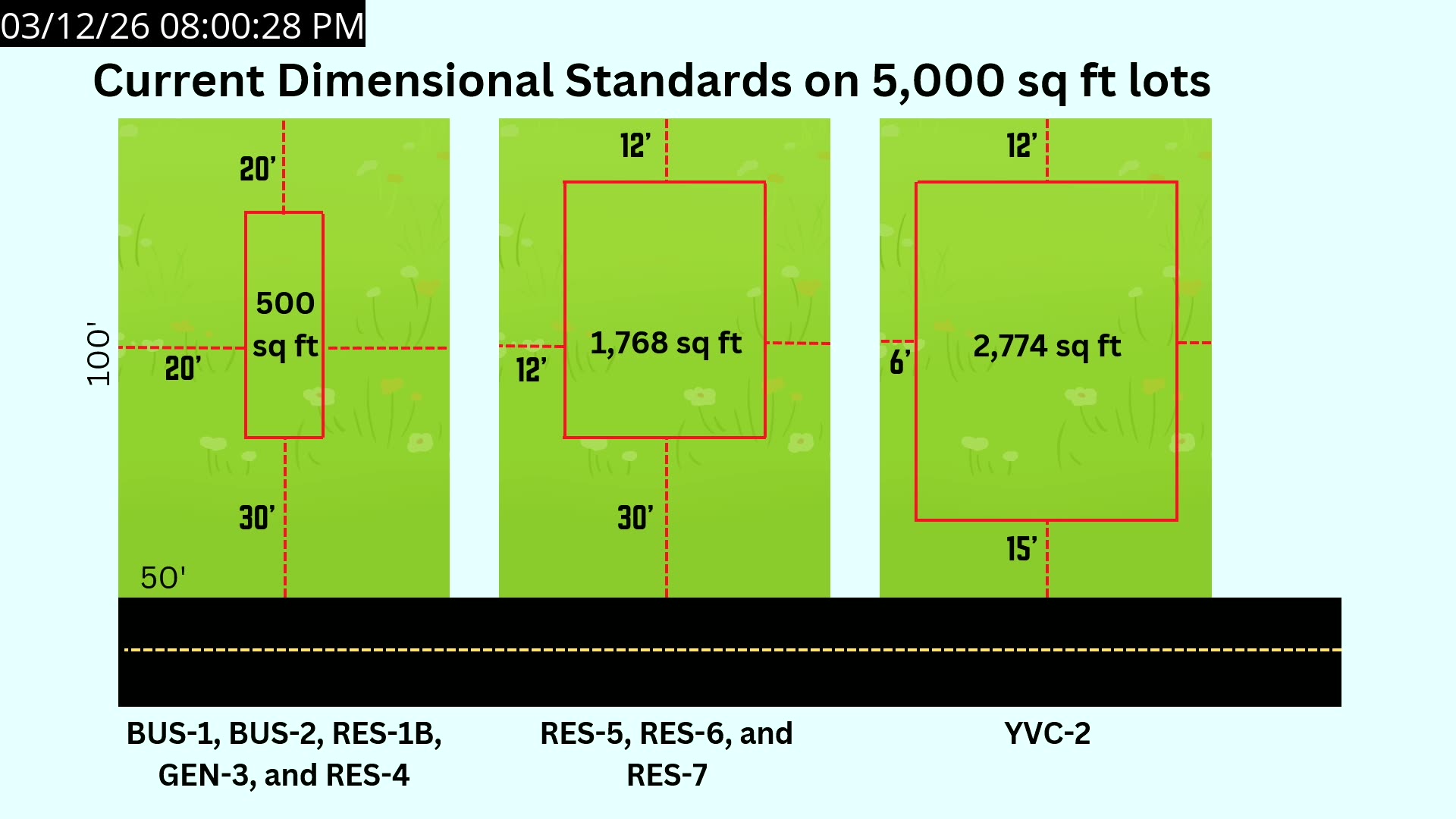
Dimensional standards on 5,000 sq ft lots by zone Video still
Dimensional standards on 5,000 sq ft lots by zone Frame from meeting video ▶ 1:00:17

Questions about this meeting? ⁠Just ask.

Ask MeetingWatch answers from this meeting’s report, transcript, and records — with linked sources.

Summary AI-generated to surface controversy & community impact without bias — always verify against the actual meeting before relying on it.

During the March 12 Planning Board meeting, a significant debate unfolded regarding how the Town of York will implement state-mandated changes to housing density (LD 1829). This is not just a technical update; it represents a fundamental shift in how our town will grow.

The Board is currently weighing three different zoning strategies to manage these mandates. The discussion revealed a core tension: how to balance state legal requirements with the preservation of local neighborhood character. One board member specifically questioned whether the town's role is to implement these housing laws 'delicately' or to follow the mandates strictly.

Of even greater concern is the impact on our town's infrastructure. As the Director of Planning explained, state law could drop minimum lot sizes to 5,000 square feet in growth zones. This raised urgent questions about whether our water and sewer systems have the physical capacity to support a sudden influx of new connections. If the infrastructure cannot handle the density, the legal mandate creates a direct conflict with our town's operational reality.

With the Director of Planning aiming to present new use tables and definitions for a potential vote this November, residents should prepare to engage. The decisions made in the coming months will dictate the density, aesthetics, and utility demands of our community for years to come.

Mar 12, 2026 1.1h long 1 speakers Routine
Notable statements Drag to browse

“You don’t want miscellaneous... It usually means you don’t understand what it is.”

— a board member · Commenting on the use of 'miscellaneous' or 'other' categories in the zoning ordinance. ▶ 10:14

“If you can’t do a hook up, you might as well treat it as if there is no sewer.”

— a board member · Discussing the conflict between state law requiring connections and local sewer capacity constraints. ▶ 1:01:51

“The board must decide if its role is to implement new housing laws delicately or to follow the mandate strictly.”

— a board member · Discussing the implementation of housing density in established neighborhoods. ▶ 1:07:03
This meeting — choose a section

Public ⁠impact

Issues from this meeting with documented community impact.
What was discussed

Significant changes to minimum lot sizes (potentially as low as 5,000 sq ft) and dwelling unit density.

What happened

The board is weighing three different zoning approaches and evaluating the impact on infrastructure.

Topics ⁠discussed

Each topic expands to quotes and full context.
Speakers: Director of Planning, a board member
What was discussed

The Director of Planning presented a draft charter for a new subcommittee focused on reviewing land use and ordinance regulations.

What happened

The board expressed general agreement with the idea of the subcommittee and the importance of cleaning up the use tables.

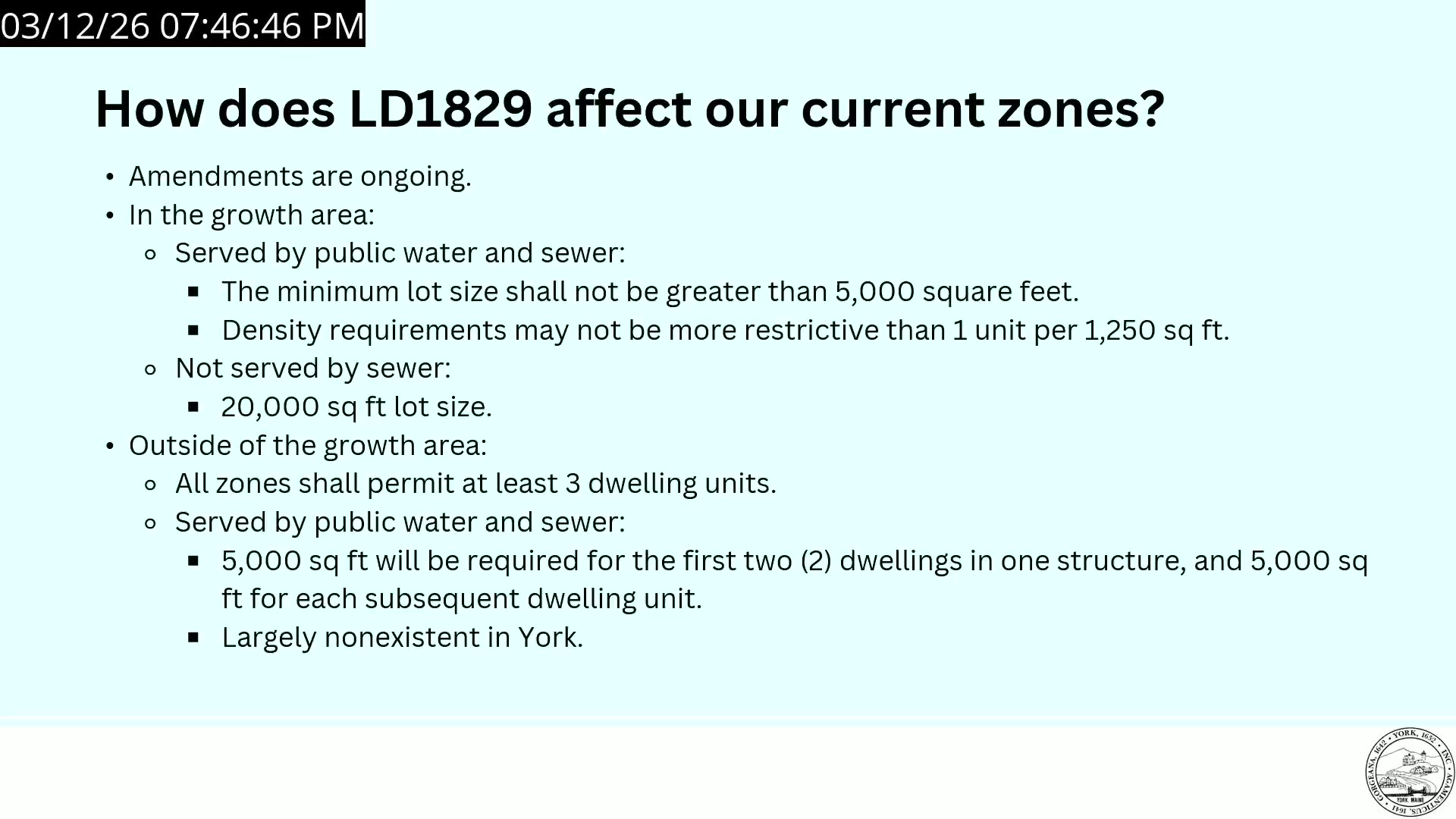
How LD1829 affects current zones Video still
How LD1829 affects current zones ▶ 46:35
Speakers: Director of Planning, a board member
What was discussed

A detailed explanation of how LD 1829 affects minimum lot sizes and dwelling unit density in growth and non-growth zones.

What happened

The board noted the potential tension between state-mandated density increases and local infrastructure capacity limits.
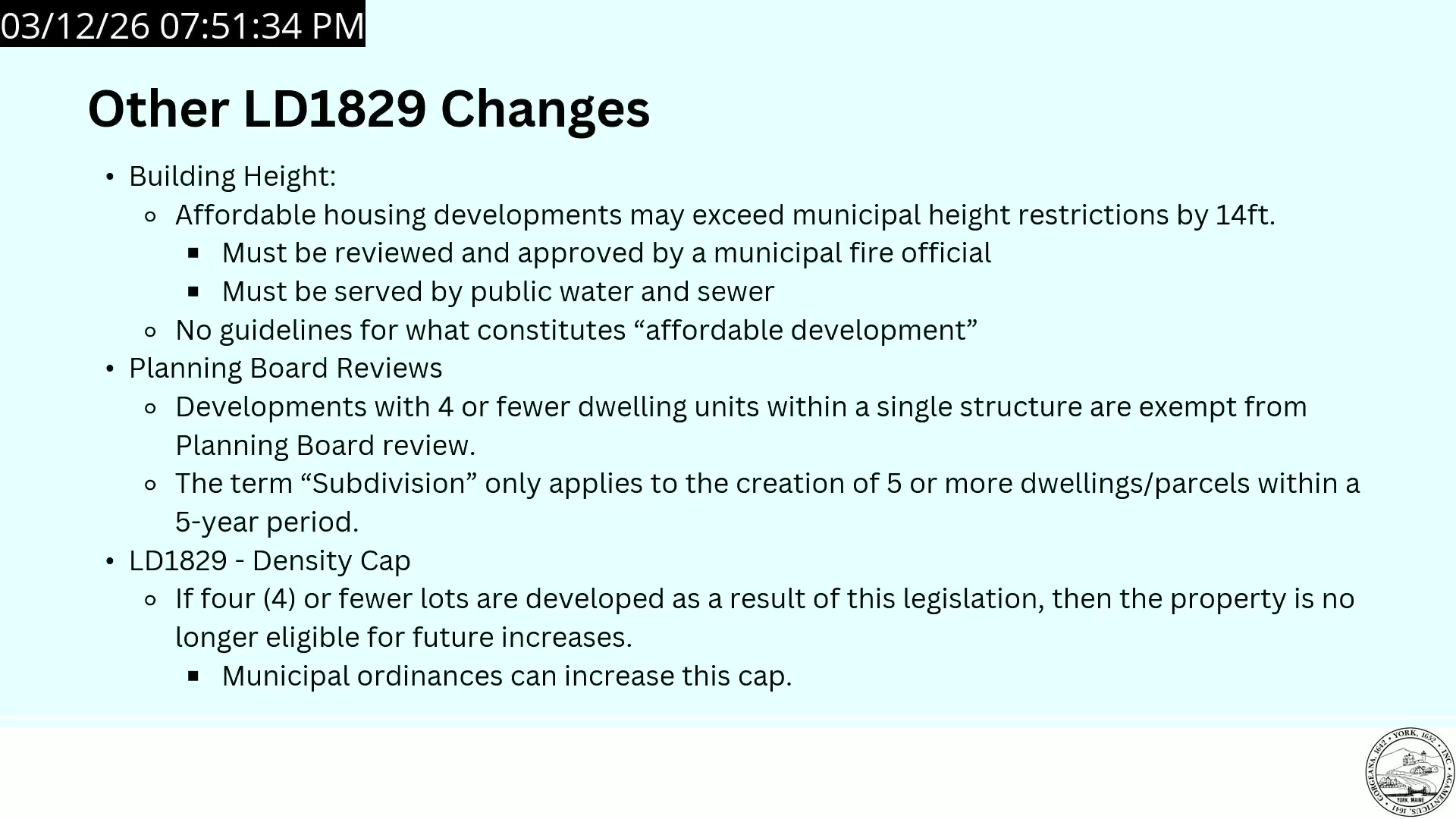
Other LD1829 changes overview Video still
Other LD1829 changes overview ▶ 51:23
Speakers: Director of Planning, a board member
What was discussed

The board discussed three potential strategies for updating the town's zoning: Euclidean overhaul, character/form-based code, or a hybrid approach.

What happened

The board recognized the complexity of the task and the need to balance state mandates with local character. The board is weighing the balance between meeting legal minimum standards and preserving neighborhood aesthetics and building envelopes.

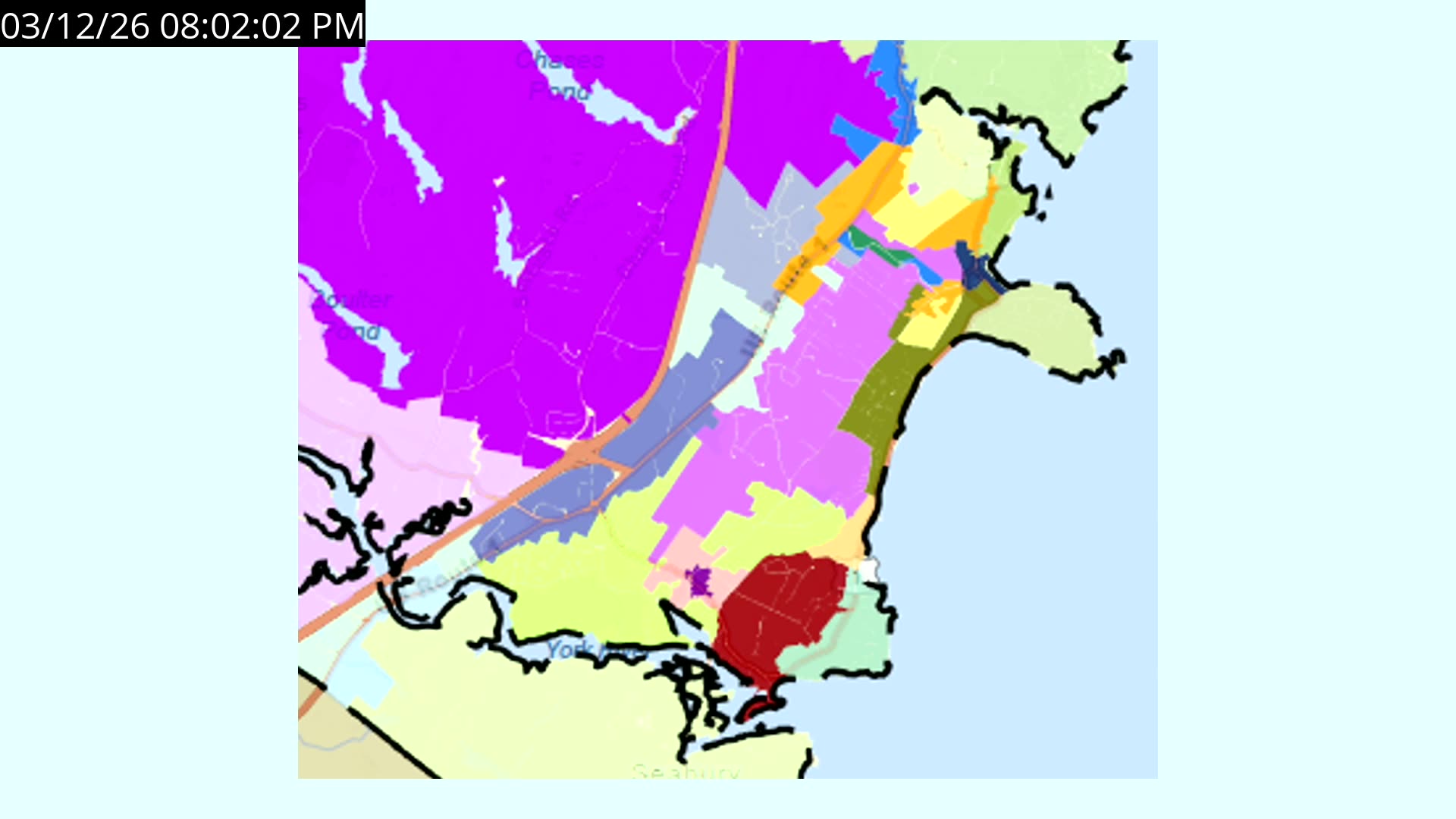
Color-coded zoning/land use map of York area Video still
Color-coded zoning/land use map of York area ▶ 1:01:51
Speakers: a board member
What was discussed

The board discussed the tension between legal mandates to provide utility connections and the actual physical capacity of water and sewer systems.

What happened

No formal decision was reached; the discussion served as a deliberation on the implications of current laws regarding utility usage.

Controversy & ⁠dissent

Where the board, the community, or the agenda diverged.

Potentially controversial issues

01

Implementation of LD 1829 Zoning Mandates

State law requires changes to density and lot sizes that may conflict with local neighborhood character and existing infrastructure capacity.
Board position: The board is deliberating how to balance legal mandates with the preservation of neighborhood aesthetics and utility limits.
Internal dissent
Board members expressed differing views on whether to implement the laws 'delicately' or follow the mandates strictly, and debated the choice between Euclidean, form-based, or hybrid zoning models.
medium concern
02

Infrastructure Capacity vs. State Density Mandates

There is a potential conflict between state-mandated increases in housing density and the actual physical capacity of the town's water and sewer systems.
Board position: The board acknowledged the tension and questioned if the sewer district can be compelled to provide connections if capacity is constrained.
medium concern

Public ⁠comment

What residents said — verbatim, with timestamps.
No public comments were identified in this meeting.

Share ⁠this report

Drafts ready to post — click a block to copy, or use Share to post it.

X / Twitter — by angle

Internal board division regarding state mandate implementation
At the March 12 Planning Board meeting, members debated a critical question: Should York implement state housing mandates 'delicately' or follow them strictly? The outcome will change the density and character of our neighborhoods... https://meetingwatch.org/me/york/planning-board/2026-03-12/ #MeetingWatch
307/280 chars
Potential misalignment between density mandates and infrastructure capacity
State law (LD 1829) may soon allow lot sizes as small as 5,000 sq ft in growth zones. At the 3/12 Planning Board meeting, serious questions were raised about whether our water and sewer infrastructure can actually handle this increased... https://meetingwatch.org/me/york/planning-board/2026-03-12/ #MeetingWatch
312/280 chars
Upcoming significant regulatory changes
York Planning Board is weighing three different zoning models to address state mandates. The decision will impact everything from lot sizes to the 'feel' of our streets. Residents should watch for the new use table presentation this... https://meetingwatch.org/me/york/planning-board/2026-03-12/ #MeetingWatch
309/280 chars

X thread

1
York’s neighborhood character and infrastructure are facing a major crossroads. During the March 12 Planning Board meeting, the discussion centered on how to implement the state’s LD 1829 density mandates. 🧵 #MeetingWatch #YorkME
229/280
2
The board is debating three paths: traditional zoning, form-based codes, or a hybrid approach. This isn't just paperwork—it determines if we see more quadplexes and smaller lots (potentially 5,000 sq ft) in our existing neighborhoods.
234/280
3
A major point of tension: Can our infrastructure support this? Board members questioned if our water and sewer systems can handle the connections required by state law, especially if capacity is already near its limit.
218/280
4
The fundamental question remains: Is the Board’s job to implement these laws 'delicately' or to follow the mandate strictly? With a potential vote coming in November, residents need to stay informed on how these density changes will impact our town. https://meetingwatch.org/me/york/planning-board/2026-03-12/
273/280

Facebook — long form

During the March 12 Planning Board meeting, a significant debate unfolded regarding how the Town of York will implement state-mandated changes to housing density (LD 1829). This is not just a technical update; it represents a fundamental shift in how our town will grow.

The Board is currently weighing three different zoning strategies to manage these mandates. The discussion revealed a core tension: how to balance state legal requirements with the preservation of local neighborhood character. One board member specifically questioned whether the town's role is to implement these housing laws 'delicately' or to follow the mandates strictly.

Of even greater concern is the impact on our town's infrastructure. As the Director of Planning explained, state law could drop minimum lot sizes to 5,000 square feet in growth zones. This raised urgent questions about whether our water and sewer systems have the physical capacity to support a sudden influx of new connections. If the infrastructure cannot handle the density, the legal mandate creates a direct conflict with our town's operational reality.

With the Director of Planning aiming to present new use tables and definitions for a potential vote this November, residents should prepare to engage. The decisions made in the coming months will dictate the density, aesthetics, and utility demands of our community for years to come. https://meetingwatch.org/me/york/planning-board/2026-03-12/ #MeetingWatch #YorkME

Action ⁠items

Who owes what, by when.
Send the Excel version of the principal permitted use chart to the board members.
Assigned: Director of Planning · Due: ASAP
Support coverage

Creating this report cost ⁠real money.

MeetingWatch attended, transcribed, and analyzed this meeting on its own dime. If this work is valuable to you, chip in to keep covering York.

Report composed by xai.grok-4.3, gemma-4-26b, grok-4.20-0309-non-reasoning, grok-4.20-0309-reasoning · analyzed 2026-08-07.