Your area Not set — showing everywhere
Meeting report · Planning Board
Creating this report cost real money. Help fund coverage →

Planning Board — June 9, 2026

The meeting featured lively technical questioning from both the public and the board, particularly regarding environmental safety and development limits.
Date Tuesday, June 9, 2026 Duration 1.4h Speakers 12 Public comments 5 Decisions 3 Lively
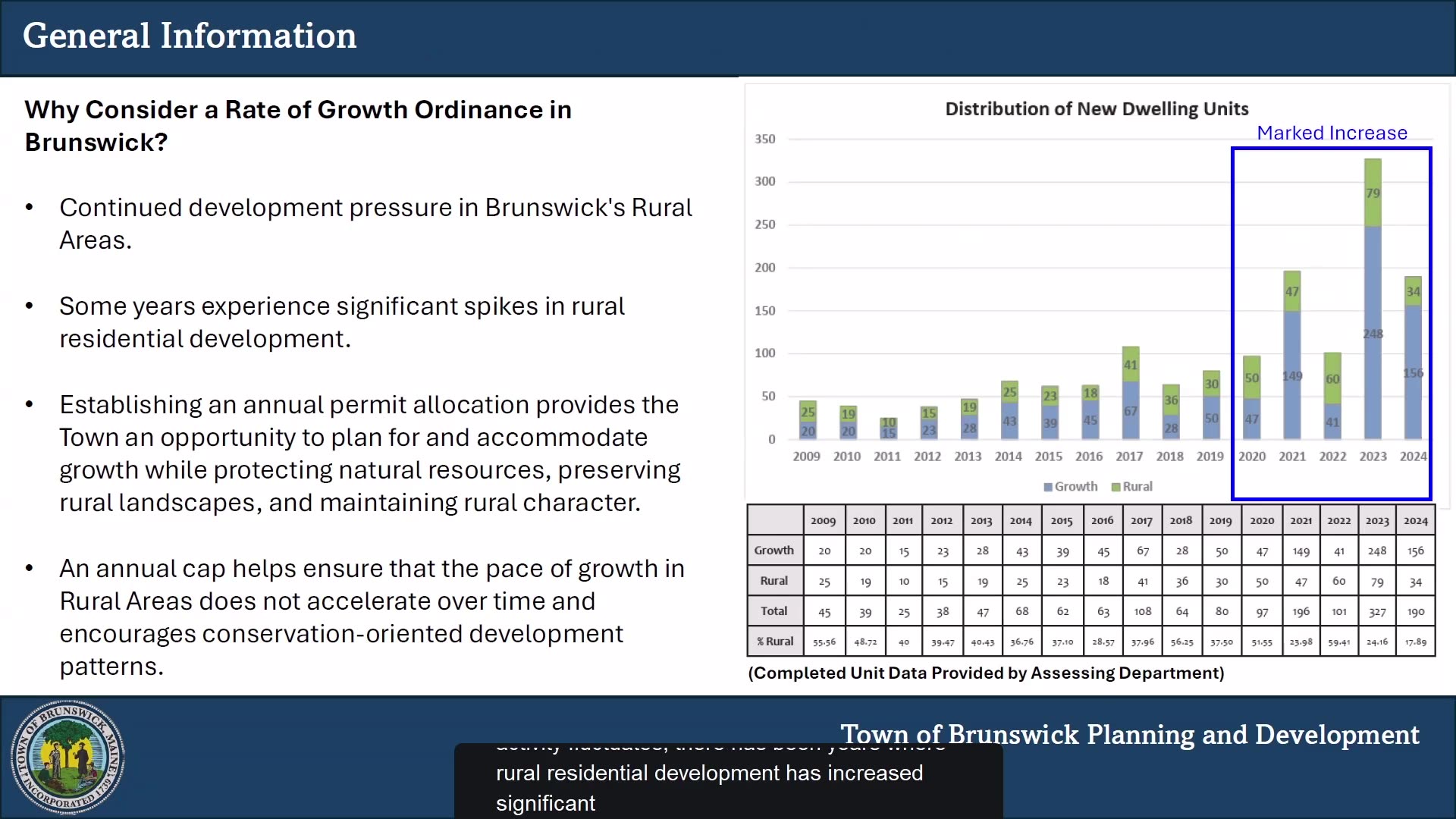
Chart: Distribution of new dwelling units in Brunswick (2009-2024) Video still
Chart: Distribution of new dwelling units in Brunswick (2009-2024) Frame from meeting video ▶ 43:28

Public ⁠impact

Issues from this meeting with documented community impact.
01

Rate of Growth Ordinance and Zoning Text Amendments

Limits the number of rural growth permits to 32 per year. Affected: All residents in rural areas, prospective homeowners, and property developers.
See more
What was discussed

The board discussed a proposal to allocate a set number of annual growth permits for rural areas to prevent sprawl. Debates centered on permit transferability, the 'waiting list' mechanism, and preventing incremental subdivisions from bypassing limits.

What happened

The board voted unanimously to recommend the ordinance to the Town Council with specific wording refinements.

What's next

Introduction to the Town Council on July 6th and a public hearing on July 20th.

zoning change

Decisions ⁠logged

Every recorded vote, with timestamps and dissents.
Motion to concur that the Golick Multi-Family Development application is complete for substantive review.
The board moved to accept the staff's conclusion that major development review materials have been submitted.
Unanimous
Motion to table Case 26-21 (Golick Multi-Family Development) until the June 23rd meeting.
The motion was made to allow time for the applicant to address stormwater technicalities and financial capacity documentation.
Unanimous
Motion to recommend the proposed ordinance text amendments to the Town Council, including the board's comments and subject to attorney review.
The motion was made by Laura Hatton Maker and seconded by Chris. The recommendation supports the strategies in Brunswick's Comprehensive Plan.
Unanimous

Topics ⁠discussed

Click a topic to expand quotes and full context.
▶ 00:07 Case 26-21: Golick Multi-Family Development Site Plan Amendment
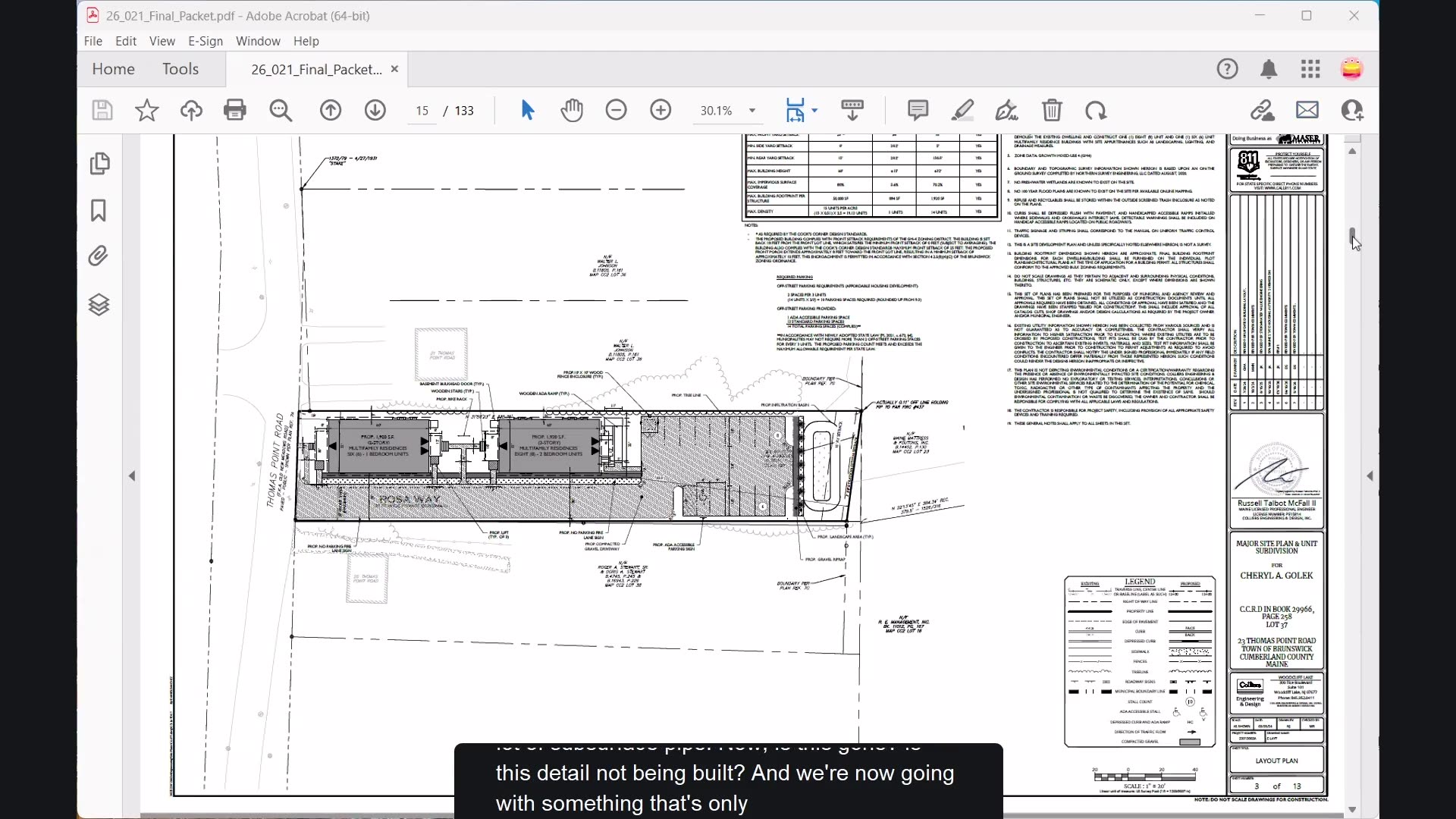
Site plan layout for proposed multifamily residences Video still
Site plan layout for proposed multifamily residences ▶ 14:42

The board reviewed a site plan amendment for a multi-family housing project, focusing on changes to stormwater management and building design.

Speakers: Unidentified speaker
See more
What was discussed

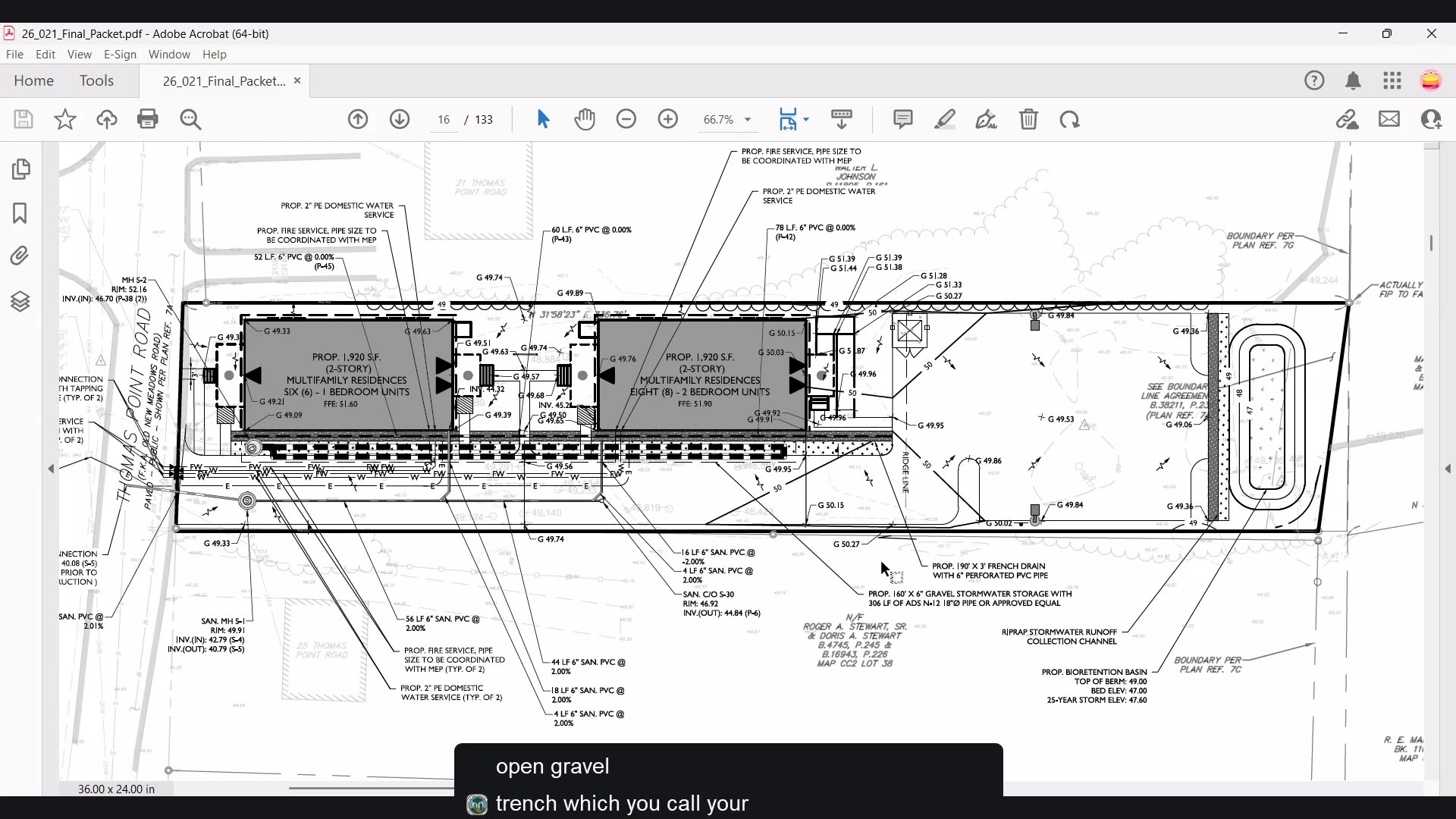
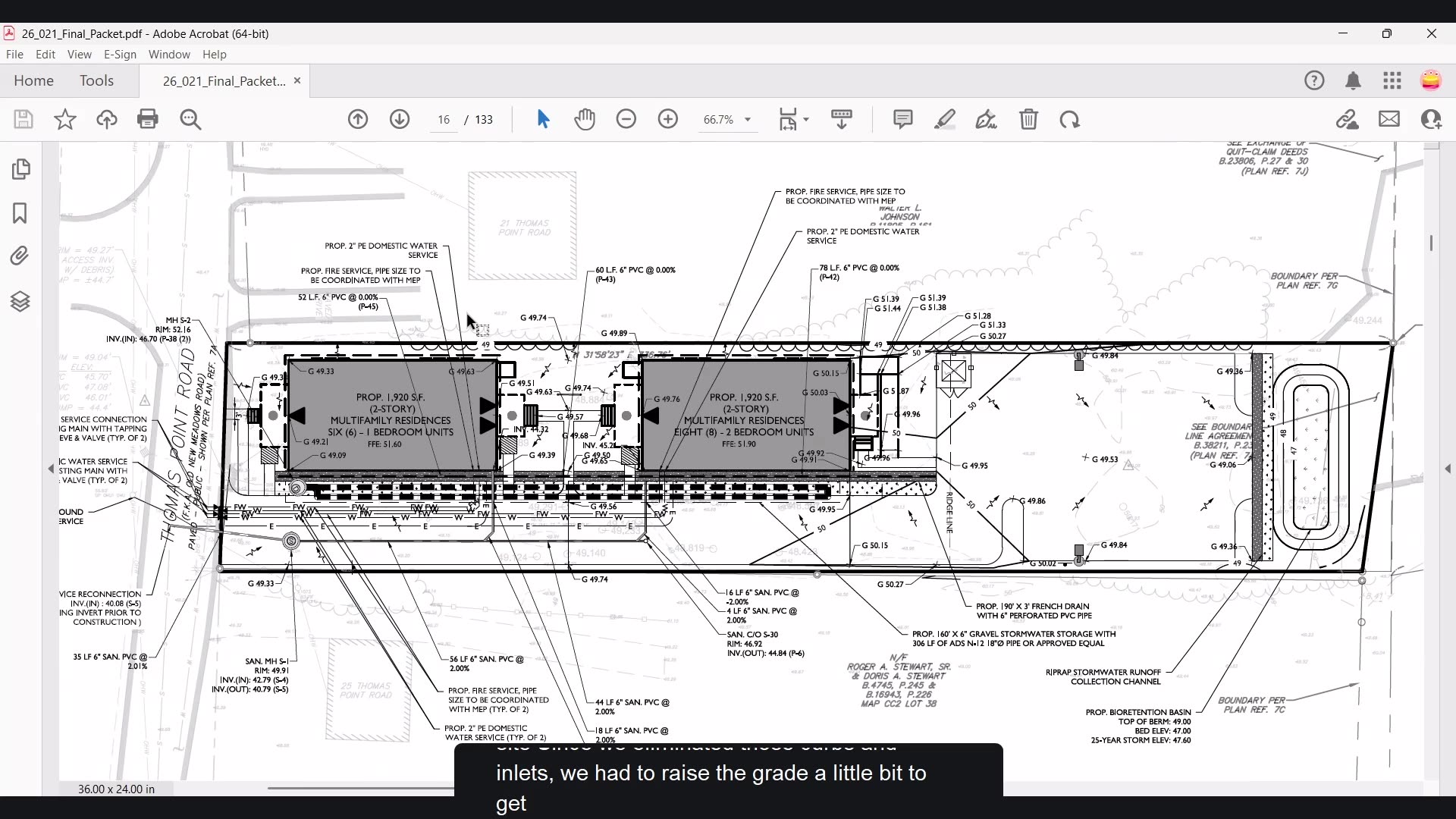
The applicant proposed modifications to parking, walkways, and stormwater systems, moving from a commercial-style chamber system to a green infrastructure approach (bioretention cells and infiltration trenches). Board members raised significant technical concerns regarding the seasonal high groundwater table, the adequacy of the infiltration rates used in modeling, and the lack of specific construction details for the proposed French drains. Additionally, the board questioned the developer's financial capacity based on a Maine Housing letter that provided assurance of continued processing but not a formal commitment of funds.

What happened

The board decided to table the application to allow the applicant to provide more technical detail and address financial contingency concerns.

What's next

The case is tabled until the June 23rd meeting; the applicant is encouraged to provide a more detailed report on financial contingencies and site-specific construction details for the infiltration trenches.
▶ 41:00 Case 26-20: Rate of Growth Ordinance and Zoning Text Amendments
Detailed site plan with utilities and stormwater features Video still
Detailed site plan with utilities and stormwater features ▶ 16:47

A discussion regarding a proposed ordinance to manage the pace of residential development in Brunswick's rural areas by allocating a limited number of growth permits annually, including specific language on availability, transferability, and reporting of rural growth permits.

Speakers: Unidentified speaker
See more
What was discussed

Staff proposed an annual allocation of 32 growth permits for rural areas (24 for common schemes/subdivisions and 8 for individual projects) to prevent sprawl and protect community character. Board members discussed the mechanics of the 'waiting list,' the potential for a 'free-for-all' before the new allocation year starts, and whether the ordinance could be used to restrict development on non-conforming roads. There were also concerns regarding the impact on individual homeowners waiting for interest rates to drop or contractors to become available. The board debated the wording of section J1 regarding how many rural growth permits are available and how they should be reported. There was a significant discussion regarding whether permit applications are transferable, with members noting that while permits should transfer to new owners of a lot, the applications themselves should not be. They also discussed the potential for developers to bypass limits through incremental subdivisions.

What happened

The board reviewed the draft and engaged in extensive discussion regarding technical wording and policy implications. The board agreed to refine the language and move toward a recommendation to the Town Council.

What's next

The board is expected to make a recommendation to the Town Council; the tentative schedule includes an introduction to the Council on July 6th and a public hearing on July 20th. The recommendation, including board comments, will be forwarded to the Town Council for further debate.

▶ 1:15:28 Public Hearing on Rural Development

A public hearing was held to allow for community input regarding the proposed ordinance amendments and rural development philosophy.

Speakers: Unidentified speaker
See more
What was discussed

Town Council member Steve Weems spoke in his capacity as a member of the Comprehensive Plan update steering committee. He emphasized the importance of the 'funnel' philosophy—directing most development to already developed areas while limiting growth in rural areas to protect town character. He argued that this ordinance is a necessary step to eventually lift the current development moratorium.

What happened

The hearing was opened and then closed after no further members of the public requested to speak.

Controversy & ⁠dissent

Where the board, the community, or the agenda diverged.

Potentially controversial issues

01

Golick Multi-Family Development Site Plan Amendment

The project involves significant changes to stormwater management and building design, raising technical questions about environmental safety (groundwater/soil) and the developer's financial stability for affordable housing.
Board position: The board expressed significant technical skepticism regarding the proposed green infrastructure and required more proof of financial commitment.
high concern
02

Rate of Growth Ordinance

This ordinance proposes to limit residential development in rural areas through a permit cap, which pits long-term town character preservation against the rights and interests of individual homeowners and developers.
Board position: The board signaled support for the ordinance's goals in alignment with the Comprehensive Plan but focused on refining technical language to prevent loopholes.
medium concern

Community vs. board tension

Action ⁠items

Who owes what, by when.
Provide more detailed construction drawings for the infiltration trenches and address groundwater/stormwater technical concerns.
Assigned: Cheryl Golick / Dooryard · Due: 2026-06-23
Provide a written report or clarified statement regarding Maine Housing financial contingencies and compliance with project requirements.
Assigned: Cheryl Golick / Dooryard · Due: 2026-06-23
Incorporate suggested wording changes to the Rate of Growth Ordinance (e.g., 'building permit applications' instead of 'permits submitted', updating 'rural growth permits' to 'rate of growth permits').
Assigned: Planning Staff
Forward the Planning Board's recommendation (including attached comments) to the Town Council.
Assigned: Department of Planning and Development

Notable ⁠statements

My sole goal since the beginning of this project is just simply to build quality, permanent, affordable housing on property that runs generations back in my family. — Cheryl Golick · Introduction of the project and its intent. ▶ 05:25
I don't like the idea of people who want to build their homes sitting on a waiting list. — Chris Baldwin (via Board Member) · Expressing concern over the impact of the Rate of Growth Ordinance on individual homeowners. ▶ 1:41:14
Decisions on this ordinance may be appealed directly to Superior Court without going to the Board of Appeals. I don't know why, and I'd say this to the counselors, why we don't do that with every decision that's made by this board. — Unidentified speaker · Questioning the legal appeal structure provided in the ordinance text. ▶ 1:13:08
The philosophy as you all know in the comprehensive plan is to funnel the majority of future development in brunswick into the already developed areas... and limit, still allow, but limit the amount of growth in the rural areas. — Steve Weems · Providing context on the long-term planning goals of the town during public comment. ▶ 1:17:41

Member ⁠positions

2 issues · 0 explicit · 15 inferred
Present
Case 26-21: Golick Multi-Family Development Site Plan Amendment YES ~
Case 26-20: Rate of Growth Ordinance and Zoning Text Amendments YES ~
Present
Case 26-21: Golick Multi-Family Development Site Plan Amendment YES ~
Case 26-20: Rate of Growth Ordinance and Zoning Text Amendments YES ~
Present
Case 26-21: Golick Multi-Family Development Site Plan Amendment YES ~
Case 26-20: Rate of Growth Ordinance and Zoning Text Amendments YES ~
Case 26-20: Rate of Growth Ordinance and Zoning Text Amendments
Expressed concern about homeowners being placed on a waiting list.
Present
Case 26-21: Golick Multi-Family Development Site Plan Amendment YES ~
Case 26-20: Rate of Growth Ordinance and Zoning Text Amendments YES ~
Present
Case 26-21: Golick Multi-Family Development Site Plan Amendment YES ~
Case 26-20: Rate of Growth Ordinance and Zoning Text Amendments YES ~
Case 26-21: Golick Multi-Family Development Site Plan Amendment YES ~
Case 26-20: Rate of Growth Ordinance and Zoning Text Amendments YES

Positions marked ~ are inferred from context and may not reflect the member's explicitly stated position. UNCLEAR means the vote was split but the record did not name how this member voted — it is not a “yes.”

Public ⁠comment

What residents said — verbatim, with timestamps.
5
Total speakers
4
Addressed
1
Partial
0
Not addressed
Unidentified speaker
Addressed
The speaker inquired about traffic concerns and whether the project's trip count triggered the need for a Traffic Management Plan (TMP). They sought clarification on why a TMP was not required. Key concern
Traffic management and the requirement (or lack thereof) for a TMP.
Board response
A board member (a speaker) explained that the project did not meet the trip threshold for a TMP and clarified that while MDOT could issue one, it was not required for this project.
The board provided a direct explanation regarding the trip count threshold and the MDOT's stance on the TMP.
Unidentified speaker
Partial
The speaker expressed agreement with previous comments regarding the need for more robust and opaque landscape screening. They also noted concerns regarding the treatment of soils in the area due to historical spills. Key concern
Impervious surface treatment, landscape screening, and soil safety/management.
Board response
The board did not respond directly to this speaker during their turn, but the subsequent discussion involved the developer and board members addressing stormwater and site conditions.
While the board didn't respond to the speaker immediately, the subsequent debate focused on the technical aspects of stormwater and site management which relate to the concerns raised.
Unidentified speaker
Addressed
The speaker questioned the impact of increased finished elevations on stormwater management and groundwater levels. They also questioned the decision to use the current stormwater model over underground storage tanks and suggested that a test pit is necessary before proceeding. Key concern
Stormwater runoff management, elevation changes, and the adequacy of soil testing.
Board response
The developer (a speaker/a speaker) explained the engineering reasons for the elevation change and the cost/functionality reasons for the stormwater model. The board eventually decided to table the meeting to allow for more detail on the French drain and test pits.
The board and developer engaged in a detailed technical discussion and ultimately decided to table the item to gather the specific information requested (test pit details and drainage info).
Unidentified speaker
Addressed
The speaker complimented the aesthetic design and ADA accessibility of the buildings. However, they suggested tabling the discussion for two weeks to obtain more detail on the French drain and the bioretention cell test pit. Key concern
Requesting more technical detail on drainage and soil testing before approval.
Board response
The board agreed with the suggestion and voted unanimously to table the project until June 23rd.
The board followed the speaker's suggestion to table the matter to gather more information.
Unidentified speaker
Addressed
The speaker raised concerns regarding the project's financial capacity, noting that the letter from Maine Housing was not a commitment of funding. They requested clarity on how the developer intends to meet specific contingencies and deadlines. Key concern
Financial capacity and meeting Maine Housing's funding contingencies.
Board response
The developer explained that the planning process caused the missed deadlines. The board responded by requesting that the developer provide a clear statement or list showing which Maine Housing conditions have been met and which are pending approval.
The board addressed the concern by deciding to table the meeting so the developer can provide more explicit documentation regarding financial compliance and Maine Housing requirements.

From the meeting

Site plan showing proposed buildings and drainage details Video still
Site plan showing proposed buildings and drainage details ▶ 25:41
Support coverage

Creating this report cost ⁠real money.

MeetingWatch attended, transcribed, and analyzed this meeting on its own dime. If this work is valuable to you, chip in to keep covering Brunswick.

Report composed by grok-4.3, gemma-4-26b, grok-4-fast, grok-4.20-0309-reasoning · analyzed 2026-06-10.