MeetingWatch
Your area Not set — showing everywhere
Meeting report · Conservation Commission
Creating this report cost real money. Help fund coverage →

Conservation Commission — June 3, 2026

While community members raised valid concerns regarding herbicide use and tree protection, the meeting remained professional and focused on technical discussions and presentations.

Date Wednesday, June 3, 2026 Duration 1.7h Speakers 29 Public comments 11 Decisions 4 Routine

Public ⁠impact

Issues from this meeting with documented community impact.
01

Quak'a Pond Ecological Testing

A $990,000 request for design and ecological testing via the Community Preservation Act. Affected: Watertown residents and local ecosystems
other high impact

Decisions ⁠logged

Every recorded vote, with timestamps and dissents.
Approval to close out the Order of Conditions for the 99 College Avenue bike path project.
Motion made by Leo (a speaker) and seconded by Marilyn (a speaker); unanimous approval.
Passed
Approval of the modification to the Japanese Knotweed management plan.
Motion made to accept the proposed modifications for the removal of Japanese knotweed; unanimous approval.
Passed
Approval of the May meeting minutes.
Minutes were accepted as amended to include the fact that a shed was located within a 200-foot riverfront area.
Motion carried
Adjournment of the meeting.
The meeting held on June 3, 2026, was adjourned.
Motion carried

Topics ⁠discussed

Click a topic to expand quotes and full context.
▶ 00:59 99 College Avenue Bike Path COC Request

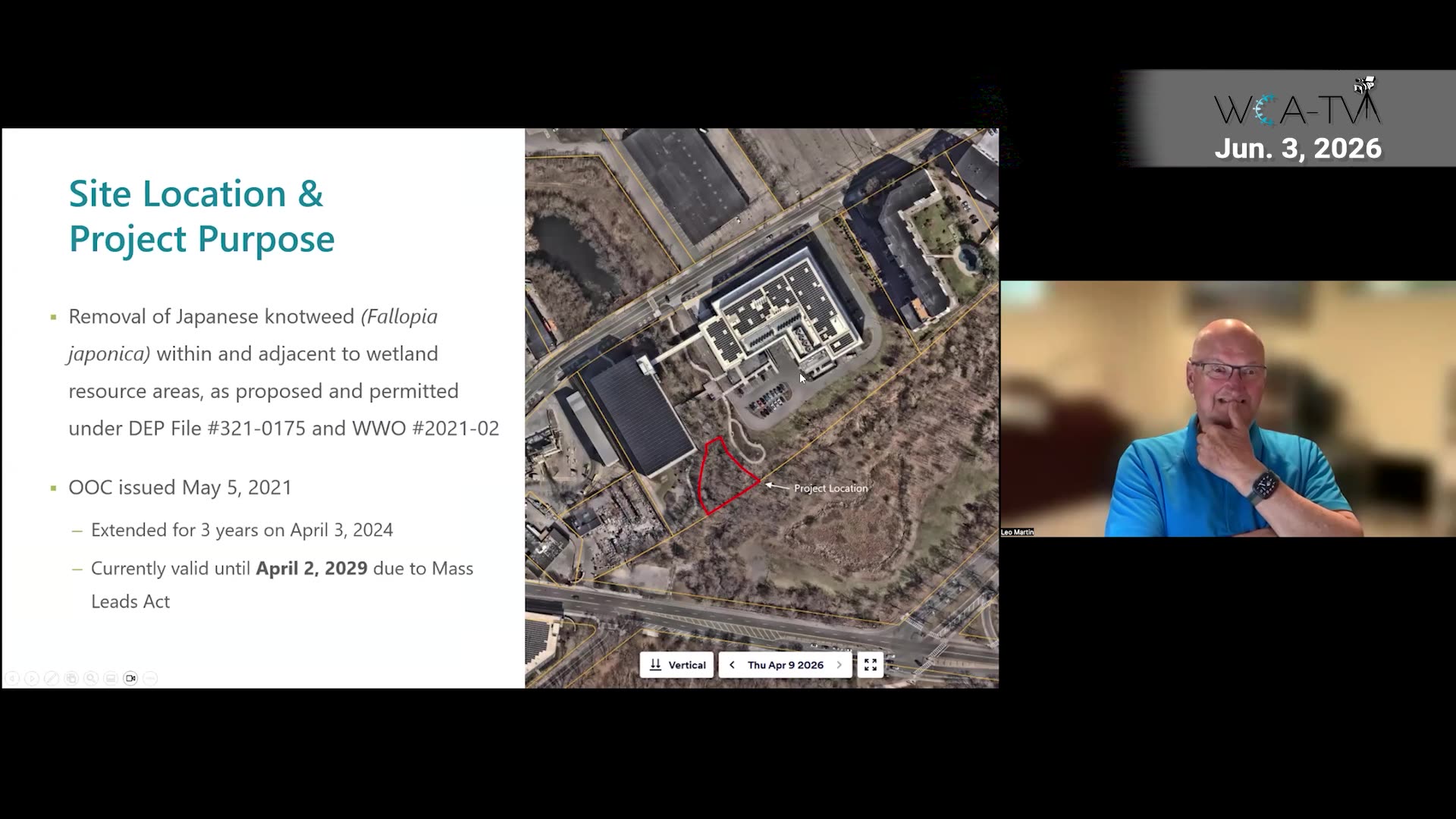
The applicant requested a Certificate of Compliance (COC) to close out conditions for a non-motorized bike path extension connecting 99 College Avenue to the DCR path and Arsenal Street sidewalk.

Speakers: Unidentified speaker
▶ 10:46 Japanese Knotweed Management Plan Modification

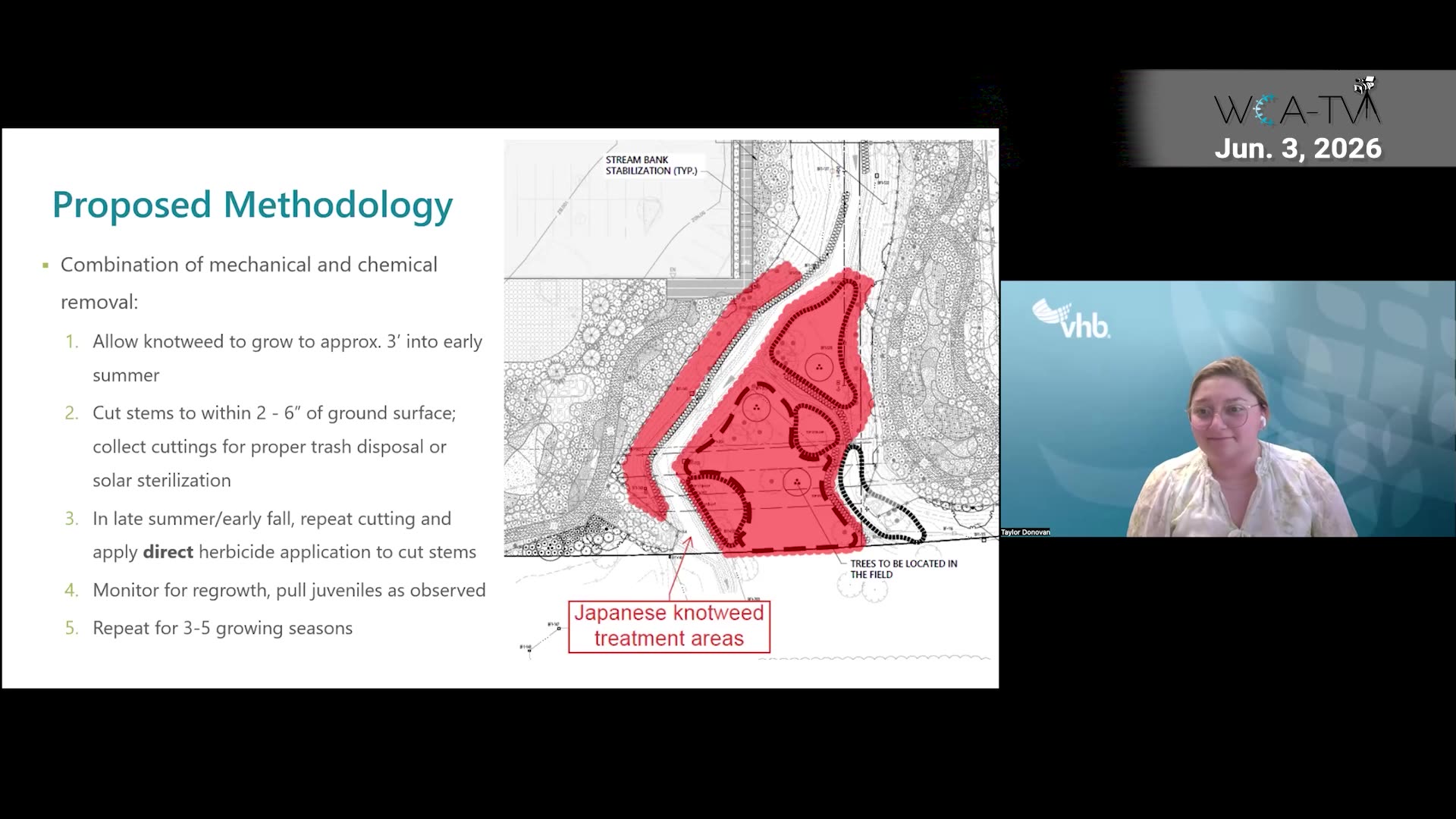
A proposal to modify the existing invasive species management plan for the 99 College site to include a combination of mechanical and targeted chemical removal (glyphosate) for Japanese knotweed.

Speakers: Unidentified speaker
▶ 33:09 Whitney Hill Park Carbon Sequestration Presentation

The Minerva Action Group presented a report detailing a study on carbon storage and sequestration in the trees of Whitney Hill Park, comparing data from 2015 and 2021.

Speakers: Unidentified speaker
▶ 1:12:04 Tree Preservation and Educational Initiatives

Discussion regarding a study on tree canopy value and the potential to present this data to high school science classes to teach carbon sequestration and math applications.

Speakers: Unidentified speaker
▶ 1:12:31 Tree Protection Ordinance

Discussion of the ongoing efforts by Trees for Watertown to establish a tree protection ordinance to prevent loss of large trees due to development.

Speakers: Unidentified speaker
▶ 1:28:54 Chair and Vice Chair Vacancies

The Chair provided an update on the need to fill the Vice Chair and Chair positions before the July meeting and noted the transition of leadership in September.

Speakers: Unidentified speaker
▶ 1:31:02 Community Preservation Act (CPA) Update

Report on the CPA meeting regarding funding for Quak'a Pond, including a request for $990,000 for design and ecological testing.

Speakers: Unidentified speaker
▶ 1:35:59 Agent's Report

Update on site visits, pending information regarding a shed in a riverfront area, the DEP evaluation of the Max's appeal, and the recording of Woodbine Hill survey plans.

Speakers: Unidentified speaker

Controversy & ⁠dissent

Where the board, the community, or the agenda diverged.

Potentially controversial issues

01

Japanese Knotweed Management Plan (Glyphosate Use)

The use of the herbicide glyphosate is a point of contention due to potential environmental risks and collateral damage to healthy vegetation/trees.
Board position: The board approved the modification to include chemical removal but implemented a mitigation strategy requiring a 48-hour advance notification to commissioners.
medium concern
02

Tree Protection Ordinance

Advocates are pushing for legislative protection to prevent developers from removing mature trees, which touches on the conflict between development and conservation.
Board position: The board acknowledged the suggestion but stated that such legislative matters fall under the jurisdiction of the City Council rather than the Commission.
medium concern

Community vs. board tension

Action ⁠items

Who owes what, by when.
Send an email to all commissioners to notify them 48 hours in advance of any chemical applications for the knotweed treatment.
Assigned: Conservation Office Staff (Katie/Susan) · Due: Ongoing
Email the chart comparing the carbon value of large mature trees versus multiple smaller trees to the Commission staff.
Assigned: Bob Leverett (Minerva Action Group)
Email Joanna to check the status of potential new commissioners.
Assigned: Susan · Due: Tomorrow
Follow up with Patrick regarding new commissioner updates.
Assigned: Katie
Verify that the GIS is updated with the recently recorded Woodbine Hill survey plans.
Assigned: Katie

Notable ⁠statements

Expressed concern regarding the use of glyphosate, noting the risk of collateral damage to nearby trees due to the hollow stems of Japanese knotweed. — Libby Shaw · Public comment during the Japanese Knotweed management plan discussion. ▶ 26:08
Explained that the Whitney Hill Park forest is estimated to hold approximately 2.4 million pounds of carbon based on the US Forest Service model. — Bob Leverett · Presentation of findings regarding carbon sequestration in Whitney Hill Park. ▶ 42:00
Highlighted the ongoing effort by Trees for Watertown to establish a tree protection ordinance and mentioned a current LiDAR study of the town's canopy. — Libby Shaw · Public comment following the carbon sequestration presentation. ▶ 1:13:01
The task for the Conservation Commission... is to come up with recommendations for the management of Whitney Hill Park, particularly with education in mind. — Unidentified speaker · Discussing the educational potential of tree studies and the role of the Commission. ▶ 1:21:00
Someone has to be chairperson starting in September... we're skipping August. — Unidentified speaker · Clarifying the timeline for leadership transitions and the commission's meeting schedule. ▶ 1:29:54

Member ⁠positions

2 issues · 0 explicit · 6 inferred
Present
99 College Avenue Bike Path COC Request YES
Approved the request to close out the Order of Conditions.
Japanese Knotweed Management Plan Modification YES ~
Approved the modification to include chemical removal.
Present
99 College Avenue Bike Path COC Request YES ~
Approved the request to close out the Order of Conditions.
Japanese Knotweed Management Plan Modification YES ~
Approved the modification to include chemical removal.
Present
99 College Avenue Bike Path COC Request YES ~
Approved the request to close out the Order of Conditions.
Japanese Knotweed Management Plan Modification YES ~
Approved the modification to include chemical removal.
Leo
Present
99 College Avenue Bike Path COC Request YES
Approved the request to close out the Order of Conditions.
Japanese Knotweed Management Plan Modification YES ~
Approved the modification to include chemical removal.

Positions marked ~ are inferred from context and may not reflect the member's explicitly stated position.

Public ⁠comment

What residents said — verbatim, with timestamps.
11
Total speakers
9
Addressed
2
Partial
0
Not addressed
Taylor
Addressed
Taylor provides a presentation on behalf of National Development regarding the completion of the 99 College Avenue bike path. They request a Certificate of Compliance (COC) to close out the project's conditions. Key concern
Request for Certificate of Compliance for the completed bike path project.
Board response
The board accepted the request and passed the motion to close out the order of conditions.
The board held a vote and officially approved the request to close out the conditions.
Unidentified speaker
Addressed
A commissioner (Marie) asks questions regarding the efficacy of the proposed Japanese knotweed removal method and whether there are differences between EPA and DEP herbicide regulations. Key concern
Inquiry into herbicide effectiveness and regulatory standards.
Board response
The presenter (Taylor) and staff addressed the questions regarding methodology and the requirement to provide herbicide information to the Commission.
The presenter answered the technical questions directly.
Libby Shaw
Addressed
Libby expresses concern regarding the use of glyphosate for knotweed removal. She warns about the difficulty of treating hollow-stemmed plants and mentions a past incident where herbicide application caused collateral damage to nearby trees. Key concern
Potential for collateral damage to healthy trees and soil due to glyphosate application.
Board response
The board president acknowledged the feedback, and the presenter (Taylor) promised to keep the concern in mind and noted the herbicide would be diluted.
The board and applicant acknowledged the concern and discussed mitigation strategies (dilution and careful application).
Unidentified speaker
Addressed
A commissioner asks for clarification on whether the 48-hour notice for chemical application is just an informal info-share or if the commission must vote again. Key concern
Clarification of the notification and approval process for future herbicide applications.
Board response
Staff (Katie/Susan) clarified that they would receive the notice and share it with the commission for awareness, and the board agreed to this process.
The staff and board explicitly defined the notification procedure to satisfy the question.
Bob West
Addressed
Bob introduces the Minerva Action Group and explains their mission to focus on climate change education for high school students. He introduces the carbon sequestration study conducted at Whitney Hill Park. Key concern
Introduction of a scientific study on carbon sequestration in local forests.
Board response
The board listened to the presentation and thanked the group for their work.
The board provided a platform for the presentation and acknowledged the value of the group's work.
Bob Leverett
Addressed
Bob presents the technical findings of the carbon sequestration study. He explains the methodology used to calculate biomass and the total carbon stored in the Whitney Hill Park forest. Key concern
Presenting data on the importance of the park as a carbon sink.
Board response
The board engaged with the presenter through questions about growth limits and tree age.
The presentation was completed and the board engaged with the technical content.
Unidentified speaker
Addressed
A commissioner asks about the loss of benefits when large shade trees are removed in the town. Key concern
The impact of losing mature trees on the town's ecosystem.
Board response
The presenter (Bob Leverett) provided a detailed explanation of how mature trees are vital reservoirs of carbon compared to young saplings.
The presenter provided a technical explanation addressing the loss of carbon benefits.
Marie
Addressed
Marie asks about the level of involvement high school students have in the Minerva Action Group's projects and the educational opportunities they provide. Key concern
The educational aspect and student involvement in the study.
Board response
The group (Ron) explained how students have participated in measurements and suggested future educational collaborations.
The presenter answered the question regarding student participation and educational goals.
Unidentified speaker
Partial
A speaker suggests that the town should consider implementing a tree protection policy/ordinance similar to neighboring towns to prevent developers from removing valuable old trees. Key concern
Need for a formal tree protection ordinance in Watertown.
Board response
The board president noted that while not anti-tree policy, such matters are typically handled by the City Council.
The board acknowledged the suggestion but deferred the responsibility to the City Council.
Libby Shaw
Addressed
Libby, President of Trees for Watertown, supports the call for a tree protection ordinance. She mentions current efforts like LiDAR studies and requests that the group present their findings to local high school science classes. Key concern
Advocating for tree protection and requesting educational outreach in schools.
Board response
The Minerva Action Group expressed strong interest in presenting to high school classes and suggested coordinating through the school system.
The presenters accepted the request for future educational outreach and discussed how to implement it.
Patrick Fairborn
Partial
Patrick discusses the intersection of conservation and education, mentioning efforts to work with the high school biology and math departments. He also encourages the Commission to use its influence to support a tree ordinance. Key concern
Integrating conservation education into the curriculum and advocating for legislative action on tree protection.
Board response
The board listened to the remarks; the discussion focused on the practicalities of school coordination and the limitations of the Commission's power.
The board acknowledged the educational vision, but the request for the commission to influence legislative bodies was addressed as being outside their direct authority.
Support coverage

Creating this report cost ⁠real money.

MeetingWatch attended, transcribed, and analyzed this meeting on its own dime. If this work is valuable to you, chip in to keep covering Watertown.

Report composed by grok-4.3, gemma-4-26b, grok-4-fast, grok-4.20-0309-reasoning · analyzed 2026-06-04.