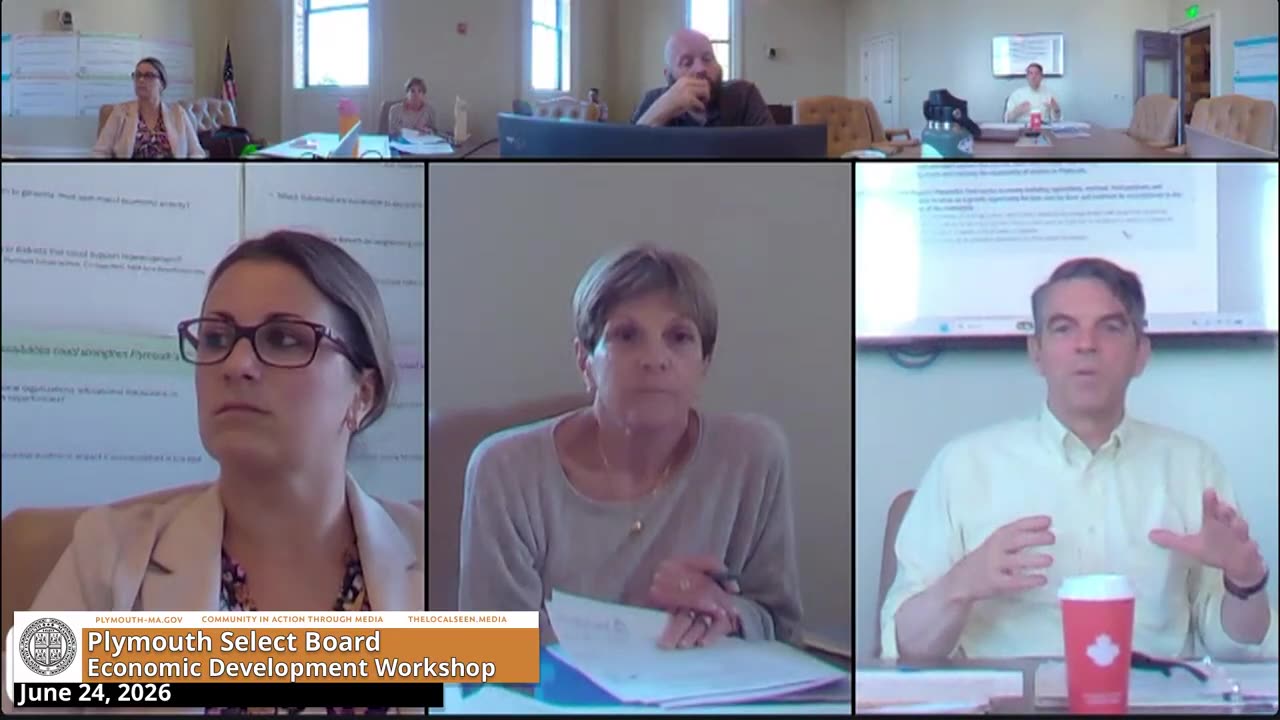
The meeting featured spirited public testimony, significant questioning regarding board ethics, and internal disagreement over a major land development decision.
Date Wednesday, June 24, 2026Duration 3.2hSpeakers 63Decisions 6Spirited
Why this is flagged: The meeting featured spirited public testimony, significant questioning regarding board ethics, and internal disagreement over a major land development decision.
SummaryAI-generated to surface controversy & community impact without bias — always verify against the actual meeting before relying on it.
The June 24 Select Board meeting was marked by significant tension between residents and the Board regarding land use, transparency, and fiscal planning.
Most notably, the Board confirmed it has waived the town's right of first refusal on the 140-acre Landers property. While the Board argued that the town lacked the funds to purchase the land outright, the decision was not without internal conflict. One board member expressed explicit dissent, stating they would not sign the Memorandum of Understanding (MOU) because the provisions for walking trails and wastewater management are 'aspirational' rather than legally enforceable.
Public testimony also focused heavily on ethics. Residents raised concerns about the 'appearance of impropriety' regarding personal friendships between board members and developers, specifically questioning the frequent use of executive sessions. In response to the scrutiny, the Board has scheduled a staff presentation to review the proper use of executive sessions and Open Meeting Law.
Lastly, the town's financial roadmap is under fire. A resident challenged the accuracy of the five-year budget forecast, arguing that a flat 4% inflation rate for critical departments like Police and DPW could be masking a significant deficit. The Board has agreed to begin presenting monthly financial reports in August and will present a revised forecast in September.
Jun 24, 20263.2h long63 speakers6 decisionsSpirited
❝ Notable statements
↔ DragSwipe to browse
“I think that three AM for alcohol is very late in the town of Plymouth... The prospectus for late night, poor decisions is significantly higher.”
— Unidentified speaker · Arguing against opting into the state's extended liquor hours pilot program. ▶ 11:04
“I reached a conclusion that I felt, and I do have experience in my professional life just as I often have to represent people that I have known before in various capacities... I was able to conclude that I can do that.”
— Unidentified speaker · Addressing concerns regarding a potential conflict of interest due to a personal friendship with the Landers property developer. ▶ 43:30
“The [conditional waiver] was the best outcome we could come up with at the time given the information that we had and the limited re-financial resources that we have at this point.”
— Unidentified speaker · Defending the decision to waive the right of first refusal instead of purchasing the land. ▶ 1:12:52
“I didn't sign, the document because it was aspirational language... we gave up our first right with these conditions that are unenforceable.”
— Unidentified speaker · A board member expressing dissent regarding the MOU for the Landers property development. ▶ 1:42:30
“I think each board member has the obligation to look into themselves and ask themselves the question... if you leave the board exposed to this level of criticism... it spreads to the entire board, the town, and our communities.”
— Unidentified speaker · Discussing the importance of individual conduct and the perception of conflict of interest to protect the board's integrity. ▶ 2:02:52
“A conflict of interest is defined as a financial interest of yourself or an immediate family member... that was not applicable here, but we did understand that there could be the appearance of some undue influence.”
— Unidentified speaker · Addressing allegations of conflicts of interest regarding personal friendships with developers. ▶ 2:01:10
“Each board member has the obligation to look into themselves and ask themselves the question when they feel they come across a moment of a conflict.”
— Unidentified speaker · Concluding remarks on the ethical responsibilities of board members following public criticism. ▶ 2:02:00
“If we're gonna go out into the neighborhood, I'd like to see that something that the board takes on together.”
— Unidentified speaker · Advocating for a more unified and collaborative approach to planning neighborhood meetings and agendas. ▶ 19:44
“We're going to combine that [executive session] with a discussion about some changes we might need to be making to our own agenda format based on open meeting law.”
— Unidentified speaker · Explaining that legal counsel will be consulted to ensure the town's agenda meets specific legal standards for transparency. ▶ 3:10:49
“My biggest concern is that there's not enough people talking about thirty-five and unders... that demographic is being left out of the economic conversation in this country.”
— Unidentified speaker · Discussing the long-term economic impact of housing prices on the younger population in Plymouth. ▶ 2:50:00
This meeting — choose a section
Public impact
Issues from this meeting with documented community impact.
What was discussed
140 acres of land development and potential impact on the sole source aquifer.
What happened
The waiver was confirmed as recorded and the purchase will proceed under the current terms.
What's next
The MOU will be filed with the Registry of Deeds and requirements will be evaluated during the permitting process.
What was discussed
Potential multi-year budget deficit depending on inflation and department costs.
What happened
The board agreed to implement monthly financial reports and a revised forecast.
What's next
Monthly reports begin in August; a revised 5-year forecast will be presented in September.
Topics discussed
Each topic expands to quotes and full context.
Speakers: Unidentified speaker
What was discussed
The board held a moment of silence to honor former Selectman Jean Lane and journalist Bobby Clark.
What happened
The board and attendees observed a moment of silence.
Speakers: Unidentified speaker
What was discussed
The Select Board discussed whether to opt into a state pilot program allowing extended liquor license hours until 3:00 AM during the summer of 2026.
What happened
The board decided not to take formal action to opt in, which legally serves as a decline. The licensing agent will notify holders that the extension is not authorized.
What's next
The licensing agent will send a notice to all liquor license holders tomorrow morning confirming no action was taken.
Speakers: Unidentified speaker
What was discussed
The Town Manager provided updates on SBA disaster loans, infrastructure projects, and community recognitions.
What happened
Information was shared regarding the SBA presence in town and upcoming public engagement for wastewater planning.
What's next
The SBA center in town is scheduled to close on July 1st; residents can use sba.gov/disaster after that date.
Speakers: Unidentified speaker
What was discussed
A resident challenged the accuracy of the five-year budget forecast, leading to a discussion on future budget oversight processes.
What happened
The board outlined a new process for increased transparency, including monthly financial reports and department head presentations.
What's next
Monthly financial reports will begin in August (reporting on July results); a revised five-year forecast will be presented in September.
Speakers: Unidentified speaker
What was discussed
Public debate occurred regarding the board's decision to waive the town's right of first refusal on the Landers property in favor of a developer, including discussion of a conditional waiver requiring adherence to permitting standards.
What happened
The decision to waive the right of first refusal stands; the MOU will run with the land and be filed with the Registry of Deeds. The waiver is recorded and the purchase will proceed according to the terms of the purchase and sale agreement. The Board maintained that the decision was a complex, negotiated balance of competing interests.
What's next
The Board will discuss the ten percent affordable housing goal strategy at the next meeting on June 30th.
Speakers: Unidentified speaker
What was discussed
A debate regarding the difference between 'legally affordable' housing (based on state AMI) and 'attainable' housing (starter homes priced for local market realities), including economic sustainability for younger generations.
What happened
The discussion clarified the town's multi-tiered strategy regarding state requirements and local economic needs. The Board acknowledged the economic pressure on younger residents.
What's next
An economic development workshop will be held tomorrow night to create an action plan for livable wages and industry growth.
Speakers: Unidentified speaker
What was discussed
Public criticism regarding the use of executive sessions and perceived conflicts of interest involving board members' relationships with developers.
What happened
Board members defended their actions and the integrity of their votes.
What's next
The Board is working with legal counsel to schedule a staff presentation on the proper use of executive sessions.
Speakers: Unidentified speaker
What was discussed
Concerns were raised regarding how 'incidental' sand removal is defined and regulated, referencing past issues at 71 Hedges Pond, along with updates on the Earth Removal Bylaw Review Committee's progress and discussion of Hedges Pond development including ingress/egress and potential 40B housing.
What happened
The town is relying on a new building inspector and an ongoing bylaw review committee to provide more consistent regulation. The committee is currently undergoing a line-by-line review and is in the process of hiring a consultant via an RFP. The Board clarified that the town's role was strictly to exercise or waive its right of first refusal and noted that while the developer intends to explore an easement via Hedges Pond Road to avoid residential streets, specific engineering plans are not yet available.
What's next
The earth removal bylaw review committee will present recommendations for potential revisions to Town Meeting. The committee continues to meet Thursdays from 4:00 to 6:00 PM; the revised bylaw is expected to be ready for a Spring 2027 Town Meeting. The Town Manager/Board will revisit the accuracy of the easement claims regarding Mr. Landers' property.
Speakers: Unidentified speaker
What was discussed
Updates on the use of Hedges Pond and the Great Hall.
What happened
The town is exploring community-beneficial uses for the Great Hall and looking into ways to separate day camp users from public swimmers to maintain access.
What's next
The town will revisit strategies for separating beach access from camp operational hours.
Speakers: Unidentified speaker
What was discussed
Discussion regarding scheduling of presentations on Chapter 61 legislation, rules governing executive sessions, adding a Shallow Pond item to a future agenda, and improving neighborhood and village meeting processes.
What happened
The Board Chair (S60) confirmed that these items are already being prepared for upcoming agendas and will likely be addressed as distinct subjects. The Chair confirmed that the Shallow Pond item is being added to the upcoming agenda. The board discussed the possibility of developing a more rigorous investigation or process for identifying area-specific issues.
What's next
The items will appear on the agenda distributed next week.
Controversy & dissent
Where the board, the community, or the agenda diverged.
•
Board unity: While the board was largely unified on most administrative matters, there was visible internal dissent regarding the legal strength of the Landers property MOU.
Potentially controversial issues
01
Landers Property Right of First Refusal Waiver
The decision to waive the town's right to purchase 140 acres of land in favor of a private developer is being challenged by residents who believe the town failed to explore sufficient preservation alternatives or legal protections for the aquifer and walking trails.
Board position: The board defended the decision as a necessary compromise due to limited financial resources and tight deadlines.
Internal dissent
One board member expressed explicit dissent, stating they did not sign the Memorandum of Understanding because the language regarding land preservation was 'aspirational' and 'unenforceable'.
high concern
02
Ethics and Transparency regarding Developer Relationships
Citizens raised concerns about the appearance of impropriety, specifically questioning if personal friendships between board members and developers influence decision-making and the use of executive sessions.
Board position: The board defended their actions, stating that executive sessions were legally necessary for real estate negotiations and that all necessary disclosures were made.
high concern
03
Municipal Budget Forecasting Accuracy
A resident challenged the board's five-year fiscal forecast, arguing that a flat 4% inflation rate for major departments like Police and DPW is unrealistic and masks a looming deficit.
Board position: The board acknowledged the need for more real-time data and transparency.
medium concern
Split votes
The Landers property Memorandum of Understanding (MOU) / waiver of first refusal
Not a formal vote on the MOU itself, but a recorded decision to waive the right
Community vs. board tension
⚖
Landers Property Development Community wants: Residents want the town to purchase the land for preservation, ensure strictly enforceable environmental protections, and use legal bonds to hold developers accountable. Board response: The board maintained that the town lacked the funds to purchase the land and that the MOU's provisions would be managed through the permitting process.
⚖
Affordable Housing Definitions Community wants: Younger residents and community members argued that 'legally affordable' housing based on state metrics is still too expensive for the local workforce. Board response: The board explained their strategy of targeting 'attainable' housing (priced between $450k-$500k) to bridge the gap.
⚖
Executive Session Transparency Community wants: Public suspicion regarding the use of closed sessions to avoid scrutiny of developer relationships. Board response: The board defended the legality of the sessions and promised a staff presentation on the proper use of executive sessions.
Ready to share? AI-written accountability posts about this meeting's controversies.
Spoke about the Clever Lucy graduation ceremony at the library and the crucial role of the library trustees and foundation. He expressed gratitude to the town representatives for attending the event.
Key concern
Acknowledgment of library community events.
Board response
a speaker acknowledged the sentiment and agreed on the importance of the program.
The board members present acknowledged the comments and the value of the library program.
Provided an overview of the US Small Business Administration's disaster recovery program following the February blizzard. She explained available low-interest loans for businesses and nonprofits and shared how to access assistance.
Key concern
Information dissemination regarding SBA disaster recovery loans.
Board response
The board thanked her for the information and a speaker asked about alternative meeting locations.
The board engaged with the information provided and asked follow-up questions regarding accessibility.
Clarified the role of the Citizen Advisory Committee for the Comprehensive Wastewater Management Plan. He explained that they are grouping precincts to facilitate community questions regarding sewer likelihood and costs.
Key concern
Clarification of the CWMP advisory committee process.
Asked if the change in terminology from 'Public Comment' to 'Public Question and Answer' implies that the board will now provide answers to questions asked.
Key concern
Clarification of the rules for the Q&A session.
Board response
a speaker confirmed that it does imply a change where questions will be answered.
The board explicitly confirmed the change in procedural intent.
Argued that the recent five-year budget forecast is likely understating the severity of the town's fiscal situation by using unrealistic 4% expense growth assumptions. She requested urgency in addressing potential deficits and asked about hiring freezes or cost-cutting measures.
Key concern
Inaccuracy of budget forecasts and looming fiscal deficit.
Board response
a speaker outlined the plan for monthly financial reports and a revised forecast in September; a speaker cautioned against over-reliance on the forecasting tool.
The board provided a detailed explanation of the upcoming budget process and their strategy for addressing the forecast.
Requested the adoption of a land acknowledgment for the Wampanoag Tribe and expressed strong opposition to a recent development vote. She also raised concerns regarding school overcrowding in South Plymouth and the lack of business growth in Cedarville.
Key concern
Land acknowledgment, development concerns, and school/economic infrastructure.
Board response
a speaker responded to the development concerns and the conflict of interest question; a speaker clarified the board's responsibilities regarding the development.
The board addressed the development concerns and the conflict of interest/optics issue, but did not specifically address the land acknowledgment or the specific school/business concerns in detail.
Expressed disagreement with the decision regarding the Landers property, stating the town should have explored preservation options through the Community Preservation Act. He argued the board failed to explore alternatives to protect the land.
Key concern
Failure to adequately explore land preservation for the Landers property.
Board response
a speaker and a speaker defended the decision, citing financial limitations and the board's responsibility to assess the right of first refusal.
The board engaged in a lengthy debate to explain their reasoning for not pursuing the preservation path.
Agreed with Mr. Cohen that more time should have been taken to explore co-partnering with other interested groups for the Landers property.
Key concern
Lack of thorough exploration of preservation partnerships.
Board response
The board addressed the general argument regarding the Landers property in their responses to the preceding speakers.
The board's defense of the Landers decision covered the general sentiment of the group.
Thanked the board for coming to the Pine Hills area and expressed a desire for the board to always look out for the citizens they represent.
Key concern
Encouragement and trust in elected officials.
While no formal verbal response was required, the board acknowledged the comment through the flow of the meeting.
Expressed concern that the Memorandum of Understanding (MOU) regarding the Landers property uses vague, unenforceable language like 'pursue' or 'consider.' She argued there is no bond or leverage to ensure the developer follows through on promises.
Key concern
Enforceability of the MOU and lack of developer accountability.
Board response
a speaker explained that the document runs with the land and will be used in the permitting process by the planning board/ZBA.
The board explained the legal mechanism (permitting and recording with the Registry of Deeds) they believe provides enforcement.
Argued that the MOU is purely aspirational and lacks teeth because it contains no financial bonds. He questioned what leverage the town has once the right of first refusal is waived.
Key concern
Lack of legal leverage/bonds in the Landers MOU.
Board response
a speaker and a speaker argued that the requirements are incorporated into the permitting process and that the town's role was limited to the right of first refusal.
The board defended the legal process they followed and how it interacts with subsequent permitting.
Stated they did not sign the MOU because the language is too vague. They noted that even with the 40% preservation requirement, much of that is already protected by wetlands/bogs and questioned the use of CPA funds.
Key concern
Vague language in the MOU and inaccuracy of preservation percentages.
Board response
a speaker and a speaker defended the document and the decision-making process.
The board addressed the nature of the document and the preservation aspect.
Questioned why the decision to waive the right of first refusal was rushed in June when they had until August. He suggested the town should have allowed land organizations more time to find partners.
Key concern
Perceived rush in the decision-making timeline for the Landers property.
Board response
a speaker explained the timeline, the need for a Town Meeting, and the advice received from legal counsel regarding the risks of assigning rights to other groups.
The board provided a detailed chronological and legal explanation for the timing of the decision.
Spoke on behalf of younger generations, emphasizing the need for environmental justice and clean water. He expressed concern about the long-term sustainability of the town and requested protections for the sole source aquifer.
Key concern
Environmental protection, clean water, and long-term town viability for youth.
Board response
a speaker thanked him for representing his generation; a speaker/T addressed the complexity of the decision.
The board acknowledged the sentiment and the difficulty of the decision, but did not provide a specific technical response regarding the aquifer.
Expressed concern for her constituents regarding affordable housing. She noted the rise of Airbnbs and questioned how the town guarantees that 'affordable' housing projects actually provide housing for locals rather than being diverted.
Key concern
Authentic affordable housing vs. Airbnbs and developer leeway.
Board response
a speaker and a speaker defined the difference between legal 'affordable' (80% AMI) and 'attainable' housing and discussed the goal of reaching 10% safe harbor.
The board provided a detailed explanation of housing definitions and the town's long-term strategy.
Questioned why the Landers decision was made behind closed doors (Executive Session). He also questioned the $5 million valuation and raised concerns about incidental sand mining affecting his well water.
Key concern
Transparency (Executive Sessions), property valuation, and sand mining impact on water.
Board response
a speaker explained the legal use of Executive Sessions for real estate negotiations and addressed the 'incidental' sand mining definition issues.
The board explained the legality of the sessions and addressed the sand mining/inspector concerns.
Questioned the reliability of relying on individual building inspectors to prevent a repeat of the Hedges Pond situation. She also asked if the town has any legal recourse since the waiver has been recorded.
Key concern
Systemic prevention of bad decisions and legal recourse.
Board response
a speaker explained the ongoing Earth Removal Bylaw review. a speaker stated the waiver is recorded and thus a 'done deal,' though the purchase hasn't closed.
The board addressed both the systemic (bylaw) and legal (waiver status) aspects of her question.
Critiqued the board's integrity and ethics regarding the perceived conflict of interest and the lack of transparency. He argued that the board should have been more cautious to avoid the appearance of impropriety.
Key concern
Board integrity and ethical standards.
Board response
a speaker defended the board, stating that disclosure forms were filed to maintain transparency and that no financial conflict existed.
The board directly addressed the ethical concerns by explaining their disclosure process.
Asked about the ingress/egress (road access) for the Landers development and expressed concern regarding traffic influx in her neighborhood.
Key concern
Traffic and road access for the new development.
Board response
a speaker/T explained that the developer intends to use a new easement/access road rather than existing residential streets; a speaker noted they are in 'safe harbor' regarding 40B.
The board provided information regarding the intended access points for the development.
Questioned where the road access would go if the easement on Hedges Pond Road is not granted, expressing fear that traffic will be routed through her neighborhood.
Key concern
Traffic routing through residential neighborhoods.
Board response
a speaker/T stated their understanding is that an easement exists that allows egress via Hedges Pond Road rather than through Mountain Hill/Great Woods.
The board responded with the information they had regarding the developer's planned access.
Expressed frustration over being 'disenfranchised' by the decision timeline. He also raised concerns that 'incidental' sand mining could still occur and requested an independent survey of the land.
Key concern
Public disenfranchisement and sand mining risks.
Board response
a speaker/T explained the difficulty of the process. a speaker/R discussed the earth removal bylaw review and the current approach to regulating sand value.
The board addressed both the process frustration and the specific technical concerns regarding sand.
The board held a formal vote to adjourn the meeting following the discussion of old business.
Passed unanimously (S60, S62, S61)
Share this report
Drafts ready to post — click any block to copy.
●
Accountability posts. AI-drafted to highlight decisions made outside the public agenda, split votes, and community concerns that went unaddressed. Always verify facts before sharing.
⚠
Select Board waives rights to 140-acre Landers property despite warnings of 'unenforceable' developer promises.
X / Twitter — by angle
Internal board dissent and the lack of legal enforceability in the Landers property MOU
At the 6/24 Select Board meeting, a board member voiced dissent over the Landers property deal, calling the developer's promises regarding trails and wastewater 'aspirational' and 'unenforceable.' The town has already waived... https://meetingwatch.org/ma/plymouth/select-board/2026-06-24/ #MeetingWatch #PlymouthMA
315/280 chars
Fiscal responsibility and potential budget inaccuracies
Is the Plymouth budget realistic? During the 6/24 meeting, residents challenged the 5-year forecast, noting a flat 4% inflation rate for Police and DPW may mask a looming deficit. The Board has promised a revised forecast in... https://meetingwatch.org/ma/plymouth/select-board/2026-06-24/ #MeetingWatch #PlymouthMA
315/280 chars
Ethics, transparency, and perceived conflicts of interest
Public trust is at a crossroads. At the 6/24 meeting, citizens questioned if personal friendships between Board members and developers influence decisions. The Board defended their use of executive sessions, but promised a... https://meetingwatch.org/ma/plymouth/select-board/2026-06-24/ #MeetingWatch #PlymouthMA
313/280 chars
X thread
1
The June 24 Select Board meeting revealed deep divisions over how Plymouth handles development and transparency. From land deals with 'unenforceable' terms to questions about board ethics, here is what you need to know. 🧵 #MeetingWatch #PlymouthMA
247/280
2
First, the Landers property decision: The Board has officially waived the town’s right to purchase the 140-acre site. While the Board defended this as a necessity, one member refused to sign the MOU, calling the environmental and trail protections 'aspirational' and legally weak.
280/280
3
Second, ethics concerns were front and center. Residents questioned if personal relationships between board members and developers create an appearance of impropriety. The Board maintains their executive sessions are legal, but a review of their processes is now pending.
271/280
4
Finally, a warning on our finances: A resident pointed out that the town's 5-year budget forecast uses a generic 4% inflation rate for Police and DPW, which may underestimate future costs. The Board is now tasked with providing a more accurate forecast... https://meetingwatch.org/ma/plymouth/select-board/2026-06-24/
279/280
Facebook — long form
The June 24 Select Board meeting was marked by significant tension between residents and the Board regarding land use, transparency, and fiscal planning.
Most notably, the Board confirmed it has waived the town's right of first refusal on the 140-acre Landers property. While the Board argued that the town lacked the funds to purchase the land outright, the decision was not without internal conflict. One board member expressed explicit dissent, stating they would not sign the Memorandum of Understanding (MOU) because the provisions for walking trails and wastewater management are 'aspirational' rather than legally enforceable.
Public testimony also focused heavily on ethics. Residents raised concerns about the 'appearance of impropriety' regarding personal friendships between board members and developers, specifically questioning the frequent use of executive sessions. In response to the scrutiny, the Board has scheduled a staff presentation to review the proper use of executive sessions and Open Meeting Law.
Lastly, the town's financial roadmap is under fire. A resident challenged the accuracy of the five-year budget forecast, arguing that a flat 4% inflation rate for critical departments like Police and DPW could be masking a significant deficit. The Board has agreed to begin presenting monthly financial reports in August and will present a revised forecast in September. https://meetingwatch.org/ma/plymouth/select-board/2026-06-24/ #MeetingWatch #PlymouthMA
Action items
Who owes what, by when.
Send notice to all liquor license holders regarding the decision not to opt into extended hours.
Complete review and bring recommendations for bylaw revisions to Town Meeting.
Assigned: Earth Removal Bylaw Review Committee
Respond to public records requests for the Memorandum of Understanding.
Assigned: Town Staff (Conner Anderson) · Due: Within 10 days (or 48 hours if readily available)
Provide an update on the Sand and Gravel Committee RFP and consultant hiring process.
Assigned: Town Manager · Due: Next Town Manager's report
Schedule a meeting with Pilgrim Hall representatives to resolve final disbursement questions.
Assigned: Town Manager · Due: TBD
Inquire with MassDOT regarding the condition of State Road.
Assigned: Select Board · Due: TBD
Include Chapter 61, executive session, and Shallow Pond items on the upcoming agenda for distribution next week.
Assigned: Chair (Speaker S60) · Due: Next week
Support coverage
Creating this report cost real money.
MeetingWatch attended, transcribed, and analyzed this meeting on its own dime. If this work is valuable to you, chip in to keep covering Plymouth.
Follow Plymouth
One email when a new report is published from the Select Board — or one weekly digest.
Report composed by grok-4.3, gemma-4-26b, grok-4-fast, grok-4.20-0309-reasoning · analyzed 2026-06-24.
Show me what's happening near me.
MeetingWatch covers communities across the country. Tell us where you are and we'll surface the meetings, votes, and decisions in your town.
Request coverage
We'll let you know when MeetingWatch starts covering your area.
Please add your name and a valid email.
Check your inbox — click the link in our email to finish your request.
Or browse covered communities:
Send feedback
Spotted an error, or have a tip? Let us know — we read every note.
Know where the video for this meeting lives? Paste the link below and we'll add it.
We'll email you a link to confirm — this keeps out spam. We won't share your address.
Please add a valid email and a message.
Check your inbox — click the link in our email to confirm your feedback.
Search MeetingWatch
MeetingWatchStay informed — without the slant.
Hours of public meetings. Zero time to watch them.
MeetingWatch uses AI to attend every public meeting in covered communities —
transcribing debates, logging votes, and surfacing what actually mattered.
No slant. No bias. Just what was said on the record, so you can stay
informed about your town without burning your evenings.
Get started in three steps
1
Tell us where you live.
We'll surface the meetings, votes, and decisions in your town first.
One weekly email. Decisions, dissents, and the off-agenda items from every covered community. Unsubscribe in one click.
✓ Subscribed — check your inbox to confirm
3
Support the work.
MeetingWatch is a civic accountability project. Reader contributions cover transcription, hosting, and the cost of attending every meeting — and help grow coverage to more towns.