
Your area Not set — showing everywhere
Meeting report · Planning Board
Creating this report cost real money. Help fund coverage →

Planning Board — June 10, 2026

The meeting featured a high volume of public speakers expressing deep dissatisfaction with the developer's adherence to the original community vision.
Date Wednesday, June 10, 2026 Duration 1.7h Speakers 23 Public comments 12 Decisions 2 Spirited
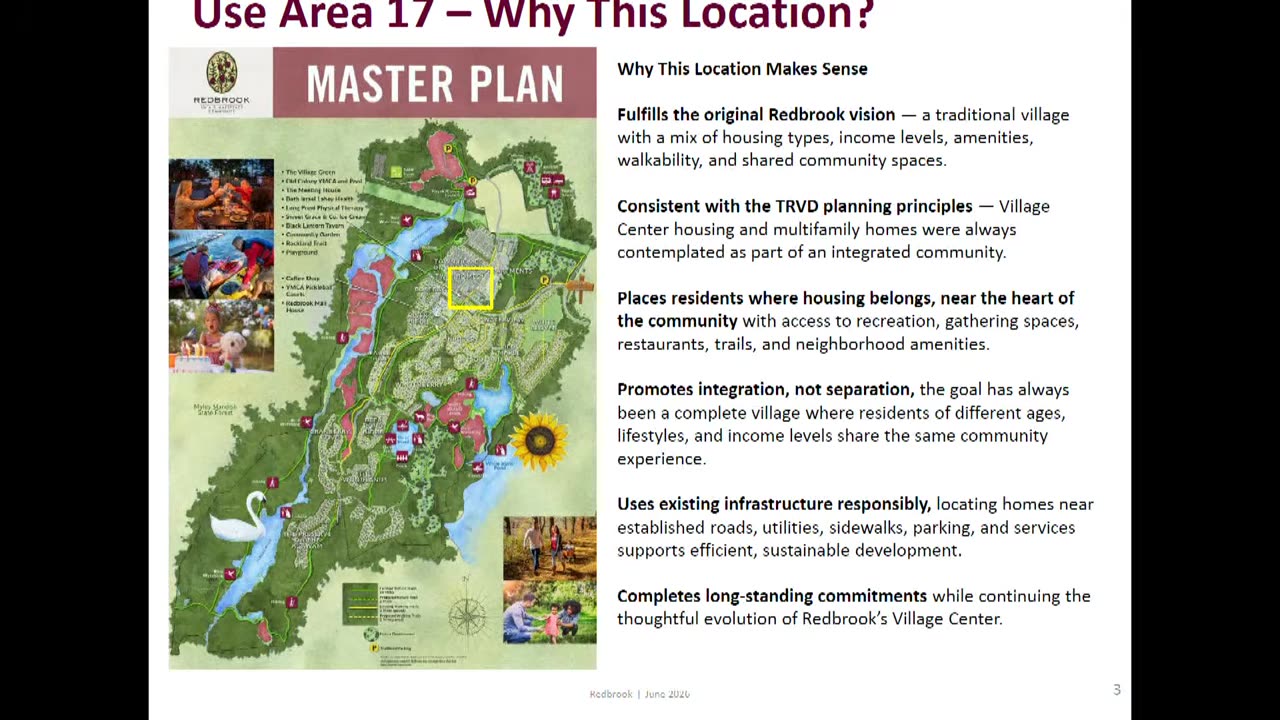
Master plan map and rationale for Redbrook Use Area 17 Video still
Master plan map and rationale for Redbrook Use Area 17 Frame from meeting video ▶ 13:59

Public ⁠impact

Issues from this meeting with documented community impact.
01

Redbrook Development Infrastructure

Significant changes to density, housing types, and community amenities. Affected: Current and future residents of Redbrook and surrounding South Wareham areas.
See more
What was discussed

The meeting covered new residential subdivisions, affordable housing placement, and stormwater management efficacy. Residents questioned the adequacy of drainage for extreme weather and the impact of density on local traffic and safety.

What happened

The board unanimously approved the market-rate and affordable housing components for Use Area 17, subject to sidewalk connectivity and a six-month parking review.

What's next

The developer's engineer must revise grading plans; the board will revisit parking adequacy six months post-completion.

zoning change

Decisions ⁠logged

Every recorded vote, with timestamps and dissents.
Motion to close public comment.
The board voted unanimously to close the public comment period for Use Area 18.
Unanimous
Joint approval of market-rate and affordable housing components for Use Area 17.
The approval is subject to two specific conditions: 1) The developer must ensure sidewalk connectivity throughout the Village Green, and 2) The board will revisit the adequacy of parking six months after project completion.
Unanimous

Topics ⁠discussed

Click a topic to expand quotes and full context.
▶ 00:00 Use Area 17: Playground and Affordable Housing

Public discussion regarding the location of a new playground and concerns about the density and suitability of proposed affordable housing.

Speakers: Lori Downs, Diane Chellis, Ruth Ann Rayhall, Keith Gravelin (Robert Chouet), Chris McMillan, Mr. Howe
See more
What was discussed

Residents raised concerns regarding the playground's proximity to the tavern and traffic, the loss of shade, and the disruptive nature of musical equipment. Regarding housing, speakers argued that the proposed one-bedroom affordable units are unsuitable for families and that the location increases congestion in an already dense area. There were also claims of broken promises regarding original master plan amenities like athletic fields and commercial spaces.

What happened

Public comment was heard; the board noted the feedback but did not make an immediate decision during this segment.

▶ 21:00 Use Area 18: Residential Subdivision

Presentation of a proposal for 54 single-family homes, including a request for a rear yard setback waiver to increase buffers.

Speakers: Speaker SPEAKER_20, Lori Downs, Douglas Love, Ruth Ann Rayhall, Herb Chalice, Keith Gravelin (Robert Chouet), Chris McMillan, Mr. Howe, Toby Karats, Steve Leiden, Speaker SPEAKER_19
See more
What was discussed

The applicant presented a plan for 54 market-rate homes, requesting a setback waiver from 25 to 15 feet to provide a better buffer for neighbors. Residents expressed concerns about tree removal, lack of sidewalks, emergency vehicle access due to single-point entry, and the absence of affordable housing in this specific phase. A board member questioned the reliability of stormwater drainage calculations in the context of climate change and habitat protection.

What happened

The applicant responded to questions regarding buffers, stormwater management, and emergency access, noting that residential streets are not required to have sidewalks.

▶ 1:07:39 Stormwater Management and Maintenance

Discussion regarding the efficacy of stormwater infrastructure, specifically catch basins, and the long-term maintenance plan for the development.

Speakers: Unidentified speaker
See more
What was discussed

Concerns were raised about whether current engineering data adequately accounts for extreme storm events. The developer's representative explained that catch basins are not designed for 100-year storms and that the system relies on 'over land relief' and specific maintenance protocols, such as annual inspections of deep sump hooded catch basins and water quality units.

What happened

The board received technical explanations regarding the use of existing depressions for recharge and the role of third-party inspectors.

▶ 1:12:16 Technical Site Specifications: Dead Ends and Roadway Grading

Inquiry into compliance with street length regulations and discrepancies between roadway cross-section details and grading plans.

Speakers: Unidentified speaker
See more
What was discussed

A board member questioned why a street appeared to exceed the 500-foot dead-end limit, to which staff clarified that the Trivid Special Permit allows for certain waivers. Additionally, a discrepancy was identified between the typical cross-section (showing a 4-foot shoulder with a specific slope) and the grading plan, which appeared to show a much steeper 3:1 or 4:1 slope.

What happened

The developer's representative acknowledged the potential discrepancy and agreed to have engineers review and potentially revise the plans.

What's next

Developer's engineer to review and update grading plans to ensure they reflect the intended roadway shoulder and slope.

▶ 1:16:06 Commercial Space and Economic Viability

Discussion on the feasibility of including retail/commercial space within the development.

Speakers: Unidentified speaker
See more
What was discussed

Board members asked about the market demand for commercial space. The developer noted the difficulty in attracting retail due to high costs, lack of highway access, and the need for high density (more 'doors') to sustain small businesses.

What happened

The board acknowledged the economic challenges of sustaining retail in the specific location.

▶ 1:18:48 Affordable Housing and Density

Debate over the concentration of affordable housing units and the benefits of higher density to preserve open space.

Speakers: Unidentified speaker
See more
What was discussed

Arguments were made regarding 'distributed affordability' versus the concentration of units in the Village Green. The Board Chair explained that higher density is a requirement of the Trivid permit to allow for the conservation of approximately 1,800 to 2,200 acres of land. There was also a discussion on why multi-family units are more economically viable for affordable housing than single-family homes due to rising maintenance and tax costs.

What happened

The board affirmed that the proposal meets the requirements of the 2008 Trivid permit.

Controversy & ⁠dissent

Where the board, the community, or the agenda diverged.

Potentially controversial issues

01

Redbrook Development: Vision vs. Reality

Residents expressed significant frustration regarding 'broken promises' related to original master plan amenities like athletic fields and commercial spaces, arguing current developments deviate from the community's intended character.
Board position: The board signaled that they are legally bound by the existing Trivid special permit and town bylaws rather than original marketing visions.
high concern
02

Affordable Housing Density and Location

There is a conflict between residents who desire distributed affordable housing and those who believe the current concentration in the Village Green increases congestion and lacks adequate buffers.
Board position: The board supported the proposal, noting that higher density is a requirement to satisfy the permit and preserve surrounding open space.
high concern

Community vs. board tension

Action ⁠items

Who owes what, by when.
Follow up with residents regarding buffer/tree discussions and explore potential trail connections between White Island and Redbrook.
Assigned: Speaker a speaker (Applicant)
Review and revise grading plans to ensure roadway shoulders and slopes match the construction detail sheets.
Assigned: Developer's Engineer
Revisit parking adequacy with the board six months after completion of the project.
Assigned: Developer/Makepeace · Due: 6 months post-completion

Notable ⁠statements

The dream being sold versus the dream being built... is totally incongruent. — Keith Gravelin (Robert Chouet) · Commenting on the discrepancy between the original Redbrook marketing/master plan and current developments. ▶ 20:49
The regulations, policy, and the like that are written into their enabling legislations when they were first envisioned don't change and are often for a variety of understandable reasons, they're hesitant to adapt to changing attitudes or realities. — Speaker SPEAKER_19 · Discussing the difficulty of updating 'frozen in time' special zoning/Trevid regulations to meet modern community standards. ▶ 1:44:05
The higher density, so they're not destroying the entire area... it would have taken up all the 1800 acres of open space that we have now in protection. — Unidentified speaker · Defending the density requirements of the Trivid permit as a means of land conservation. ▶ 1:27:19
We do not have the right to turn around and say, we don't like something, therefore we're going to reject it. We're subject to the town bylaws and the terms of the permits. — Unidentified speaker · Clarifying the legal limitations of the Planning Board's authority regarding the special permit. ▶ 1:34:50

Public ⁠comment

What residents said — verbatim, with timestamps.
12
Total speakers
5
Addressed
5
Partial
2
Not addressed
Laurie Downs
Addressed
She suggested cutting a woodland pathway through the woods from the White Island area. This would improve walkability for residents in the South Wareham area to reach Redbrook. Key concern
Lack of walkability and pedestrian connectivity.
Board response
The applicant (Speaker a speaker) stated he has no issues with the idea and is willing to investigate if connections can be made through town or private land.
The applicant explicitly responded to the suggestion and expressed willingness to work on it.
Douglas Love
Partial
He expressed frustration that despite 54 houses being built, there is still no affordable housing in the area. He suggested affordable housing should be integrated into the neighborhood rather than in more congested areas. Key concern
Lack of affordable housing and the discrepancy between the original 'dream' and current reality.
Board response
The applicant and board members discussed the economic necessity of multifamily affordable housing and the legal constraints of the permit.
While the board addressed the 'why' and the 'where' regarding the current plan, they did not grant his request to change the housing model.
Ruthanne Rahal
Addressed
She questioned whether there are any sidewalks planned for the new community. She expressed concern that a lack of sidewalks would force families into the streets, compromising safety. Key concern
Safety and lack of sidewalks for families.
Board response
The applicant explained that because this is a designated residential street under the permit, sidewalks are not required.
The applicant provided a direct technical reason why sidewalks were not included in the plan.
Herb Chalice
Addressed
He asked if the Conservation Commission has the authority to approve tree cutting in the development. He suggested that individual trees should be plotted to prevent clear-cutting and protect the forest. Key concern
Environmental protection and preventing clear-cutting of trees.
Board response
The applicant stated that they are outside the jurisdiction of the Conservation Commission regarding this matter but noted the difficulty of saving trees when building close to lot lines.
The applicant answered the jurisdictional question and addressed the practical reality of tree preservation.
Keith Gravel
Partial
He criticized the lack of consistency and compliance over the last decade, citing 'broken promises' regarding an athletic field and a community center. He also argued that the current apartment proposal is a fallback because commercial development failed to materialize. Key concern
Broken promises by the developer and a lack of consistency in the community vision.
Board response
The applicant and board discussed the difficulties of commercial recruitment and the legal requirements of the existing permits.
The board/applicant addressed the commercial and density points but could not resolve his grievances regarding past 'broken promises.'
Diane Chellis
Addressed
She suggested that the board coordinate with the YMCA regarding their planned playground. She proposed combining the two separate playground areas into one large, unified space. Key concern
Inefficient placement of two separate playgrounds in close proximity.
Board response
A board member noted it is a good comment and mentioned that the developer could work with the YMCA to see if a combination is possible.
The board acknowledged the suggestion and directed it toward potential coordination with the YMCA.
Speaker SPEAKER_15
Partial
She echoed concerns about broken promises regarding the clubhouse and athletic field. She also argued that the proposed affordable housing lacks buffers and increases density in an already crowded area. Key concern
Density, lack of environmental buffers, and adherence to the special permit.
Board response
The applicant and board addressed the density arguments by explaining that the site was already cleared and that the permit requires maximizing density to preserve other land.
The board provided a technical defense for the density and site selection, but did not change the plan to include more buffers.
Mr. Howe
Partial
He questioned why a multi-story apartment building was being placed in the center of Redbrook, arguing it does not fit the community's vision. He suggested the space should be used for retail (grocery, bank, etc.) and noted a lack of employee parking. Key concern
Inappropriate building type/scale and lack of commercial amenities and parking.
Board response
The applicant explained the difficulty of attracting commercial tenants and addressed the parking issue, stating that parking requirements would be handled during financing.
The applicant addressed the commercial/building type concerns and the parking concern, though the user remained dissatisfied with the building choice.
Speaker SPEAKER_14
Partial
She raised concerns about the impact on White Island Pond, including water quality, well water, and endangered species like turtles and swans. She also expressed concern over fire safety and the funding of a donated fire department. Key concern
Environmental impact on the pond/wildlife and public safety (fire protection).
Board response
The applicant addressed the water quality by explaining the private wastewater system and noted that they follow a management plan for endangered species.
The applicant provided technical explanations for water and wildlife management, though the speaker's broader concerns about history and fire funding were not resolved.
Toby Karats
Addressed
He expressed concern that the Woodlands and Area 18 only have one entrance/exit. He worried that if the road is blocked by trees or other obstacles, emergency vehicles would not have access. Key concern
Emergency vehicle access due to single-entrance developments.
Board response
The applicant stated that the fire department reviewed the plans and found no issues with the access points.
The applicant provided a direct response citing the fire department's approval.
Steve Leiden
Not addressed
He asked for clarification regarding the status of the athletic field. He also expressed skepticism about the viability of a new general store based on past experiences in the area. Key concern
Clarification on the athletic field and commercial viability.
Board response
The board/applicant discussion covered the general history of the area, but a specific technical answer for the athletic field location was not explicitly provided in this snippet.
While commercial viability was touched upon by others, the specific confusion regarding the athletic field was not directly clarified.
Rachel Dunbar
Partial
She expressed concerns regarding the 'broken promises' of the developer and the impact of density on the community. She also noted the difficulty in viewing digital plans during the meeting. Key concern
Broken promises and visual accessibility of plans.
Board response
The board/applicant addressed the broken promises through general discussion of the permit, and the chair/applicant acknowledged the technical difficulty of the Zoom presentation.
The technical issue with the digital plans was acknowledged, but the substantive grievances were addressed via general debate.
Support coverage

Creating this report cost ⁠real money.

MeetingWatch attended, transcribed, and analyzed this meeting on its own dime. If this work is valuable to you, chip in to keep covering Plymouth.

Report composed by grok-4.3, gemma-4-26b, grok-4-fast, grok-4.20-0309-reasoning · analyzed 2026-06-12.