MeetingWatch
Your area Not set — showing everywhere
Meeting report · Town Meeting
Creating this report cost real money. Help fund coverage →

Town Meeting — April 29, 2026

The meeting featured significant debate on environmental policy and waste fees, characterized by strong opposing opinions from residents regarding taxes and town priorities.

Date Wednesday, April 29, 2026 Duration 2.9h Speakers 53 Public comments 22 Decisions 10 Contentious

Public ⁠impact

Issues from this meeting with documented community impact.
01

Waste Disposal Modernization

Potential transition to usage-based fees and automated collection requirements. Affected: All residents, specifically large households, seniors, and disabled residents.
fee change
02

Playground Fencing Appropriation

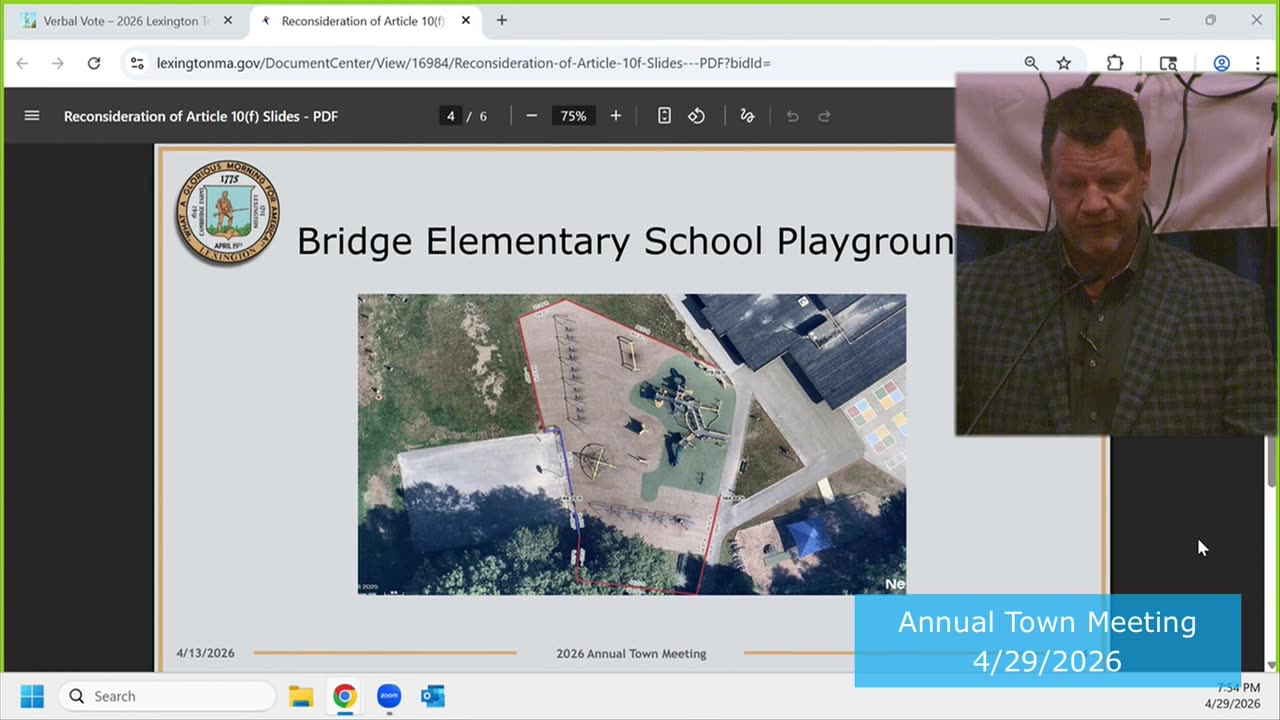
Installation of containment fencing to prevent student 'bolting'. Affected: Students at Fisk and Bridge Elementary schools and their parents.
safety change

Decisions ⁠logged

Every recorded vote, with timestamps and dissents.
Motion to receive the report of the Committee on Cary Lectures and place it on file.
Unanimous approval by voice vote.
Carried
Reconsideration of Article 10F (Playground Infrastructure Upgrades).
126 in favor, 31 opposed, 5 abstaining.
Carried
Closing debate on Article 10F.
117 in favor, 42 opposed, 13 abstaining.
Carried
Final vote on Article 10F (Playground Infrastructure Upgrades).
132 in favor, 34 opposed, 5 abstaining.
Carried
Closing debate on Avellone's amendment to Article 34.
143 in favor, 18 opposed, 8 abstaining.
Carried
Avellone's amendment to Article 34 (clarifying language regarding vendor notification).
38 in favor, 115 opposed, 10 abstaining.
Failed
Article 34 (Original Motion)
159 in favor, 13 opposed, 2 abstaining.
Carried
Motion to end debate on Article 31
129 in the affirmative, 28 in the negative, 11 abstaining. Carried by more than two-thirds.
Passed
Article 31 Motion
116 in the affirmative, 49 in the negative, 2 abstaining.
Passed
Motion to adjourn until Monday, May 4th at 7:30 p.m.
Vita Holm served notice of reconsideration of Article 31 immediately following the motion to adjourn.
Adjourned with notice of reconsideration

Topics ⁠discussed

Click a topic to expand quotes and full context.
▶ 00:36 Meeting Opening and Procedural Reminders

The moderator established the hybrid meeting format, provided instructions for remote and in-person participation, and shared technical support information.

Speakers: Unidentified speaker
▶ 11:11 Article 2: Cary Lecture Series Report

The Committee on Cary Lectures presented a report reviewing the -2 lecture series, including speakers, themes, and future scheduled events.

Speakers: Unidentified speaker
▶ 14:00 Article 10F: Playground Infrastructure Upgrades

A discussion and reconsideration of a proposal to install fencing at Fisk and Bridge Elementary schools to improve student safety and containment.

Speakers: Unidentified speaker
▶ 44:47 Article 34: Skip the Stuff (Citizen Petition)

A proposal to require takeout food establishments to ask customers if they want single-use plasticware and condiments before including them in orders.

Speakers: Unidentified speaker, REYNOLDS
▶ 1:13:19 Amendment to Article 34 regarding vendor requirements

Debate over an amendment to a bylaw (likely regarding takeout utensils/condiments) to clarify whether vendors can make items optional. The amendment was proposed by Mr. Avellone but ultimately failed.

Speakers: Unidentified speaker
▶ 1:29:00 Article 31: Regulation of Refuse Disposal

Discussion regarding a proposal to modernize waste collection, potentially moving to automated bins and implementing a 'pay-as-you-throw' or threshold-based fee system for excess waste.

Speakers: Unidentified speaker
▶ 2:22:35 Article 31: Waste Disposal Strategy and Bylaw Amendment

Debate regarding a proposal to transition to automated trash collection and amend bylaws to allow for flexible fee structures (pay-as-you-throw) to incentivize waste reduction.

Speakers: Unidentified speaker
▶ 2:23:13 Bulky Item Disposal Fees

Discussion on whether the ability to charge fees for bulky item disposal is contingent upon the approval of Article 31 and the potential budget impact of continuing to absorb these costs.

Speakers: Unidentified speaker

Controversy & ⁠dissent

Where the board, the community, or the agenda diverged.

Potentially controversial issues

01

Article 31: Waste Disposal Strategy and Bylaw Amendment

The proposal to move to automated collection and a 'pay-as-you-throw' fee structure is contentious due to concerns over regressive taxation, lack of concrete design details (bin sizes, costs), and potential impact on large families and vulnerable populations.
Board position: The board/Select Board supported the article to authorize the development of a new program design.
high concern
02

Article 34: Skip the Stuff (Citizen Petition)

Debate centered on whether the town should mandate restaurant practices for single-use plastics versus a voluntary approach, with opponents arguing it is punitive to businesses and hypocritical regarding larger environmental issues.
Board position: The board supported the original motion to require vendors to ask customers before including utensils.
medium concern
03

Article 10F: Playground Infrastructure Upgrades

Concerns were raised regarding the necessity of the fencing for student safety versus the financial transparency of the requested appropriation and the timing of the request.
Board position: Supported the installation of fencing for school safety.
medium concern

Split votes

Article 31 Motion (Waste Disposal)
116 in favor, 49 in the negative, 2 abstaining
Avellone's amendment to Article 34 (Vendor Requirements)
38 in favor, 115 opposed, 10 abstaining

Community vs. board tension

Action ⁠items

Who owes what, by when.
Distribute lecture flyers shortly after Labor Day.
Assigned: Cary Lecture Series Committee · Due: After Labor Day 2026
Notify the finance department of any unspent funds from the playground fencing appropriation at the end of the fiscal year.
Assigned: Mr. Cronin · Due: End of Fiscal Year 2027
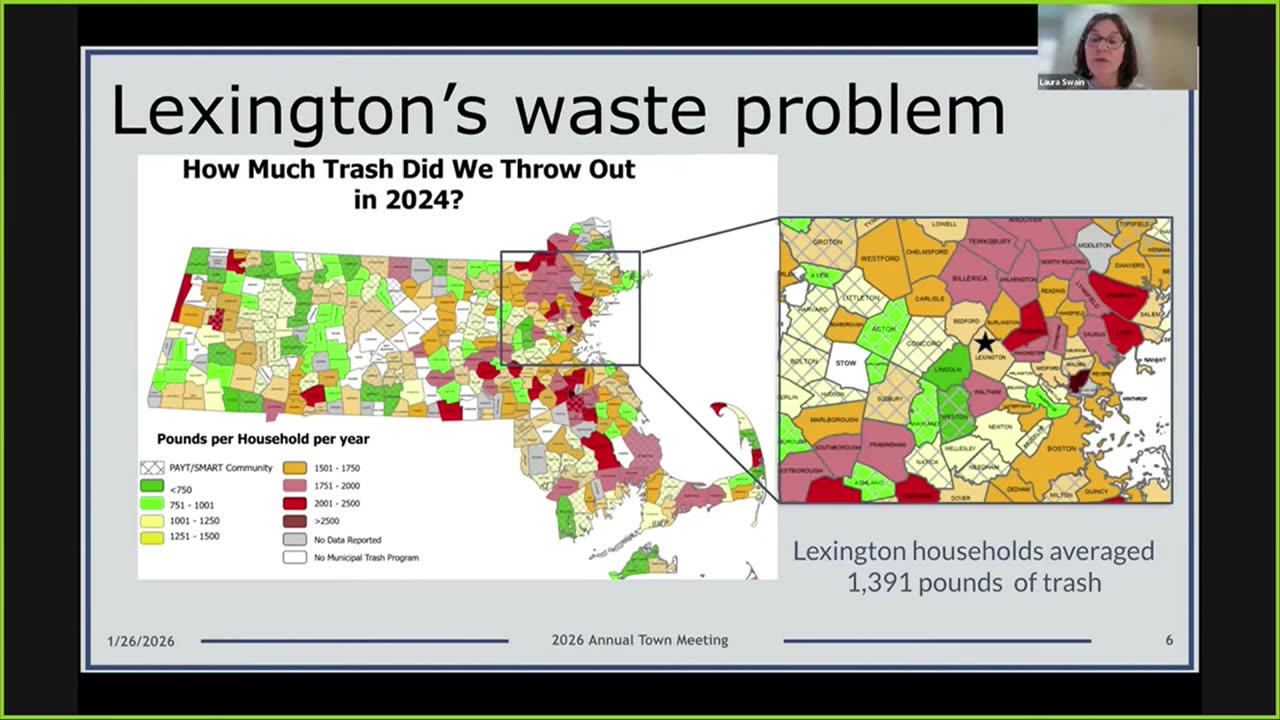
Design a waste collection program, including bin sizes and accommodation options for residents (e.g., seniors/disabled), to be presented after the current meeting.
Assigned: Town Staff / Select Board · Due: Before the November Special Town Meeting
Continue discussions with waste haulers regarding the transition to automated collection and management of excess waste.
Assigned: Select Board · Due: Coming months
Develop a detailed implementation plan for the waste disposal program, including design specifics (bin sizes), accessibility for elderly/disabled residents, and equity/hardship accommodations.
Assigned: Select Board and Town Staff · Due: Next year

Notable ⁠statements

The fencing would eliminate the ability for students [who bolt] to run into the field before staff members are able to help support them and deescalate them. — Meg Coelho (Bridge Principal) · Explaining the necessity of fencing for student safety due to increased instances of students bolting. ▶ 29:40
I believe that my child's safety is my business. It's not subject to a popular vote by any other group of parents. — Abram Baskin · Supporting the playground fencing article. ▶ 35:48
It's about changing a mindset away from a throwaway single-use culture. — Laura Swain (Lexington Zero Waste Collaborative) · Defending the Skip the Stuff bylaw amendment against claims that it is too burdensome for restaurants. ▶ 1:10:48
This is not a ban on anything. It's simply asking us to make a conscious choice. — Nicholas Sykes · Supporting the takeout utensil bylaw amendment. ▶ 1:13:16
I prefer we work with collaboration with the restaurants instead of enforcing this via bylaws. — Kenneth Shine · Opposing the Skip the Stuff article, favoring a voluntary program. ▶ 55:00
How many ketchup packets add up to the demolition of a building? — Leticia Holm · Opposing the takeout utensil bylaw, arguing the town focuses on small items while ignoring larger environmental issues like building demolition. ▶ 1:20:24
Voting on Article 31 during this town meeting gives staff time to work with key committees... to design a thoughtfully crafted program. — Maggie Peard · Explaining why a final program design is not yet available for the vote. ▶ 1:28:12
Trash removal is not a free service to the community. It is paid for out of our taxes. — Ricky Papo · Supporting Article 31 and the move toward usage-based waste fees. ▶ 1:33:00
I feel like we are asking for... basic parameters so that we can assess the impact on our constituents. — Kate Colburn · Opposing Article 31 due to lack of information on bin sizes and costs to residents. ▶ 1:57:00
This article seeks to charge a tax for throwing away trash that we all generate. — John McKenna · Opposing Article 31 by comparing it to previous failed tax measures and the 2002 pay-as-you-throw program. ▶ 2:05:40
Our proper job is to ratify a good design, not to simply approve a design before we actually know what it is and whether it's good or not. — Unidentified speaker · Arguing against the proposal due to lack of specific design details like bin size and disability accommodations. ▶ 2:22:09
It's time to stop living in the past and look to the future... Article 31 sets the stage for the Select Board to begin formulating a new waste disposal strategy for Lexington. — Unidentified speaker · Supporting the article as a necessary step for environmental and economic sustainability. ▶ 2:38:58
WE WILL HAVE TO ADDRESS THE QUESTION DIRECTLY, RECOGNIZING THAT IT IS ABOUT A $300,000 HIT TO OUR BUDGET IF WE WERE TO CONTINUE TO ABSORB THE BULKY ITEM DISPOSAL WITHIN THE BUDGET. — Unidentified speaker · Explaining the financial consequences if the bulky item fee issue is not resolved through this or similar measures. ▶ 2:50:09
Convenience, accessibility, and reliable service are also top priorities in designing this program, and those will not be forgotten during the design process. — Unidentified speaker · Reassuring the meeting that the implementation process will account for resident needs. ▶ 2:51:40

Public ⁠comment

What residents said — verbatim, with timestamps.
22
Total speakers
13
Addressed
0
Partial
9
Not addressed
Catherine Yan
Addressed
She inquired about the specific rationale for the fencing at Bridge School, asking if the current fencing wouldn't already prevent students from running out. She also asked if the school had consulted parents regarding this specific type of fencing. Key concern
The necessity and rationale of the proposed fencing at Bridge School.
Board response
The Bridge School principal, Meg Coelho, was called upon to explain that the fencing is needed to contain students with special education needs or trauma backgrounds who tend to 'bolt'.
The speaker's question was directly answered by the school principal who provided the reasoning.
Abram Baskin
Addressed
He stated his support for the playground fencing, emphasizing that parental responsibility for child safety is a private matter. He expressed trust in the judgment of the school principals. Key concern
Support for the motion based on child safety.
His comment was a statement of support rather than a request for action/clarification.
Lauren Black
Addressed
She questioned why the appropriation for fencing is being requested now if these have been long-standing issues at the schools. She sought clarification on the timing of the proposal. Key concern
The timing and suddenness of the request for playground fencing.
Board response
The Bridge School principal explained that student profiles have changed, with an uptick in 'bolting' behaviors in recent years.
The principal provided an explanation for why the need has become more acute recently.
Deepika Saini
Not addressed
She urged support for the article and suggested that the fencing at Bridge School should also consider the safety of the back parking lot where cars are close to the playground. Key concern
Safety concerns regarding the proximity of cars to the playground.
The speaker provided a suggestion/observation but did not pose a question requiring a response.
Don McKenna
Addressed
He questioned the cost difference between the original $100,000 request and the new, reduced scope. He expressed discomfort with voting for a proposal that seemed to offer the same price for less work. Key concern
The financial discrepancy and perceived lack of actual savings in the revised proposal.
Board response
The staff member (Mr. Cronin) explained that the motion was written based on the original estimate and they would return unused funds to the CPA fund rather than reducing the line item mid-process.
The speaker's financial concern was explained by the presenter.
Andrea Falcone
Addressed
She spoke in support of the 'Skip the Stuff' initiative, arguing that it shifts the default from automatic inclusion to intentional choice. She noted it reduces waste and helps businesses save on unused supplies. Key concern
Support for waste reduction through consumer choice.
Comment was a statement of support.
Kenneth Shine
Not addressed
He expressed agreement with the goal of reducing waste but opposed a mandatory bylaw. He suggested a voluntary program with a logo for participating restaurants instead of enforcement. Key concern
Preference for a voluntary program over a mandatory bylaw.
The speaker voiced an opinion/alternative but did not pose a direct question to the board.
Mona Roy
Addressed
She spoke in support of the article, noting it is an easy change for restaurants and will save money and the environment. Key concern
Support for the initiative.
Comment was a statement of support.
Catherine Reynolds
Addressed
She supported the article, pointing out that existing platforms like DoorDash and UberEats already use this 'opt-in' model, making it a reasonable and consistent improvement. Key concern
Consistency with existing digital ordering habits.
Comment was a statement of support.
Mr. Avellone
Addressed
He introduced an amendment, expressing concern that the article's language regarding specifying items could be interpreted as vendors being unable to provide orders unless specifically requested. He worried this would cause negative experiences for visitors. Key concern
Ambiguity in the wording of the bylaw regarding mandatory requests.
Board response
The proponent (Ms. Swain) explained that the amendment was rejected because it was non-mandatory and placed the burden on the restaurant rather than the consumer habits.
The speaker's concern regarding the language was addressed through the debate and the response of the article proponent.
Suzanne Lau
Addressed
She asked if national chains would be required to customize their websites for Lexington, noting that as a resident, she already has to manage these settings for out-of-town orders. Key concern
Implementation logistics for national restaurant chains.
Board response
The proponent explained that while it depends on the ordering system, many national online platforms already offer these options and this would just formalize it locally.
The speaker's technical question was answered by the proponent.
Leticia Holm
Not addressed
She strongly opposed the article, arguing that it is punitive to businesses and hypocritical given other town waste issues like building demolition. She suggested the town focuses on larger environmental issues instead. Key concern
Hypocrisy of the town's waste priorities and the punitive nature of the bylaw.
The speaker expressed a strong opposing opinion but did not pose a question.
Sanjay Padakee
Addressed
He asked several questions regarding the implementation of the trash program: whether there is a plan for a town-wide ballot, how extra bins/bags work, if there is a trade-in option for bin sizes, and how service works in snow. Key concern
Practical implementation and logistics of the automated trash program.
Board response
Staff/Select Board members answered: there is no ballot plan; extra bags can be bought at DPW or retail; trade-ins are undecided; and automated service works through winter despite potential snow delays.
All specific questions regarding logistics were answered by staff.
Nicholas Sykes
Addressed
He clarified that the proposed trash plan is 'pay above a threshold' rather than 'pay as you throw,' and noted that neighboring towns like Arlington have implemented similar systems successfully. Key concern
Clarification of the program type and success in neighboring towns.
Comment was a clarifying statement of support.
Cornelia Johnson
Addressed
She argued that trash collection has never truly been free and that the town needs to act on its zero-waste resolution to avoid escalating disposal costs and environmental damage. Key concern
The necessity of addressing rising waste costs through the zero-waste plan.
Comment was a statement of support/argument.
Ryan Wise
Addressed
He expressed support for automation and pay-as-you-throw in principle but felt the current proposal was too incomplete, specifically regarding bin sizes and the lack of a clear design. Key concern
The incompleteness of the program design and lack of clear parameters.
Board response
Ms. Peard (Staff) explained that the program design is still being developed and that the vote only gives the green light to move forward with that design process.
The speaker's concern about the proposal being 'incomplete' was addressed by explaining the purpose of the vote.
Maggie Peard
Addressed
She provided clarification that the vote on Article 31 is intended to provide staff with the authority to design a program, not to enact a final design immediately. She noted that accommodations for disabilities would be part of the design process. Key concern
Clarification of the purpose and scope of the Article 31 vote.
The speaker was an official providing clarification to the assembly.
Kate Colburn
Addressed
She opposed the article, stating she lacks sufficient information to weigh the costs and benefits, specifically regarding the impact on large households and the lack of mandatory hardship accommodations in the current wording. Key concern
Lack of information regarding bin sizes and impact on large families/households.
Board response
Ms. Peard explained that the design process (including bin sizes and accommodations) is still ongoing and will include public input.
The speaker's concern about lacking information was addressed by explaining the forthcoming design process.
Steve Kaufman
Not addressed
He opposed the article because the design is not fully developed. He argued that approving a plan before knowing basic parameters like bin size can lead to bad outcomes and citizen dissatisfaction. Key concern
The danger of approving an undefined and undeveloped plan.
The speaker voiced an opinion/opposition but did not pose a question.
Benjamin Lee
Addressed
He questioned the relationship between the current article and Article 24 (tax aid for elderly/disabled), asking how the town would provide fair and comprehensive relief if the program passes. Key concern
Ensuring equity and relief for vulnerable populations under the new waste fee structure.
Board response
Ms. Kumar (representing the Select Board/Staff) stated that the public process will include discussions with the Commission on Disability to incorporate their input into the final design.
The speaker's question about equity was answered with a commitment to the design process.
Brian Kelly
Not addressed
He opposed the article, arguing that it is a regressive way to raise money that will increase costs for taxpayers. He believes the town should maintain the current high-quality manual collection system. Key concern
The regressive nature of fees and the potential decline in service quality.
The speaker voiced a strong opposition but did not pose a question.
Vita Badarino Home
Not addressed
She opposed the article, calling it an uncredible plan and suggesting that it might be a ploy to divert money from the operating budget. She also expressed concern about the lack of a referendum. Key concern
The lack of a credible, finished plan and the potential for budget diversion.
The speaker voiced an opinion/opposition but did not pose a question.
Support coverage

Creating this report cost ⁠real money.

MeetingWatch attended, transcribed, and analyzed this meeting on its own dime. If this work is valuable to you, chip in to keep covering Lexington.

Report composed by gemma-4-26b, claude-opus-4-6 · analyzed 2026-05-19.