MeetingWatch
Your area Not set — showing everywhere
Meeting report · Town Meeting
Creating this report cost real money. Help fund coverage →

Town Meeting — April 15, 2026

The meeting featured high-stakes debates over a nearly $660 million project, characterized by a fundamental clash between resident demands for accountability and the administration's concerns over security and workload.

Date Wednesday, April 15, 2026 Duration 2.6h Speakers 47 Public comments 22 Decisions 9 Contentious

Public ⁠impact

Issues from this meeting with documented community impact.
01

Lexington High School Project Budget and Oversight

$659.7 million project budget with ongoing scrutiny regarding cost controls and design-phase management. Affected: All Lexington taxpayers
other high impact

Decisions ⁠logged

Every recorded vote, with timestamps and dissents.
Motion to receive the School Building Committee report and place it on file.
Motion by Ms. Lenahan; no objections noted.
Carried
Motion to close debate on Article 26.
121 in the affirmative, 41 in the negative, 14 abstaining.
Carried
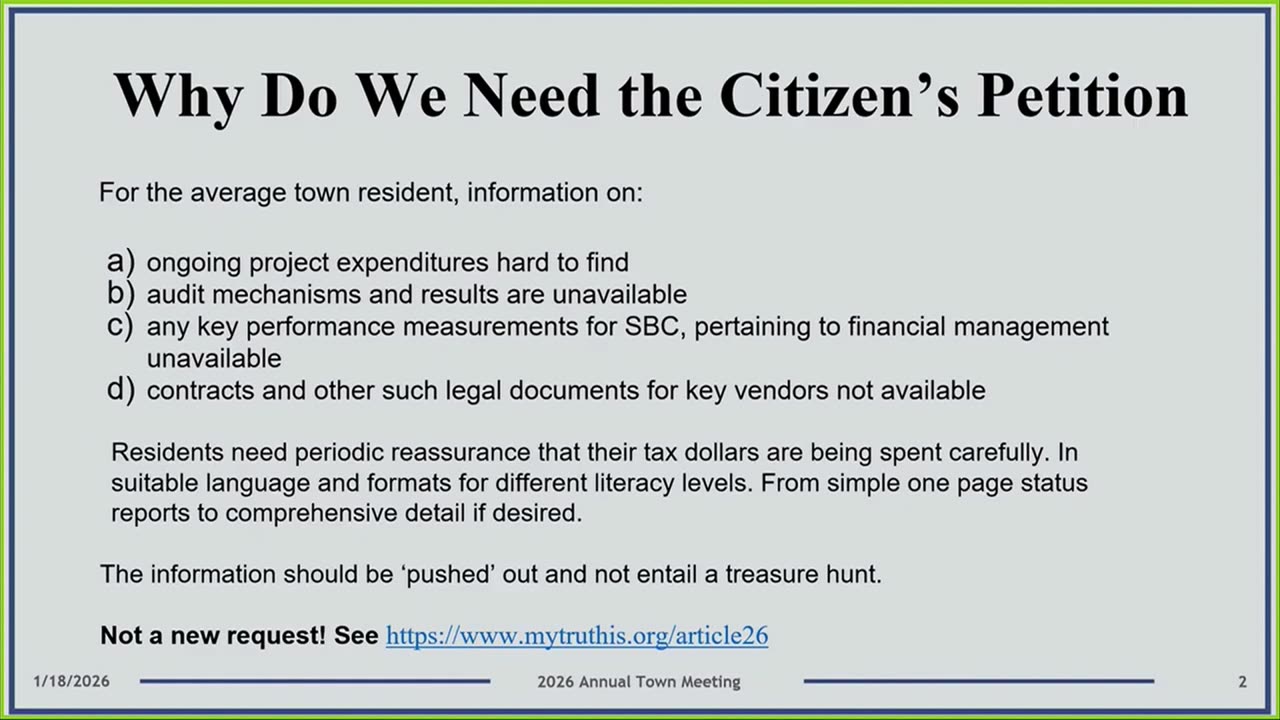
Article 26: Oversee Financial Expenditures, Lexington High School Project (Citizen Petition).
38 in the affirmative, 125 in the negative, 11 abstaining.
Failed
Motion to amend Article 27 by substitution (the 'Parker Amendment')
Replaced the original motion with a substitute resolution directing the Select Board to study and report back on transparency requirements by Fall 2026 Special Town Meeting.
Passed (137 in favor, 36 opposed, 4 abstaining)
Motion to close debate on the Kaufman amendment
128 in the affirmative, 36 in the negative, 10 abstaining.
Passed
Kaufman Amendment to the Parker substitute (including $50,000 appropriation)
63 in the affirmative, 105 in the negative, 8 abstaining.
Failed
Motion to close all debate on Article 27
145 in the affirmative, 13 in the negative, 14 abstaining (surpassed two-thirds requirement).
Passed
Final vote on Article 27 (as amended by Parker)
162 in the affirmative, 11 in the negative, 1 abstaining.
Passed
Motion to adjourn
Meeting adjourned until Monday, April 27th, at 7:30 p.m.
Passed

Topics ⁠discussed

Click a topic to expand quotes and full context.
▶ 05:46 School Building Committee Report

Kathleen Lenahan provided an update on the Lexington High School project, noting the budget is $659.7 million, the project is in the detailed design phase (Module 6), and construction is slated to begin in July with a 2029 occupancy target.

Speakers: Unidentified speaker
▶ 12:41 Article 26: Oversee Financial Expenditures, Lexington High School Project

A citizen petition to create a volunteer committee of residents with financial expertise to communicate high school project spending to the public in plain language. The motion was opposed by most town boards and failed.

Speakers: Unidentified speaker
▶ 1:08:09 Article 27: Procurement for Online Capital Project Platform

Discussion of a citizen petition to appropriate up to $50,000 for an online transparency platform providing monthly updates on capital project budgets, expenditures, and progress. Debate addressed direct procurement versus a study-first approach, security/privacy concerns with detailed invoice data, and amendments including the Parker substitute (study/report by Fall 2026) and Kaufman amendment (pilot program with funding). The original motion was opposed by the Select Board; final amended version passed.

Speakers: Unidentified speaker
▶ 1:18:00 Internal Capital Invoice and Data Management

Technical discussion regarding how capital invoices are received, reviewed by project managers and architects, entered into the Tyler/Munis accounting system, and reconciled monthly.

Speakers: Unidentified speaker

Controversy & ⁠dissent

Where the board, the community, or the agenda diverged.

Potentially controversial issues

01

Article 26: Oversight Committee for High School Project

A citizen petition sought to create a volunteer resident committee to translate complex financial data into plain language. Proponents argued it was necessary for accountability and public trust, while opponents (including the Select Board and Appropriations Committee) argued it was redundant, would increase costs, and might delay the project through excessive scrutiny.
Board position: Opposed; the Select Board and various town committees recommended disapproval.
Internal dissent
The Select Board was unanimously opposed (0 in favor, 5 opposed) to the original motion for Article 27, and the general town leadership signaled strong opposition to Article 26, which ultimately failed overwhelmingly (38 in favor vs 125 against).
high concern
02

Article 27: Transparency Platform Procurement

This involved a battle between immediate action (direct procurement of a $50,000 transparency platform) versus a cautious approach (a study to evaluate needs). Proponents felt a study was a delay tactic, while the Select Board and others cited security risks (phishing), IT infrastructure concerns, and the need for better planning.
Board position: Favored a middle-ground approach via a study/report (the Parker Amendment) rather than immediate expenditure.
Internal dissent
The motion passed only after being heavily amended. The original motion was opposed by the Select Board, and there was significant debate between proponents of the Kaufman amendment and the Parker substitute.
high concern

Split votes

Article 26: Oversee Financial Expenditures, Lexington High School Project
38 in the affirmative, 125 in the negative
Kaufman Amendment to Article 27 (direct $50,000 appropriation for transparency)
63 in the affirmative, 105 in the negative

Community vs. board tension

Action ⁠items

Who owes what, by when.
Develop and launch the LHS project dashboard, expected to be live by July 1st, 2026.
Assigned: OPM and Town Staff · Due: 2026-07-01
Upload finance subcommittee minutes to the website using AI-generated notes.
Assigned: Mr. Cronin
Study, evaluate, and report back on the scope, volume, and frequency of capital project financial disclosures.
Assigned: Select Board · Due: Fall 2026 Special Town Meeting
Develop capital project reporting/transparency measures as outlined in the approved Article 27 language.
Assigned: Town Staff / Select Board

Notable ⁠statements

A yes vote is a vote for accountability. — Unidentified speaker · Supporting the citizen petition for a resident financial oversight committee. ▶ 24:00
The Select Board does not support passage of this motion by a vote of zero in favor and five opposed. — SPEAKER_28 (Mr. Lucente) · Expressing the Board's position on the original Article 27 motion, citing the need for more public input to avoid overburdening staff. ▶ 1:15:17
We don't want to just throw all of the detailed information and invoices out online... there is information in those that would make the town subject to things like phishing attempts. — SPEAKER_10 (Ms. Kosnoff) · Explaining the security and privacy concerns regarding the level of detail requested in the original transparency motion. ▶ 1:24:42
The proponents have not discussed their proposal with the town's innovation and technology department nor were they able to investigate the financial data infrastructure that has evolved in Lexington over decades. — SPEAKER_26 (Mr. Parker) · Justifying the substitute motion by highlighting the potential risks of imposing new requirements on existing IT infrastructure without proper planning. ▶ 1:35:00
The substitute stops at a study. The original moves forward and delivers something. — SPEAKER_31 (Mr. Kaufman) · Arguing against the Parker Amendment, claiming it delays actual transparency in favor of a non-binding process. ▶ 1:49:00
This article does not ensure that mix of skills [required for auditing]... is more likely to increase project costs, waste town staff time, and result in costly project delays. — Unidentified speaker · Opposing Article 26 based on professional accounting and consulting experience. ▶ 1:02:10
Do we take a step towards delivering transparency this year or continue studying it? — Unidentified speaker · Presenting Article 27 regarding the procurement of a transparency platform. ▶ 1:12:07
Town meeting cannot compel the town to do the work. You're asking... to exercise authority that you don't have. — SPEAKER_26 (Mr. Parker) · Arguing against the amendment's ability to mandate specific town operations. ▶ 2:20:19
When you appropriate money, you earmark it for that purpose... However, management... can decide whether or not to use that appropriation. — SPEAKER_32 (Mr. Mercurius) · Clarifying the legal effect of earmarking $50,000 for the project. ▶ 2:25:55
We have a transparency resolution with no transparency requirement. With [this amendment] we have a commitment not just to study but to deliver. — SPEAKER_17 (Mona Roy) · Supporting the Kaufman amendment to ensure concrete outcomes. ▶ 2:27:00

Public ⁠comment

What residents said — verbatim, with timestamps.
22
Total speakers
8
Addressed
0
Partial
14
Not addressed
Unidentified speaker
Not addressed
The speaker expressed high praise for the scrutiny and dedication of the SBC and PBC committees. They argued that the existing financial oversight processes for the LHSV2 project are already exceptionally thorough. Key concern
Defending the current level of financial oversight and committee commitment.
The speaker was making a statement of support/opinion rather than asking a question or making a formal request for the board to act upon.
Unidentified speaker
Addressed
Representing the Appropriation Committee, the speaker noted that eight members voted to recommend disapproval of the motion. They referred to the committee report for the specific rationale. Key concern
Formal recommendation for disapproval of the article.
Board response
The Moderator acknowledged the comment.
The board received the official committee recommendation.
Priya Patel
Addressed
The speaker questioned the comparative benefit of passing Article 26. They asked how the article would provide more value to citizens than the progress reports already planned by the town. Key concern
The added value and necessity of Article 26 compared to existing town plans.
Board response
An official (a speaker) responded at length, explaining that Article 26 seeks to move toward more accountability, transparency, and data-driven reporting rather than just narrative reports.
The town representative provided a detailed comparison and justification for the article.
Unidentified speaker
Not addressed
The speaker supports the article but expressed concern about the lack of oversight during the design phase. They noted that cost increases (like the foundation costs) should be addressed through better control during design development. Key concern
Ensuring cost control and transparency during the design phase, not just the construction phase.
The speaker was expressing a position in the 'yes' line and the moderator simply thanked them.
Harry Forsdick
Addressed
The speaker expressed support for the petitioners' desire for information but stated they will be voting 'no' on the article. They expressed confidence that the four existing monitoring measures are sufficient. Key concern
Whether additional oversight is necessary given existing monitoring methods.
Board response
The Moderator thanked the speaker.
The speaker's stance was acknowledged.
Jia Lu
Not addressed
The speaker urged a 'yes' vote on Articles 26 and 27, arguing they provide the human element and infrastructure needed for transparency. They clarified that the committee is a temporary, non-decision-making body intended to bridge the gap between data and resident understanding. Key concern
The necessity of formalizing transparency through a volunteer committee and a digital platform.
The speaker was presenting arguments for the 'yes' vote.
Monica Davis
Addressed
The speaker raised questions regarding the expected time commitment for volunteers and the form that 'non-binding advice' would take. They expressed skepticism about the added value of the motion. Key concern
Volunteer workload, the nature of the committee's advice, and the actual utility of the article.
Board response
A town representative (a speaker) answered all three questions, discussing meeting frequencies, the use of ERP reports for efficiency, and the hope for valid, evidence-based suggestions.
The representative provided specific answers to the questions regarding workload and the nature of the advice.
Unidentified speaker
Addressed
The speaker supports the article, noting that transparency helps all committees. They cited previous failures in communicating school budget struggles as evidence that more disclosure is needed. Key concern
The need for better disclosure to assist in long-term planning and resident trust.
Board response
The Moderator thanked the speaker.
The speaker's comments were acknowledged.
Peter Shapiro
Addressed
The speaker argued against the article, fearing the committee would inevitably move from 'communication' to 'interrogation' of project managers. They expressed concern that this would interfere with the project's ability to stay on time and budget. Key concern
The potential for the committee to cause project delays through excessive scrutiny.
Board response
The Moderator thanked the speaker.
The speaker's position was acknowledged.
Jay Xun Zhang
Not addressed
The speaker urged support for Articles 26 and 27 to solve deficits in finance and public trust. They cited examples of seemingly wasteful spending to argue that an 'Open Checkbook' system is necessary. Key concern
Rebuilding public trust through a transparent financial system.
The speaker was providing testimony in support of the motion.
Nicholas Sykes
Addressed
The speaker asked to view the dashboard and questioned what additional information the petitioners were seeking that was not already available. They also asked what commitments the Select Board and SBC could make regarding transparency. Key concern
Identifying the specific gap between existing reports and the petitioners' requests; seeking formal commitments to transparency.
Board response
Mr. Cronin (representing the Select Board/SBC) responded that the town is looking for feedback and is happy to add requested data to the website as it is identified.
The town representative responded to the inquiry about what information was missing and how the town would handle transparency commitments.
Unidentified speaker
Addressed
The speaker provided historical context on the PBC and supported the article as a way to provide 'more eyes' on a massive project. They argued that extra scrutiny is beneficial and not merely bureaucratic. Key concern
The value of additional oversight for a project of this unprecedented scale.
Board response
The Moderator thanked the speaker.
The speaker's comments were acknowledged.
Unidentified speaker
Addressed
The speaker, a former CPA and consultant, argued that the article is unnecessary because robust transaction audits and process controls are already in place. They claimed the committee would likely increase costs and cause delays. Key concern
The redundancy and potential negative impact (cost/delay) of the proposed committee.
Board response
The Moderator thanked the speaker.
The speaker's position was acknowledged.
Steve Kaufman
Addressed
As a proponent of Article 27, the speaker presented the need for a centralized transparency platform to avoid fragmented information. They explained that the motion is flexible and aimed at defining requirements rather than mandating specific software immediately. Key concern
Providing a single, accessible, and automated location for major capital project data.
Board response
The Moderator transitioned to the presentation and allowed for questions.
The speaker was presenting the article itself.
Kyle York
Addressed
The speaker asked a series of detailed questions regarding the flow of capital invoices, how they are entered into the accounting system, who reviews them, and how they are stored digitally. Key concern
Understanding the current internal processes for financial monitoring and data availability.
Board response
Mr. Cronin and Ms. Kosnoff (Assistant Town Manager for Finance) provided extensive answers regarding the multi-step approval chain, the use of the Tyler system, and the difficulty of making raw invoice data public due to security/redaction needs.
Town officials provided a very detailed technical explanation of the current accounting and invoice workflows.
Archon Basu
Not addressed
As a co-petitioner, the speaker argued that transparency is lacking compared to peer towns. They emphasized that the current dashboard is just a prototype and that the town needs to resource the finished product. Key concern
Moving from a prototype dashboard to a fully realized, town-wide transparency system.
The speaker was providing arguments for the 'yes' vote.
Unidentified speaker
Not addressed
The speaker expressed frustration with local government, citing a loss of trust due to previous budget and rezoning issues. They argued that Article 27 is a necessary first step to rebuilding that trust. Key concern
Rebuilding public trust through improved communication and disclosure.
The speaker was providing testimony in support of the motion.
Unidentified speaker
Addressed
The speaker asked if the IT department has in-house development skills and if purchased software could seamlessly integrate with existing systems. They also asked if a report like Concord's could be built in-house. Key concern
Technical feasibility, integration capabilities, and the cost/effort of in-house development.
Board response
The IT Head (a speaker) stated they have no in-house developers, only generalists, and no current way to seamlessly integrate data across departments. Ms. Kosnoff added that a PowerPoint-style report could be produced by staff but noted the effort involved.
Both IT and Finance officials provided direct answers regarding technical capabilities and manual reporting possibilities.
Sanjay Pathaki
Addressed
The speaker asked how long it took neighboring towns like Concord to implement their reporting systems and whether the town has assessed the impact on the workload of other IT projects in the pipeline. Key concern
Implementation timeline and the potential burden on the town's existing IT project queue.
Board response
Mr. Kaufman responded that while he didn't have specific implementation durations for Concord, he knew they were successfully managing many projects, and he argued that the proposed reporting is already being done by staff, just not published.
The proponent addressed the implementation and workload concerns.
Bridget McGaugh
Not addressed
The speaker supported the amendment, arguing it is a flexible and simple way to provide the information Town Meeting members frequently ask for. They suggested that the appropriation acts as a 'hedge' rather than a requirement to spend. Key concern
Providing a practical, low-complexity solution for regular project updates.
The speaker was providing arguments for the amendment.
Mona Roy
Not addressed
The speaker opposed the substitute amendment, arguing that it replaces an actual deliverable with a mere study. They claimed that the original motion provided a way to actually do the work, whereas the substitute just delays it. Key concern
Ensuring the town commits to actual implementation rather than just a study/process.
The speaker was providing arguments for the original motion.
Support coverage

Creating this report cost ⁠real money.

MeetingWatch attended, transcribed, and analyzed this meeting on its own dime. If this work is valuable to you, chip in to keep covering Lexington.

Report composed by grok-4.3, gemma-4-26b, grok-4-fast, claude-opus-4-7 · analyzed 2026-05-28.