Your area Not set — showing everywhere
Meeting report · Town Meeting
Creating this report cost real money. Help fund coverage →

Town Meeting — April 13, 2026

The meeting featured significant debate on waste management, strong opposition from a specialized commission, and was interrupted by technical failures during critical voting periods.
Date Monday, April 13, 2026 Duration 2.3h Speakers 34 Public comments 4 Decisions 5 Spirited
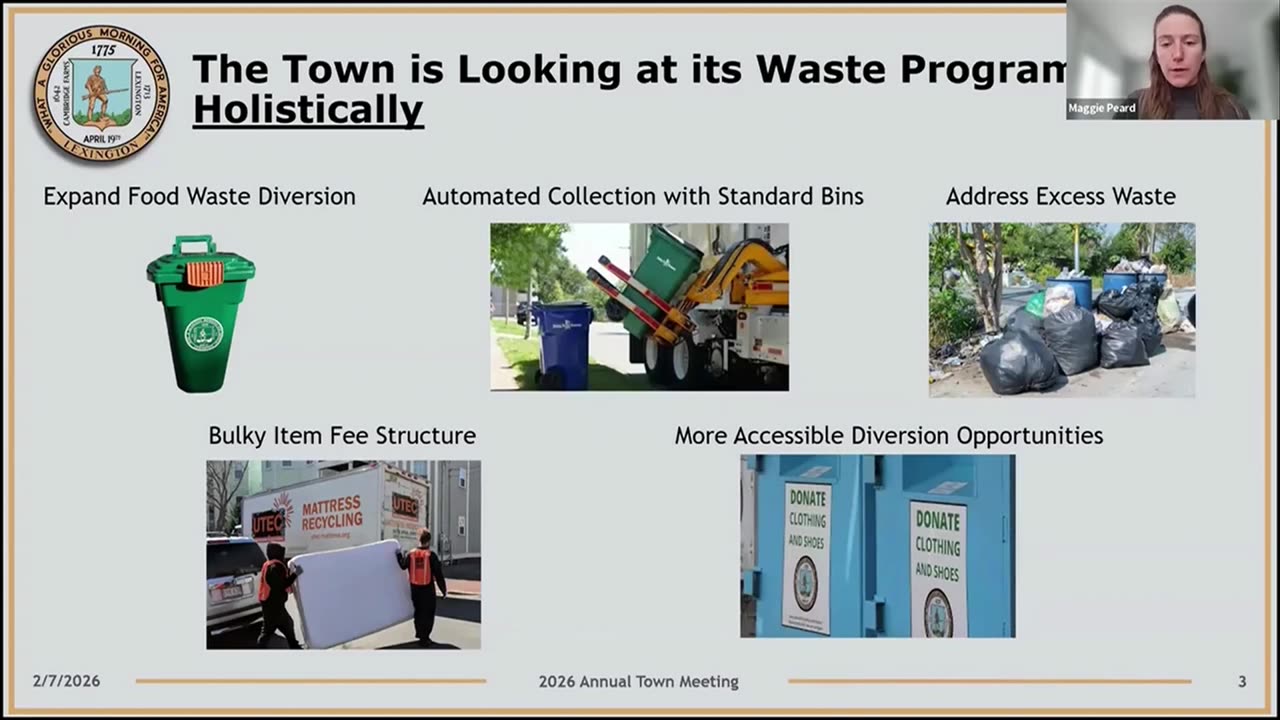
Waste program overview slide with icons and sections Video still
Waste program overview slide with icons and sections Frame from meeting video ▶ 22:32

Questions about this meeting? ⁠Just ask.

Ask MeetingWatch answers from this meeting’s report, transcript, and records — with linked sources.

Summary AI-generated to surface controversy & community impact without bias — always verify against the actual meeting before relying on it.

Significant decisions were made at the April 13 Town Meeting regarding how Lexington handles waste, leaving many residents with unanswered questions about accessibility and costs.

First, the town approved Article 23, a $1.2 million appropriation to transition to automated wheeled trash and recycling carts. While the Select Board argues this will increase efficiency and safety, the vote revealed significant community division. Opponents raised serious concerns about whether these large carts will be manageable for seniors and residents with disabilities, and whether the town has a clear plan for the environmental impact of replacing existing bins.

Second, the meeting was interrupted by technical failures during the debate over Article 31, which would authorize fee-based structures for excess waste. This is a highly contentious issue: the Commission on Disability warned that such fees create an undue financial burden on disabled residents, potentially forcing them to choose between waste disposal and essential needs like groceries or medication. This push for fees mirrors 'pay-as-you-throw' models that voters have rejected in the past.

Because of the technical issues, the vote on Article 31 was set on the table. The meeting will resume on Wednesday, April 15th at 7:30 p.m. to finish the discussion and voting. Residents should attend to ensure that the needs of our most vulnerable neighbors are prioritized over new fee structures.

Apr 13, 2026 2.3h long 34 speakers 4 public comments 5 decisions Spirited
Notable statements Drag to browse

“What we are honoring our students for is their efforts at building community within their respective high schools.”

— Unidentified speaker · Introducing the Community Builders Awards. ▶ 03:43

“Article 31 is essential policy framework that makes these improvements effective... It updates outdated bylaw language that treats disposal as free.”

— Unidentified speaker · Sustainable Lexington Committee presentation supporting the waste modernization articles. ▶ 31:37

“The problem is that this article leaves out some key implementation details... I would like to see the town come back... with a similar but more detailed request.”

— Unidentified speaker · Opposing Article 23 due to concerns over bin uniformity and wastefulness. ▶ 39:34

“The current recycle bins, which have no wheels on them... It's very dangerous in the winter, as opposed to a barrel that would just roll out.”

— Unidentified speaker · Arguing in favor of transitioning to wheeled bins. ▶ 1:11:38

“Fees cause too many disabled individuals to have to choose between groceries, prescriptions, heating oil, medical supplies, health care, and other necessities.”

— Unidentified speaker · The Commission on Disability opposing the fee-based structure in Article 31. ▶ 1:31:52

“I think of trash like our water and energy utilities, and I encourage folks to put trash on an equal footing as any other pay-as-you-use services.”

— Unidentified speaker · Arguing in favor of Article 31 to manage municipal budgets. ▶ 1:43:16
This meeting — choose a section

Public ⁠impact

Issues from this meeting with documented community impact.
What was discussed

Large-scale transition involving $1.2M in capital outlay and potential new recurring fees for residents.

What happened

Article 23 passed; Article 31 was set on the table due to technical voting issues.

Topics ⁠discussed

Each topic expands to quotes and full context.
Speakers: Unidentified speaker
What was discussed

A special presentation honoring high school students from Lexington High School and Minuteman for their community building efforts.

What happened

The ceremony concluded with applause for the honored students.

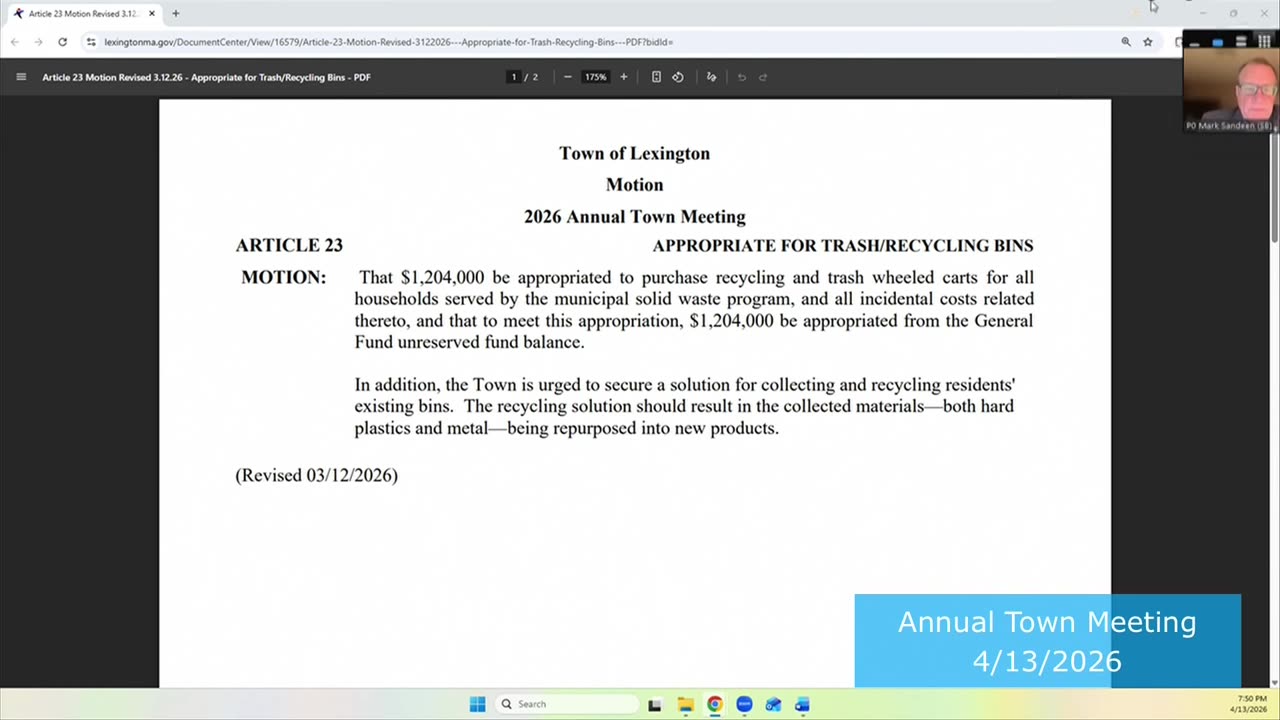
Article 23 motion text on trash/recycling bin funding Video still
Article 23 motion text on trash/recycling bin funding ▶ 20:35
Speakers: Unidentified speaker
What was discussed

A proposal to appropriate $1,204,000 for the purchase of wheeled trash and recycling carts to facilitate a transition to automated waste collection.

What happened

The topic was opened for debate following presentations from the Sustainability Officer, Select Board, and various committees. The motion to close debate passed by a two-thirds majority, and the main motion under Article 23 carried.

Speakers: Unidentified speaker
What was discussed

A proposal to modernize waste disposal bylaws to allow the Select Board to implement fee-based structures for excess waste.

What happened

Due to significant technical issues with the voting and remote participation systems, the motion was set on the table.

Speakers: Unidentified speaker
What was discussed

Honoring long-serving Town Meeting members for their civic commitment.

What happened

Tony Galitzis (30 years) and Judith Zabin (50 years) were awarded certificates and gold-plated Minuteman pins.

Controversy & ⁠dissent

Where the board, the community, or the agenda diverged.

Potentially controversial issues

01

Article 31: Amendment to Refuse Disposal Bylaw

The proposal introduces a fee-based structure for excess waste. This is highly contentious because the Commission on Disability argues it creates an undue financial burden on disabled residents for medical necessities, and notes that voters have previously rejected similar 'pay-as-you-throw' models.
Board position: The Select Board and Sustainability Committee supported the modernization of the bylaw to manage costs and landfill capacity.
high concern
02

Article 23: Automated Waste Collection Transition

The transition to large wheeled carts raised concerns regarding environmental waste (disposing of old bins), implementation details (bin sizes), and physical accessibility for seniors and residents with disabilities.
Board position: The Select Board supported the transition for increased efficiency, safety, and long-term cost savings.
medium concern

Split votes

Motion to close debate on Article 23
116 in favor, 51 opposed, 14 abstaining
Final vote on Article 23 (Waste Collection Program)
143 in favor, 29 opposed, 9 abstaining

Community vs. board tension

Public ⁠comment

What residents said — verbatim, with timestamps.
4
Total speakers
2
Addressed
0
Partial
2
Not addressed
Commission on Disability Representative
Not addressed
The Commission unanimously opposes Article 31, arguing that waste disposal fees place an undue burden on disabled residents. They highlight that many waste items are medical necessities and that fee-based systems lack equitable abatement options. They also cite a previous referendum where voters rejected 'pay-as-you-throw' models. Key concern
The financial and privacy burden of a fee-based waste system on individuals with disabilities and the lack of equity in such a system.
Board response
The board did not provide a direct verbal response to the Commission's arguments during the speaking session; however, the meeting was eventually adjourned due to technical issues.
The board/moderator did not address the specific concerns raised by the Commission before the meeting was adjourned due to technical difficulties.
Suzanne Lau
Addressed
The speaker expressed concern regarding the lack of clarity on bin sizes in the proposed bylaw. She suggested providing two smaller bins at no charge rather than a fee-based system and inquired about alternatives for residents with mobility challenges. Key concern
Uncertainty regarding bin sizing, the effectiveness of a one-size-fits-all approach, and accommodations for residents unable to move bins.
Board response
Speaker a speaker (representing the town/task force) responded in detail, explaining that bin size decisions would follow community outreach and addressing potential accommodations like bag-based pickup or placement assistance.
The town representative provided specific answers regarding the bin size decision process, the possibility of different bin sizes, and potential accommodations for mobility-impaired residents.
Speaker SPEAKER_16
Addressed
The speaker pointed out a technical issue where several community members were unable to join the digital queue to speak. They requested that IT staff assist with the problem. Key concern
Technical failure of the online meeting platform preventing residents from participating.
Board response
The Moderator (Speaker a speaker) acknowledged the issue and asked IT staff for an update, eventually calling a brief recess to address the technical 'gremlins'.
The board acknowledged the technical failure and took immediate action by calling a recess to attempt a fix.
Ricky Papo
Not addressed
The speaker supports Article 31, noting that previous 'Pay As You Throw' programs successfully reduced waste. They argued that trash collection is a service paid for by taxes and that reducing waste is necessary for budget management and environmental protection. Key concern
Encouraging the passage of Article 31 to ensure waste reduction, budget stability, and environmental responsibility.
The speaker was offering support/testimony rather than a concern requiring a response; the board did not respond.

Decisions ⁠logged

Every recorded vote, with timestamps and dissents.
Motion to receive the report of the Select Board and place it on file.
The motion was made by Ms. Hay and seconded by the moderator.
Carried (no objections)
Motion to take up Articles 23 and 31.
The motion was made by Ms. Hay.
Carried (no objections)
Motion to close debate on Article 23
The motion passed by more than a two-thirds majority.
116 in favor, 51 opposed, 14 abstaining
Final vote on Article 23 (Waste Collection Program)
The motion carried.
143 in favor, 29 opposed, 9 abstaining
Motion to adjourn and set Article 31 on the table
Meeting adjourned to Wednesday, April 15th at 7:30 p.m. due to technical difficulties.
Unanimous (no objections)

Share ⁠this report

Drafts ready to post — click a block to copy, or use Share to post it.

X / Twitter — by angle

Split vote and community concerns regarding Article 23
At the 4/13 Town Meeting, Article 23 passed, authorizing $1.2M for automated waste carts. Despite 29 'no' votes and concerns from residents about accessibility for seniors and the disabled, the town is moving forward with the... https://meetingwatch.org/ma/lexington/town-meeting/2026-04-13/ #MeetingWatch #LexingtonMA
318/280 chars
Dismissed concerns and technical failures affecting a contentious vote
The Town Meeting on 4/13 hit a wall on Article 31. A proposal to add fees for excess waste was interrupted by technical voting failures. The debate revealed a deep divide: the Select Board supports fees, while the Commission... https://meetingwatch.org/ma/lexington/town-meeting/2026-04-13/ #MeetingWatch #LexingtonMA
317/280 chars
Prioritizing ideology/policy over previous voter intent and resident hardship
Voters previously rejected 'pay-as-you-throw' models, yet Article 31 seeks to implement a similar fee-based waste structure. The Commission on Disability argues these fees force vulnerable residents to choose between trash... https://meetingwatch.org/ma/lexington/town-meeting/2026-04-13/ #MeetingWatch #LexingtonMA
315/280 chars

X thread

1
Waste management in Lexington is facing a major overhaul, but at what cost to our most vulnerable neighbors? Here is what happened at the April 13 Town Meeting regarding Articles 23 and 31. 🧵 #MeetingWatch #LexingtonMA
218/280
2
Article 23 passed, approving $1.2M for new automated trash carts. While proponents cited efficiency, many residents and 29 voters raised red flags regarding physical accessibility for seniors and the environmental impact of discarding current bins.
248/280
3
The tension peaked with Article 31, which would allow the Select Board to charge fees for excess waste. The Commission on Disability strongly opposed this, noting that such fees force disabled residents to choose between trash disposal and medical necessities.
260/280
4
The vote on Article 31 was never completed due to technical failures with the remote voting system. The discussion is set to resume on April 15th at 7:30 PM. Stay informed and show up to ensure resident concerns aren't sidelined. https://meetingwatch.org/ma/lexington/town-meeting/2026-04-13/
253/280

Facebook — long form

Significant decisions were made at the April 13 Town Meeting regarding how Lexington handles waste, leaving many residents with unanswered questions about accessibility and costs.

First, the town approved Article 23, a $1.2 million appropriation to transition to automated wheeled trash and recycling carts. While the Select Board argues this will increase efficiency and safety, the vote revealed significant community division. Opponents raised serious concerns about whether these large carts will be manageable for seniors and residents with disabilities, and whether the town has a clear plan for the environmental impact of replacing existing bins.

Second, the meeting was interrupted by technical failures during the debate over Article 31, which would authorize fee-based structures for excess waste. This is a highly contentious issue: the Commission on Disability warned that such fees create an undue financial burden on disabled residents, potentially forcing them to choose between waste disposal and essential needs like groceries or medication. This push for fees mirrors 'pay-as-you-throw' models that voters have rejected in the past.

Because of the technical issues, the vote on Article 31 was set on the table. The meeting will resume on Wednesday, April 15th at 7:30 p.m. to finish the discussion and voting. Residents should attend to ensure that the needs of our most vulnerable neighbors are prioritized over new fee structures. https://meetingwatch.org/ma/lexington/town-meeting/2026-04-13/ #MeetingWatch #LexingtonMA

Action ⁠items

Who owes what, by when.
Vote on the final waste program implementation plan, including bin size selection.
Assigned: Select Board · Due: Post-Article 23 approval
Coordinate collection and recycling of unwanted existing bins if Article 23 passes.
Assigned: Town Staff · Due: Prior to July 2027
Reboot Wi-Fi access points to resolve connectivity issues for remote voters.
Assigned: Town Staff / IT · Due: Immediate
Continue community outreach and bin size surveys to inform the waste program design.
Assigned: Sustainability and Resilience Office · Due: Before July 2027 rollout

From the meeting

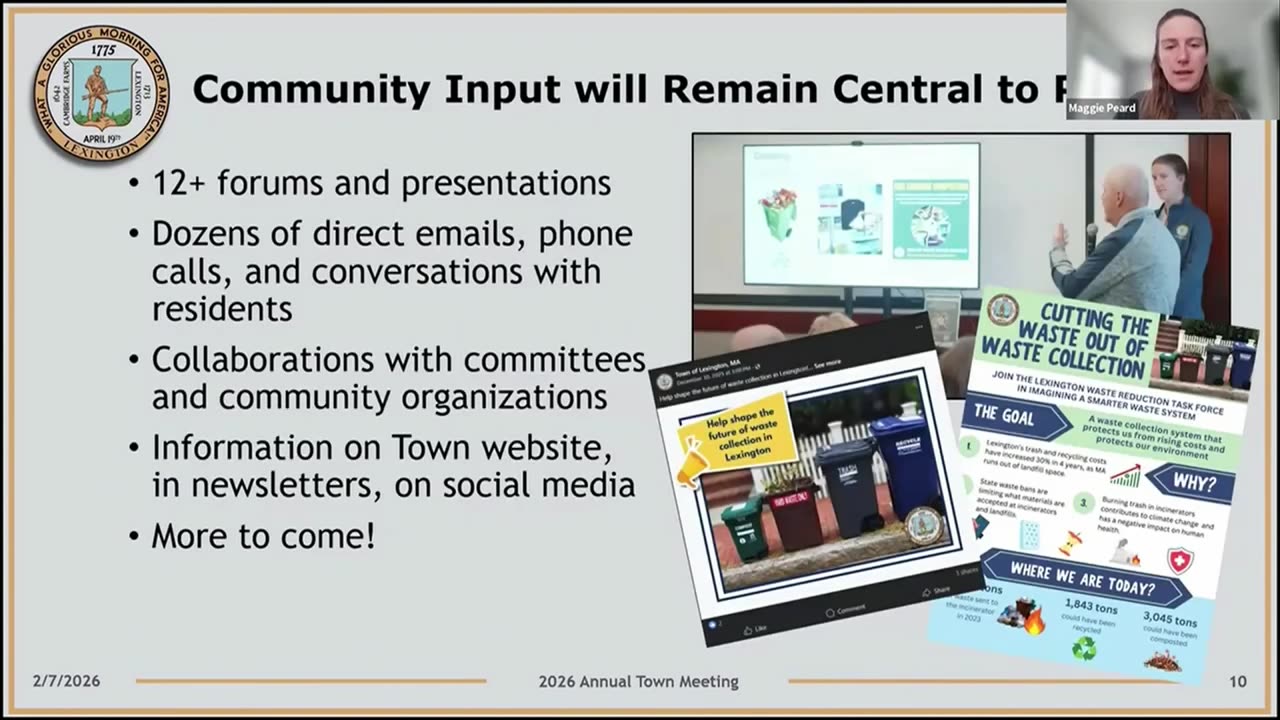
Community input slide on waste collection with graphics Video still
Community input slide on waste collection with graphics ▶ 26:57
Support coverage

Creating this report cost ⁠real money.

MeetingWatch attended, transcribed, and analyzed this meeting on its own dime. If this work is valuable to you, chip in to keep covering Lexington.

Report composed by grok-4.3, gemma-4-26b, grok-4-fast, grok-4.20-0309-reasoning · analyzed 2026-06-07.