MeetingWatch
Your area Not set — showing everywhere
Meeting report · Town Meeting
Creating this report cost real money. Help fund coverage →

Town Meeting — March 12, 2026

This was a well-structured informational session rather than a decision-making meeting, but real underlying tensions — particularly over 70 school job cuts, the transparency platform petition's adversarial process, and unresolved policy questions about the taxation aid fund — signal that the actual Town Meeting votes on these articles will carry meaningful friction.

Date Thursday, March 12, 2026 Duration 2.0h Speakers 15 Public comments 6 Decisions 1 Mildly contentious

Decisions ⁠logged

Every recorded vote, with timestamps and dissents.
No formal votes were taken during this Q&A session
This was a TMMA information session for town meeting members, not a decision-making meeting
N/A - Information session only

Topics ⁠discussed

Click a topic to expand quotes and full context.
▶ 04:51 FY27 Budget Overview

Discussion of Article 4 covering both town and school side budgets, including questions about employee cuts and reductions. School department reported approximately 70 FTE reductions while town side has no position cuts.

Speakers: Sarah Higginbotham, Carolyn, Julie Hackett, Chris Scully
▶ 08:55 Municipal Technology Audit and Efficiencies

Discussion of ongoing tech audit for both municipal and school systems to find operational efficiencies and cost savings. Project had delays due to vendor turnover but expected to restart soon.

Speakers: Julie Hackett, Bridget McGaugh, Town Staff
▶ 20:24 Waste Management Articles 23 and 31

Questions about automated waste collection system, including bin procurement costs, elimination of 'free' language from bylaws, and transition from manual to automated collection.

Speakers: Peter Shapiro, David Pinsono, Maggie Peard
▶ 40:10 Electric Vehicle Charging Infrastructure (Article 7)

Discussion of $463,000 request for police station EV charging infrastructure including level 2 and level 3 chargers, transformer upgrades, and capacity for future fleet expansion.

Speakers: Maggie Peard, Bridget McGaugh, Priya Tanjo
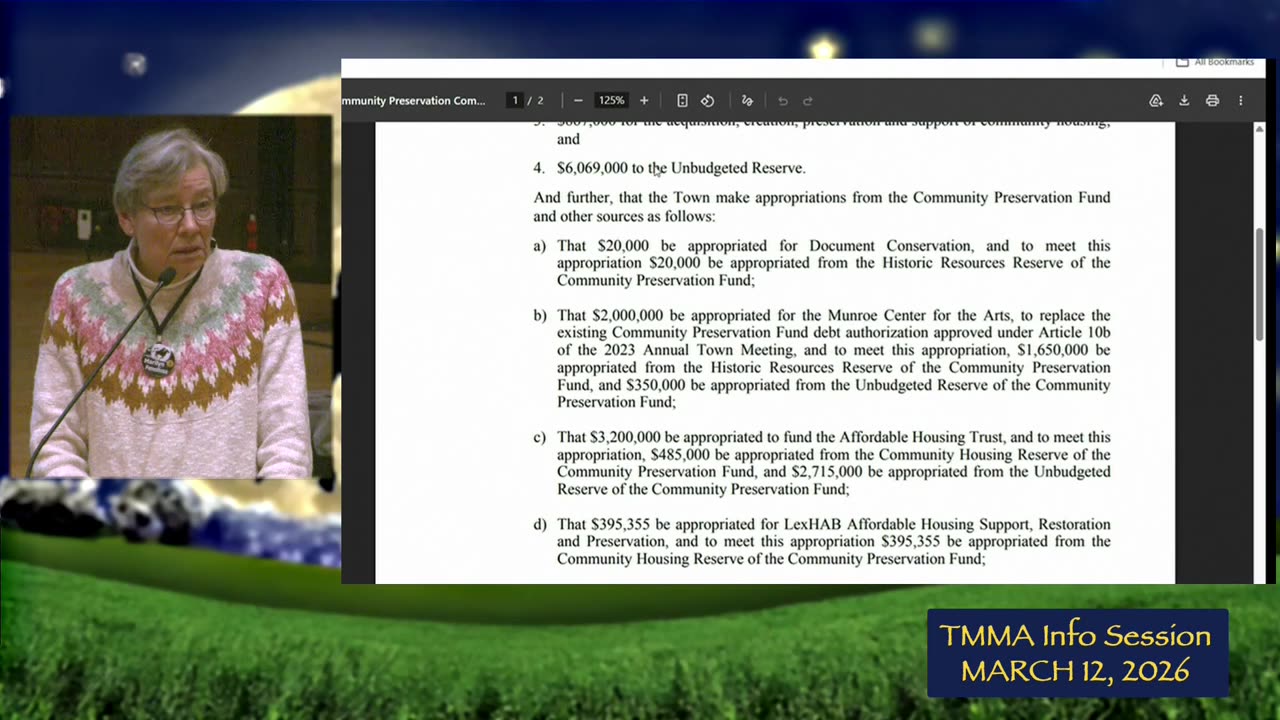
▶ 53:54 Community Preservation Act Projects (Article 10)

Questions about various CPA-funded projects including Monroe Center refinancing, Harrington field improvements, and affordable housing trust funding allocation.

Speakers: Marilyn Fenalosa, Carolyn Koznoff, Aaron
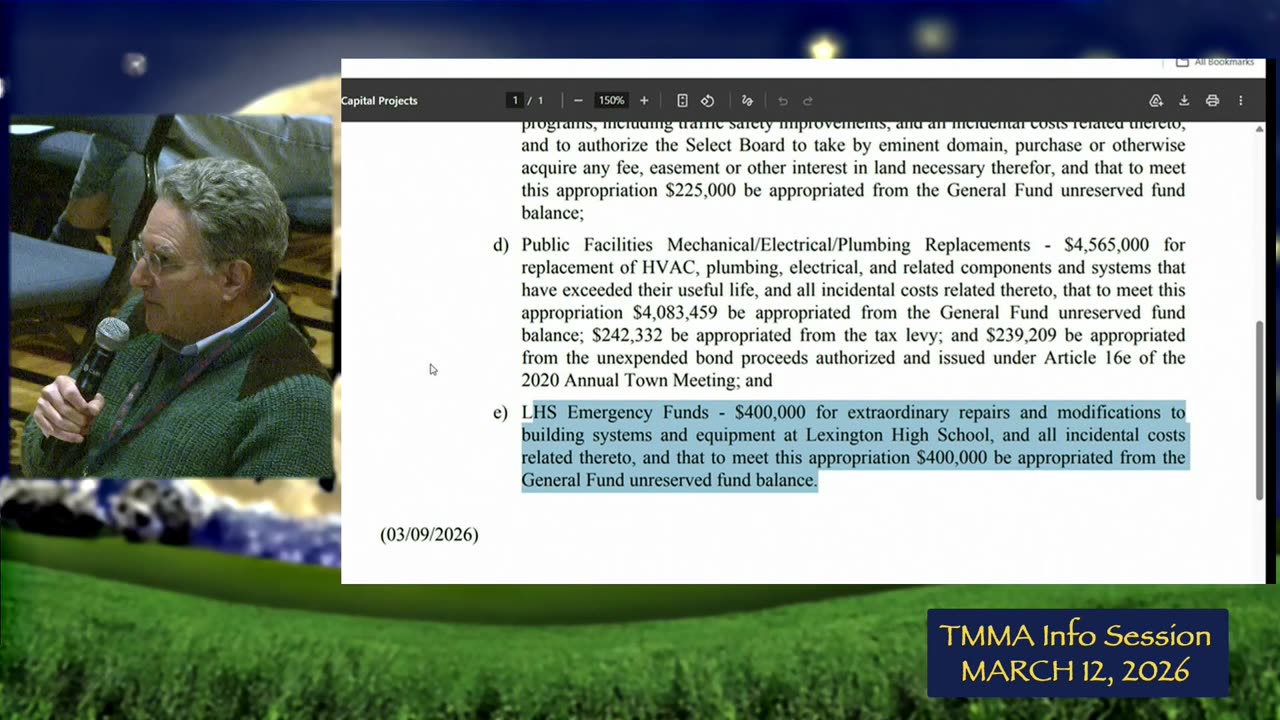
▶ 1:07:01 Article 12 Capital Projects Discussion

Discussion of multiple capital projects including bikeway connection to LHS, bicycle pedestrian plan implementation, DPW floor repairs, Burlington/North street sidewalks, and Hartwell training facility paving project. Focus on design funding rather than implementation.

Speakers: Unidentified speaker, Peter Shapiro, John Livesey, Catherine Yan
▶ 1:08:08 Bikeway Connection Design Plans

Discussion of design plans for bicycle connection from bikeway to high school, including potential blocked-off sections on Muzzy Street and various design options including shared use paths and widened sidewalks. Also covered safety considerations and accommodation options for protected bike lanes.

Speakers: Unidentified speaker, Peter Shapiro, John Livesey, Catherine Yan
▶ 1:14:02 DPW Building Floor Repairs

Questions about floor repairs needed at the DPW building built in 2009, confirmed to be normal wear and tear requiring patching, resealing, and drainage system work.

Speakers: Unidentified speaker
▶ 1:17:36 Article 24 - Elderly and Disabled Taxation Aid Fund

Discussion of proposed local taxation aid program for elderly, disabled, and low-income residents, including funding mechanisms, eligibility criteria, and comparison to existing state programs.

Speakers: Unidentified speaker
▶ 1:27:21 Article 27 - Online Capital Project Platform

Citizens petition for procurement of online platform to track capital project spending and progress, including discussion of vendor costs, implementation challenges, and administrative burden on staff.

Speakers: Unidentified speaker

Controversy & ⁠dissent

Where the board, the community, or the agenda diverged.

Potentially controversial issues

01

School Department 70 FTE Reductions in FY27 Budget

The elimination of approximately 70 full-time equivalent school positions is a high-stakes decision directly affecting educators, students, and families. The stark contrast with the town side — which has zero position cuts — raises equity questions about how budget pressures are being distributed. Parents, teachers, and education advocates are likely to scrutinize this heavily.
Board position: School administration (Julie Hackett) acknowledged the ~70 FTE reductions as fact without signaling opposition to them; town administration confirmed no parallel cuts on the municipal side.
high concern
02

Automated Waste Collection Transition and Bin Costs

Removing the word 'free' from waste collection bylaws and requiring residents to purchase or receive new bins represents a tangible cost shift to households. Questions about bin procurement costs, disposal of existing bins, and the completeness of the transition raised unresolved financial concerns. Residents may view this as a fee increase by another name.
Board position: Staff (David Pinsono) framed automation as a regional trend and operational necessity, but could not provide bin disposal cost estimates on the spot — an action item was assigned for follow-up before Town Meeting.
medium concern
03

EV Charging Infrastructure at Police Station ($463,000 — Article 7)

The $463,000 price tag generated scrutiny over cost justification. Community members and staff acknowledged the messaging was unclear — it was not immediately apparent this was exclusively for police fleet vehicles. The town was directed to improve its public communication, suggesting the framing had already caused confusion or skepticism.
Board position: Bridget McGaugh and Maggie Peard defended the expenditure as necessary infrastructure for fleet electrification, but acknowledged the messaging needed to be clarified before the Town Meeting vote.
medium concern
04

Online Capital Project Transparency Platform (Article 27 — Citizens Petition)

This citizens petition exposed a process and values conflict: petitioners argued Lexington lags peer towns on financial transparency, while senior staff pushed back on the administrative burden (citing 39 hours of staff time for a single project) and expressed frustration that the petition bypassed any prior dialogue with staff. The tension between civic accountability and operational capacity is genuine and reflects a community divide over trust in municipal government.
Board position: Staff (Mike Cronin, Steve Bartha) were openly skeptical — not of transparency as a goal, but of the petition's process and feasibility. Bartha explicitly lamented that staff first saw the proposal only after signatures were collected, framing it as a solution imposed without problem-definition dialogue.
medium concern
05

Elderly and Disabled Taxation Aid Fund — Circuit Breaker Interaction (Article 24)

Resident Vicki Blier (Precinct 9) raised a substantive policy concern: that local aid funds could inadvertently subsidize the state's existing circuit breaker tax relief program, creating an unintended fiscal leak. This question was not answered at the meeting and was deferred to a future research task, leaving a meaningful policy gap open before a vote.
Board position: Steve Bartha acknowledged it was a strong question but declined to speculate, assigning it as a research action item — leaving the concern unresolved heading into Town Meeting.
medium concern
06

Bikeway-to-High School Connection: Parking vs. Bike Safety Trade-off on Muzzy Street

The proposed bike path design along Muzzy Street directly conflicts with existing parking used by downtown merchants. This pits cyclist safety and active transportation advocates against small business owners and their customers. The concern was raised publicly and acknowledged but not resolved — the design is still in early planning stages, meaning the conflict will resurface during public hearings.
Board position: a speaker confirmed a balancing approach would be sought and that public hearings would involve relevant stakeholders including the center committee and merchants — a procedurally appropriate but substantively noncommittal answer.
medium concern

Community vs. board tension

Action ⁠items

Who owes what, by when.
Provide more detailed cost breakdown for EV charging infrastructure to address questions about $463,000 total
Assigned: Town Staff · Due: Before Town Meeting
Research and provide data on number of households still served by manual waste collectors in Eastern Massachusetts
Assigned: David Pinsono · Due: Before Town Meeting
Clarify messaging about police EV charging infrastructure to better explain it's specifically for police vehicles at police station
Assigned: Maggie Peard · Due: Before Town Meeting
Provide cost estimate for disposal of existing waste bins when transitioning to automated collection
Assigned: Town Staff · Due: Before Town Meeting
Research interaction between proposed taxation aid fund and state circuit breaker program
Assigned: Town Staff · Due: Before town meeting vote
Review TMMA Bylaws Revision presentation handout before next meeting
Assigned: TMMA Members · Due: March 19, 2026
Hold Information Session 2 covering remaining citizens petitions
Assigned: TMMA · Due: March 19, 2026 at 7:00 PM
Conduct TMMA Annual Meeting including officer elections and bylaw votes
Assigned: TMMA · Due: March 19, 2026 at 7:50 PM

Notable ⁠statements

There are no positions on the municipal side of the budget that are being cut — Carolyn · Response to question about town employee reductions ▶ 05:33
We have approximately 70 full time equivalent reductions in our FY27 budget — Julie Hackett · Response to question about school department staff cuts ▶ 06:39
All of our surrounding communities are automated except for two but they're drop off so they don't have a curbside collection — David Pinsono · Explaining trend toward automated waste collection in region ▶ 28:23
This will save the CPA fund interest cost over approximately 10 years for that project — Carolyn Koznoff · Explaining benefit of refinancing Monroe Center debt with cash ▶ 55:15
We think that transparency and municipal finance is extraordinarily important. It's part of the lifeblood of representative government, and it does appear that we have some catching up to do relative to peer towns. — Speaker L (Citizens Petitioner) · Advocating for the online capital project platform petition ▶ 1:34:56
That's 39 hours for that one project to put all the information on the dashboard. So the high school has an owner's project manager, that separate team that's going to help us put together this dashboard for the high school... all the other projects out there don't have an owner's project manager. So the person that's going to do that work to gather that report, gather all that information is this guy. — Speaker D (Mike Cronin) · Explaining administrative burden of capital project reporting ▶ 1:38:01
It would be wonderful to get to a point where ideas like this start with a conversation with staff. The first time staff saw this proposal was after the citizen signatures were collected and it was presented to us as a solution without any dialogue about what the problem was that we were trying to solve. — Speaker I (Steve Bartha) · Expressing concern about the online capital project platform petition process ▶ 1:40:58

Public ⁠comment

What residents said — verbatim, with timestamps.
6
Total speakers
3
Addressed
3
Partial
0
Not addressed
Unidentified speaker
Addressed
Asked about the trade-offs between parking and a safe bike path along Muzzy Street. Wanted to know if public hearings would involve the center committee and merchants who rely on current parking. Key concern
Balance between bike path safety and parking availability for merchants
Board response
a speaker confirmed there would be a balance sought between different uses and that public hearings would involve relevant stakeholders
The board directly acknowledged the concern and confirmed the balancing approach
Unidentified speaker
Addressed
Asked about the definition of 'low income' for the Elderly and Disabled Taxation Aid Fund program. Wanted to know how eligibility would be determined. Key concern
Criteria for determining low income eligibility in the aid program
Board response
Steve Bartha (a speaker) explained that the committee formed as part of the process would make these determinations, including income cutoffs and asset limits
The question was thoroughly answered with explanation of the process for setting eligibility criteria
Priya Tanjo, Precinct 7
Addressed
Asked about other Massachusetts towns with similar aid programs and concerns about scalability if the eligible population grows disproportionately. Also asked about state matching funds. Key concern
Sustainability and scalability of the aid program, and potential state support
Board response
Steve Bartha explained there's no state match, gave examples of other towns (Brookline, Danvers), and clarified that allocations cannot exceed available funds
All aspects of the question were addressed including examples, funding limitations, and lack of state matching
VICKI BLIER, Precinct 9
Partial
Raised concerns about interaction between the proposed local aid program and the state circuit breaker tax relief program. Worried about unintended consequences of subsidizing state programs with local funds. Key concern
Potential negative interaction with existing state tax relief programs
Board response
Steve Bartha acknowledged it was a great question but said they would need to research and get back with an answer rather than guess
The concern was acknowledged as important but not resolved - they promised to research and respond later
Sandra Hackman, Precinct 7
Partial
Suggested looking at Bedford's experience with a similar aid program, noting they had implemented it a couple years ago after considerable effort to start up. Key concern
Recommendation to study nearby town's implementation experience
Board response
The moderator simply thanked her for the suggestion
The suggestion was noted but no commitment was made to follow up on studying Bedford's experience
Peter Shapiro, Precinct 4
Partial
Asked about the audience for the proposed capital project reporting platform and whether the select board and spending committees were supportive of the initiative. Key concern
Whether key stakeholders like select board support the proposed platform
Board response
The petitioner couldn't speak to select board support but mentioned recent enthusiasm for a similar dashboard presentation for the high school project
The specific question about select board support wasn't directly answered, only tangential information was provided
Support coverage

Creating this report cost ⁠real money.

MeetingWatch attended, transcribed, and analyzed this meeting on its own dime. If this work is valuable to you, chip in to keep covering Lexington.

Report composed by claude-sonnet-4-20250514, claude-sonnet-4-6, claude-opus-4-6 · analyzed 2026-04-02.