
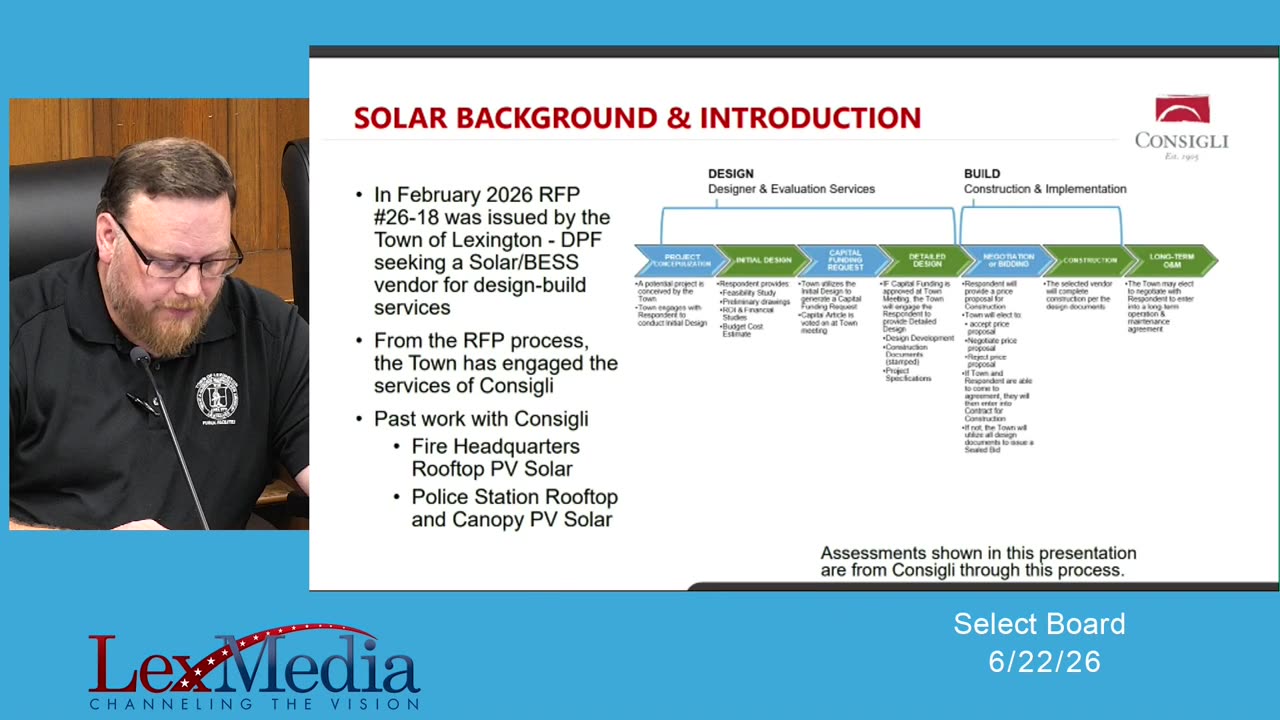
Solar Background & Introduction slide with project timelineFrame from meeting video▶ 53:02
⚡
Lively discussion: The meeting featured spirited public testimony regarding public safety pay and trash fees, alongside a tie vote on a solar project.
SummaryAI-generated to surface controversy & community impact without bias — always verify against the actual meeting before relying on it.
At the June 22 Select Board meeting, several critical issues facing Lexington residents were debated, revealing a board struggling to balance environmental goals, fiscal responsibility, and public safety.
One of the most pressing issues came from the Lexington Firefighters. Representatives testified that the department has gone two years without a pay raise and currently sits at the 35th percentile for compensation compared to neighboring towns. As high-rise residential development increases local risks, the union warned that low wages could lead to recruitment and retention crises. While the Board heard the testimony, no immediate action was taken.
There was also significant division regarding the Muzzy Street solar canopy project. The Board was split in a tie vote on whether to move forward or wait for further investigation into costs related to Historical District Commission requirements and potential shadow impacts. This lack of consensus highlights the ongoing tension between the town's green initiatives and its fiscal obligations.
Finally, residents expressed frustration over the lack of transparency and rigor in how large-scale projects are approved. One community member specifically noted that the Board seems to lack consistent financial criteria, appearing to rely on 'gut feel' rather than hard evidence for capital decisions. As the $659.7 million High School project moves toward groundbreaking, the demand for evidence-based decision-making has never been higher.
Jun 22, 20262.9h long30 speakers16 public comments5 decisionsLively
❝ Notable statements
↔ DragSwipe to browse
“The Select Board... sets the tone, the tenor, and the direction of the town manager for those negotiations... by placing their values on guidelines and policies and principles.”
— Rob Green · Discussing the role of the Board in firefighter contract negotiations. ▶ 06:45
“The change to automated pickup wasn't part of this vote. That was voted separately at town meeting.”
— Jill Hai · Clarifying community misconceptions regarding the trash referendum. ▶ 15:22
“I don't want to dismiss the no votes that... were all confused. Because it was, I think it was a simpler question.”
— Joseph Pato · Discussing the high number of 'no' votes in the trash referendum. ▶ 18:00
“If we are requiring people to double and triple the cost of things in order to comply [with HDC], that's certainly a concern for any project.”
— Unidentified speaker · Discussing the potential financial impact of historical design requirements on the solar project. ▶ 1:04:00
“It would be nice to see some kind of framework and rigor in making financial decisions for the town... It doesn't look like there is any criteria other than gut feel.”
— Unidentified speaker · Public comment regarding the board's lack of consistent financial criteria for approving capital projects. ▶ 1:48:00
“We are targeting gold [for LEED]... Platinum is a mammoth effort for us to get there... Not where the building is located and situated, not on a bus line.”
— Unidentified speaker · Explaining why the high school project is aiming for LEED Gold rather than Platinum certification. ▶ 1:57:40
“The primary purpose of that policy [integrated design] is health... the health of our students, the health of our staff.”
— Unidentified speaker · Commenting on the high school construction design and the use of non-toxic materials. ▶ 2:04:09
“I do wish we would follow the same [rules] for our own project as we would for other [projects].”
— Unidentified speaker · Regarding contractors potentially violating noise ordinances during town construction projects. ▶ 2:30:44
This meeting — choose a section
Public impact
Issues from this meeting with documented community impact.
What was discussed
Potential impact on recruitment and retention of fire department staff
What happened
No decision was made; the Board listened to the public comments.
What was discussed
Implementation of new service fees and bin size regulations
What happened
The Board will wait for staff to present survey results and program options in July.
What's next
Staff to present a summary of survey results and program options in July.
What was discussed
$659.7 million total project budget
What happened
The Board received a progress report on construction milestones and budget.
What's next
Groundbreaking is expected in early July or mid-September.
Topics discussed
Each topic expands to quotes and full context.
Speakers: Chris Lively, Oleg Feldman, Rob Green, Don McKenna, Lillian Mila, Brian Kelly, Mark Lang, Ricky Papo, Lynn Jensen, Mona Roy
What was discussed
Representatives of the Lexington Firefighters expressed significant concern regarding contract status, lack of pay raises, and competitive wages compared to neighboring towns.
What happened
The Board listened to the comments; no immediate decision was made during this segment.
Speakers: Steve Bartha
What was discussed
Town Manager Steve Bartha reported that the Department of Public Works will launch a new work order system using OpenGov in early July.
What happened
The system is expected to go live in early July.
What's next
The communications team will push out the new tool to the community.
Speakers: Jill Hai, Joseph Pato, Mark Sandeen, David Simons, Ms. Guttag, Brian Kelly, Mark Lang, Ricky Papo, Lynn Jensen, Mona Roy, Benjamin Lease
What was discussed
The Board discussed the recent referendum results regarding the town's trash services and addressed community concerns about the implementation of the new program.
What happened
The Board acknowledged the strong public sentiment and the need to design a program that balances waste reduction with community needs.
What's next
Staff will present a summary of survey results, comparable community data, and potential program options to the Board in July.
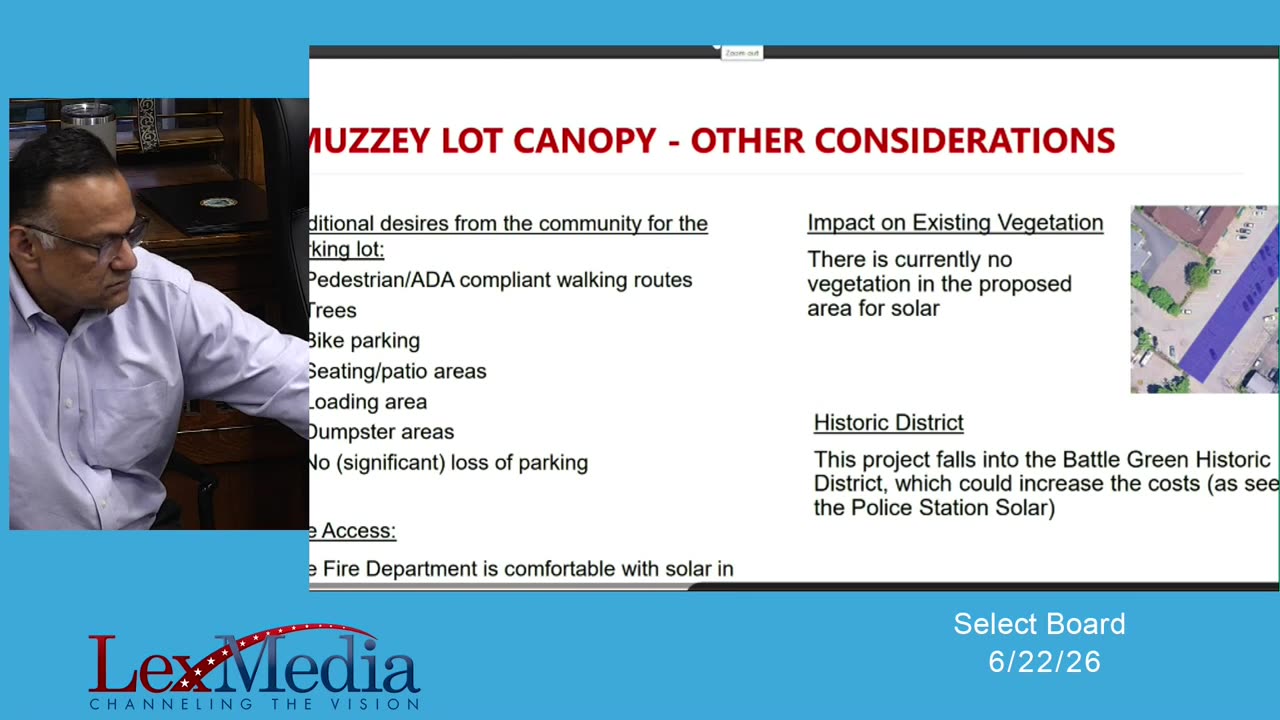
Video still
Muzzey Lot Canopy considerations slide with site map▶ 55:13
Speakers: Maggie Peard, Kailash Viswanathan, Joseph Pato
What was discussed
Staff presented a solar feasibility assessment for a solar canopy project at the Muzzy Street/Waltham Street parking lot.
What happened
The Board was asked to decide whether to continue pursuing the solar project at this site or proceed with paving without solar. The board did not approve the project but agreed to a limited investigation into specific technical and regulatory hurdles.
What's next
The Board will evaluate individual solar projects; the discussion on this specific project was paused to address it separately. Staff will investigate Eversource hosting capacity, shadow impacts from projected new buildings (e.g., 16 Clark Street), and seek preliminary feedback from the HDC regarding design standards.
Speakers: Unidentified speaker
What was discussed
Review of four solar installation options for the Pine Meadows Golf Course Clubhouse.
What happened
The board reached a consensus to move forward with Option 4 (the carport system).
What's next
The project will proceed through permitting; finance department to determine the most appropriate funding method (cash vs. bonding) and the project will eventually return to Town Meeting if bonding is required.
Speakers: Unidentified speaker
What was discussed
Update on the integrated building design, schedule, and LEED certification status for the high school project.
What happened
The board received a progress report on milestones and budget movement.
What's next
Groundbreaking is expected in early July; construction documents are expected to be finalized by next summer. A groundbreaking is expected around July 6th or September 15th; final construction documents and the main GMP are expected by next summer.
Speakers: Unidentified speaker
What was discussed
Discussion regarding the timeline for opening the new skate park and decommissioning the old one, as well as relocating the garden and throwing cage.
What happened
The timeline was clarified for members.
Speakers: Unidentified speaker
What was discussed
Concerns regarding noise levels from geothermal drilling and pile driving, and how the town will inform residents.
What happened
The board agreed to use the town website and dashboard to provide weekly updates on noisy activities.
What's next
Updates to be posted on the town website/dashboard regarding upcoming noisy construction phases.
Speakers: Unidentified speaker
What was discussed
A request from a resident for localized drainage mitigation on an unaccepted road to prevent flooding and ice hazards.
What happened
The board unanimously approved a singular, localized mitigation improvement (catch basin or dry wells) with the caveat that it is a best-effort attempt and does not establish ongoing maintenance obligations for unaccepted roads.
Speakers: Unidentified speaker
What was discussed
Continued hearing regarding Eversource Energy's requests to install conduits and manholes for service upgrades.
What happened
The board approved the grants of location, contingent upon the completion of wire transfers per the June 12, 2026, letter and coordination regarding the removal of double poles and hanging wires.
Speakers: Unidentified speaker
What was discussed
Discussion on reassigning Select Board liaison roles and the distinction between 'liaisons' and 'points of contact'.
What happened
The discussion was tabled to avoid a late-night decision.
What's next
The new Board Chair will speak with members and resolve assignments in early July.
Controversy & dissent
Where the board, the community, or the agenda diverged.
•
Board unity: While the board was closely divided on the Muzzy Street solar project, they reached consensus on other major items including the Pine Meadows solar project and the Hayes Lane drainage request.
Potentially controversial issues
01
Fire Department Compensation
Fire union representatives argued that wages are at the 35th percentile of neighboring towns and have not seen raises in two years, despite rising risks from high-rise development. This affects recruitment, retention, and public safety.
Board position: The Board listened to the testimony but took no immediate action, deferring to the Town Manager's role in negotiations.
high concern
02
Article 31 Trash Program Implementation
Following a referendum, residents expressed significant anxiety regarding new fees, bin sizes, and transparency. There is a clash between those prioritizing waste reduction/state funding and those concerned about financial hardship and confusing communication.
Board position: The Board signaled a need for flexibility and better communication to address community misconceptions and potential hardships.
high concern
03
Muzzy Street Solar Canopy Project
The project faces a conflict between environmental goals and fiscal/regulatory hurdles. Concerns were raised about high costs due to Historical District Commission requirements and the potential for a long payback period.
Board position: The Board paused the project to investigate technical, financial, and regulatory hurdles rather than approving it.
Internal dissent
The board was split on whether to proceed with the project or request more data, resulting in a tie vote on the immediate path forward.
medium concern
Split votes
Decision to proceed with the Muzzy Street solar project
Tie
Community vs. board tension
⚖
Firefighter Wages Community wants: Competitive pay (75th percentile) and a new contract to ensure staffing stability. Board response: The Board acknowledged the comments through the Chair but offered no immediate commitment or discussion on specific contract terms.
⚖
Trash Program Transparency Community wants: Clearer communication, avoidance of unexpected fees, and inclusive design for fixed-income or disabled residents. Board response: The Board engaged in discussion, promised a summary of survey results, and noted that disability commissions would be involved in design.
⚖
Financial Criteria for Capital Projects Community wants: A resident argued that the Board lacks consistent, rigorous financial criteria and relies on 'gut feel' for project approvals. Board response: The Board addressed this through the debate on the solar project's cost-benefit analysis.
Ready to share? AI-written accountability posts about this meeting's controversies.
As Vice President of Lexington Firefighters, he noted that the department has been without a contract for a year and a pay raise for two years. He highlighted that increasing construction density in Lexington creates higher risks for firefighters that are not being matched by competitive wages.
Key concern
Fair compensation and a new contract for firefighters to aid recruitment and retention.
The Chair simply thanked the speaker. No board members engaged in a discussion or response during the public comment section.
A 24-year fire department lieutenant and paramedic, he noted that while the department provides high-level care, compensation has dropped to the 35th percentile compared to neighbors. He expressed concern about the ability of future recruits to live near the community.
Key concern
The misalignment between the high level of care provided and the current compensation levels.
The Chair thanked the speaker without further comment.
The President of Lexington Fire Affairs stated that the town's current compensation does not meet the established 75th percentile benchmark for comparable communities. He called for action rather than sympathy to address the lack of a contract and pay raises.
Key concern
The board's failure to uphold its own benchmark of 75th percentile pay for public safety workers.
The Chair thanked the speaker without further comment.
A former Select Board candidate, he expressed sadness over contentious staffing issues in the schools and fire department. He noted that solutions were found in the past during tougher financial times and offered his advice.
Key concern
Finding solutions to staffing/compensation issues despite financial constraints.
The Chair thanked the speaker without further comment.
A resident and former EMT, she shared a personal story regarding the fire department's life-saving work. She argued that the current compensation does not reflect the dangers and risks faced by emergency responders.
Key concern
Inadequate compensation for the life-threatening risks faced by firefighters.
The Chair thanked the speaker without further comment.
A Town Meeting member who worked on the 'Yes' campaign, he addressed public confusion regarding the trash referendum. He noted many residents mistakenly believed the town would charge for all trash rather than providing a 35-gallon baseline.
Key concern
Addressing misconceptions and designing a fair trash program to move past the referendum.
Board response
The board discussed the trash issue extensively later in the meeting, clarifying the 35-gallon baseline and addressing confusion.
The board engaged in a lengthy discussion specifically about the trash referendum, misconceptions, and the design of the program.
A resident who worked on the campaign, she urged the board to use 'carrots' (incentives) rather than 'sticks' (fees). She also criticized the town's communication, noting that the website is difficult to navigate and instructions are unclear.
Key concern
Improvement of communication and focusing on waste reduction incentives rather than penalties.
Board response
The board discussed the need for better communication and the use of 'carrots' (like composting incentives) versus 'sticks'.
The board discussed communication strategies and the potential for composting incentives (carrots) to drive behavior.
The former chair of the 'No Trash Fees' campaign, he expressed hope for a collaborative approach involving both sides of the referendum. He advocated for flexible bin sizes, clear instructions, and accommodations for disabled or fixed-income residents.
Key concern
Ensuring the next trash contract is flexible, inclusive, and focused on service quality rather than just cost.
Board response
The board discussed flexibility, the need for accommodations, and the importance of inclusive design.
The board discussed the need for flexibility in bin sizes and the importance of considering all community needs.
A Lexington resident, he stated that the Select Board has lost the trust of many residents due to a lack of transparency. He argued that the referendum results showed a deep dissatisfaction with the board's communication and representation.
Key concern
Loss of public trust and lack of transparency in board decision-making.
Board response
The board members discussed the perception of trust and the need for transparency and engagement.
The board members directly addressed the issue of trust and transparency during their discussion on the trash topic.
A Town Meeting member and chair of LexCan, he noted that many residents did not understand the referendum. He offered the assistance of local nonprofits to help educate the community on composting and waste reduction.
Key concern
The need for better education on waste reduction and composting to support the town's goals.
Board response
The board discussed the role of staff and the upcoming engagement process for the new trash program.
The board discussed the upcoming engagement/education process to help the community transition.
A Town Meeting member, she cautioned against implying motives to the public and emphasized the significant 'No' vote in the referendum. She urged the board to include voices from both sides of the campaign in future trash plan discussions.
Key concern
Respecting the referendum results and involving both sides of the debate in the solution.
Board response
The board discussed the importance of listening to the community and being inclusive of different viewpoints.
The board engaged in a discussion regarding the referendum results and the need to be inclusive and flexible.
A Town Meeting member, he noted that most people he spoke to weren't against fees in principle, but wanted more details on bin sizes and costs. He warned against making too many compromises that might undermine the program's original goals.
Key concern
Balancing the need for program effectiveness with the need for detail and transparency.
Board response
The board discussed the balance between compromises and meeting the original goals of waste reduction.
The board discussed the tension between making compromises to appease the public and achieving the program's objectives.
Representing Sustainable Lexington, she urged the board to adopt a 35-gallon bin size to secure state funding and maximize waste reduction. She argued that larger bins would fail to change consumer behavior.
Key concern
Selecting the 35-gallon bin size to ensure waste reduction and secure state funding.
Board response
The board discussed the different bin size options and the potential for state funding.
The board discussed the pros and cons of different bin sizes and the financial implications.
A resident, she inquired about the process for persons with disabilities or group homes to receive exceptions in the new trash program. She expressed concern regarding how specific needs would be addressed.
Key concern
Clarification on exceptions and accommodations for people with disabilities and group homes.
Board response
The Chair clarified that the Commission on Disability and Commission on Aging would be involved in the process.
The Chair explicitly addressed her by stating which commissions would be consulted for such needs.
A resident, he argued against the Muzzy lot solar project, claiming it offers marginal returns. He warned against overpaying for projects due to historical constraints, citing the expensive police station solar project as an example.
Key concern
The low return on investment for the Muzzy lot solar project due to potential high costs.
Board response
The board discussed the cost-benefit analysis and the potential for high costs from the HDC.
The board discussed the 'juice vs. squeeze' aspect and the potential for the project to become too expensive.
A Town Meeting member, he strongly advocated for the solar project as an essential action against climate change. He argued that the town should not pass up opportunities for clean energy, even if the payback period seems long.
Key concern
Prioritizing climate action and solar adoption despite payback periods.
Board response
The board members discussed the environmental benefits vs. the economic constraints.
The board engaged in a debate regarding the merits of solar implementation versus financial practicality.
Speaking on behalf of Sustainable Lexington, she emphasized the importance of solar for heat reduction and reducing the 'heat island effect' in the town center. She also noted that even small investments can have a large impact.
Key concern
The environmental benefits of solar, such as heat reduction and mission alignment.
Board response
The board discussed the project's complexity and potential for impact.
The board discussed the multifaceted benefits and drawbacks of the solar project.
Decisions logged
Every recorded vote, with timestamps and dissents.
Approval of the Consent Agenda, including Select Board meeting minutes, committee appointments, and a committee resignation.
The agenda included minutes from April 27, April 27 Financial Summit, and May 4, May 11, and May 22 meetings; appointments to the Communication Advisory, Design Advisory, Housing Partnership, and Town Celebrations committees; and the resignation of Mamata Banerjee from the Human Rights Committee.
Approve a drainage mitigation improvement on Hayes Lane (unaccepted roadway) involving the installation of a catch basin or dry wells as recommended by DPW to reduce runoff for 16 Hayes Lane, without establishing future maintenance obligations.
The motion specified that this is a singular improvement and the town will maintain its current practice of limiting maintenance on unaccepted roads to public safety needs.
Approve grant of location to Eversource Energy for conduit and manhole installation at Mass Ave, Miriam Street, Depot Place, and Hartwell Ave.
Approvals were contingent upon completion of wire transfers per the June 12, 2026, letter and coordination with owners of double poles within 500 feet regarding removal and hanging wires.
Unanimous
Share this report
Drafts ready to post — click any block to copy.
●
Accountability posts. AI-drafted to highlight decisions made outside the public agenda, split votes, and community concerns that went unaddressed. Always verify facts before sharing.
⚠
Lexington Select Board split on solar project while firefighters warn of recruitment crisis due to stagnant wages.
X / Twitter — by angle
Community concerns raised but dismissed or ignored
At the 6/22 Select Board meeting, firefighters warned that wages are at the 35th percentile of neighboring towns. Despite no raises in two years and rising risks from high-rise growth, the Board took no action on this public safety... https://meetingwatch.org/ma/lexington/select-board/2026-06-22/ #MeetingWatch
311/280 chars
Split votes and internal divisions
The Select Board was split 50/50 on the Muzzy Street solar project on 6/22. Instead of a clear decision, they paused to investigate costs and historical district hurdles. Is the town prioritizing environmental goals or fiscal caution?... https://meetingwatch.org/ma/lexington/select-board/2026-06-22/ #MeetingWatch
314/280 chars
Decisions prioritizing ideology/feelings over evidence/rigor
During the 6/22 meeting, a resident challenged the Select Board's lack of rigorous financial criteria for capital projects, suggesting decisions are based on 'gut feel' rather than evidence. #LexingtonMA #FiscalResponsibility https://meetingwatch.org/ma/lexington/select-board/2026-06-22/ #MeetingWatch
302/280 chars
X thread
1
What is the real cost of Lexington's latest projects? The June 22 Select Board meeting revealed deep divisions over solar energy and growing concerns about public safety staffing. 🧵 #MeetingWatch #LexingtonMA
208/280
2
First, the Muzzy Street solar project hit a standstill. The Board was split in a tie vote over whether to proceed or wait for more data regarding costs and Historical District requirements. The 'juice' vs. 'squeeze' debate continues.
233/280
3
Second, the Fire Department is sounding the alarm. Union reps testified that compensation lags behind neighbors, with no raises in two years. The Board listened, but no immediate steps were taken to address these recruitment and safety risks.
242/280
4
Finally, residents are demanding more than 'gut feel.' During the meeting, a citizen called for more rigor and consistent financial criteria for town capital projects. As big-budget projects like the High School move forward, accountability is vital. https://meetingwatch.org/ma/lexington/select-board/2026-06-22/
274/280
Facebook — long form
At the June 22 Select Board meeting, several critical issues facing Lexington residents were debated, revealing a board struggling to balance environmental goals, fiscal responsibility, and public safety.
One of the most pressing issues came from the Lexington Firefighters. Representatives testified that the department has gone two years without a pay raise and currently sits at the 35th percentile for compensation compared to neighboring towns. As high-rise residential development increases local risks, the union warned that low wages could lead to recruitment and retention crises. While the Board heard the testimony, no immediate action was taken.
There was also significant division regarding the Muzzy Street solar canopy project. The Board was split in a tie vote on whether to move forward or wait for further investigation into costs related to Historical District Commission requirements and potential shadow impacts. This lack of consensus highlights the ongoing tension between the town's green initiatives and its fiscal obligations.
Finally, residents expressed frustration over the lack of transparency and rigor in how large-scale projects are approved. One community member specifically noted that the Board seems to lack consistent financial criteria, appearing to rely on 'gut feel' rather than hard evidence for capital decisions. As the $659.7 million High School project moves toward groundbreaking, the demand for evidence-based decision-making has never been higher. https://meetingwatch.org/ma/lexington/select-board/2026-06-22/ #MeetingWatch #LexingtonMA
Action items
Who owes what, by when.
Prepare a memo for the July meeting including survey results, comparable community summaries, and potential program options for the trash program.
Assigned: Town Staff · Due: July 2026
Investigate Eversource hosting capacity, shadow impact from new buildings, and obtain preliminary HDC feedback regarding Muzzy Street solar.
Assigned: Town Staff · Due: September 2026
Determine the optimal financing method (cash vs. bonding) for the Pine Meadows solar project.
Assigned: Finance Department
Provide weekly updates on the website/dashboard regarding upcoming noisy construction activities (e.g., pile driving, drilling).
Assigned: Project Representative/Construction Team · Due: Ongoing, starting approximately August
Discuss liaison role reassignments with individual board members and resolve by early July.
Assigned: Joseph Pato (Board Chair) · Due: Early July 2026
Provide contact information to resident Dawn McKenna to discuss the double pole near 17 Miriam Street.
Assigned: Eversource (via Kim)
Member positions
6 issues · 0 explicit · 24 inferred · 1 unclear
⚠A split vote in this meeting was recorded without naming the dissenter (e.g. a voice vote). Members whose individual vote could not be confirmed are marked UNCLEAR below — this is not the same as a “yes.” Named votes will be filled in if official minutes record them.
Solar Project Evaluation: Muzzy Street/Waltham Street Parking LotUNCLEAR
Pine Meadows Golf Course Solar OptionsYES~
Hayes Lane Drainage Mitigation RequestYES~
Eversource Grant of Location PetitionsYES~
Positions marked ~ are inferred from context and may not reflect the member's explicitly stated position. UNCLEAR means the vote was split but the record did not name how this member voted — it is not a “yes.”
Support coverage
Creating this report cost real money.
MeetingWatch attended, transcribed, and analyzed this meeting on its own dime. If this work is valuable to you, chip in to keep covering Lexington.
Follow Lexington
One email when a new report is published from the Select Board — or one weekly digest.
Report composed by grok-4.20-0309-reasoning, grok-4-fast, grok-4.3, gemma-4-26b · analyzed 2026-06-24.
Show me what's happening near me.
MeetingWatch covers communities across the country. Tell us where you are and we'll surface the meetings, votes, and decisions in your town.
Request coverage
We'll let you know when MeetingWatch starts covering your area.
Please add your name and a valid email.
Check your inbox — click the link in our email to finish your request.
Or browse covered communities:
Send feedback
Spotted an error, or have a tip? Let us know — we read every note.
Know where the video for this meeting lives? Paste the link below and we'll add it.
We'll email you a link to confirm — this keeps out spam. We won't share your address.
Please add a valid email and a message.
Check your inbox — click the link in our email to confirm your feedback.
Search MeetingWatch
MeetingWatchStay informed — without the slant.
Hours of public meetings. Zero time to watch them.
MeetingWatch uses AI to attend every public meeting in covered communities —
transcribing debates, logging votes, and surfacing what actually mattered.
No slant. No bias. Just what was said on the record, so you can stay
informed about your town without burning your evenings.
Get started in three steps
1
Tell us where you live.
We'll surface the meetings, votes, and decisions in your town first.
One weekly email. Decisions, dissents, and the off-agenda items from every covered community. Unsubscribe in one click.
✓ Subscribed — check your inbox to confirm
3
Support the work.
MeetingWatch is a civic accountability project. Reader contributions cover transcription, hosting, and the cost of attending every meeting — and help grow coverage to more towns.