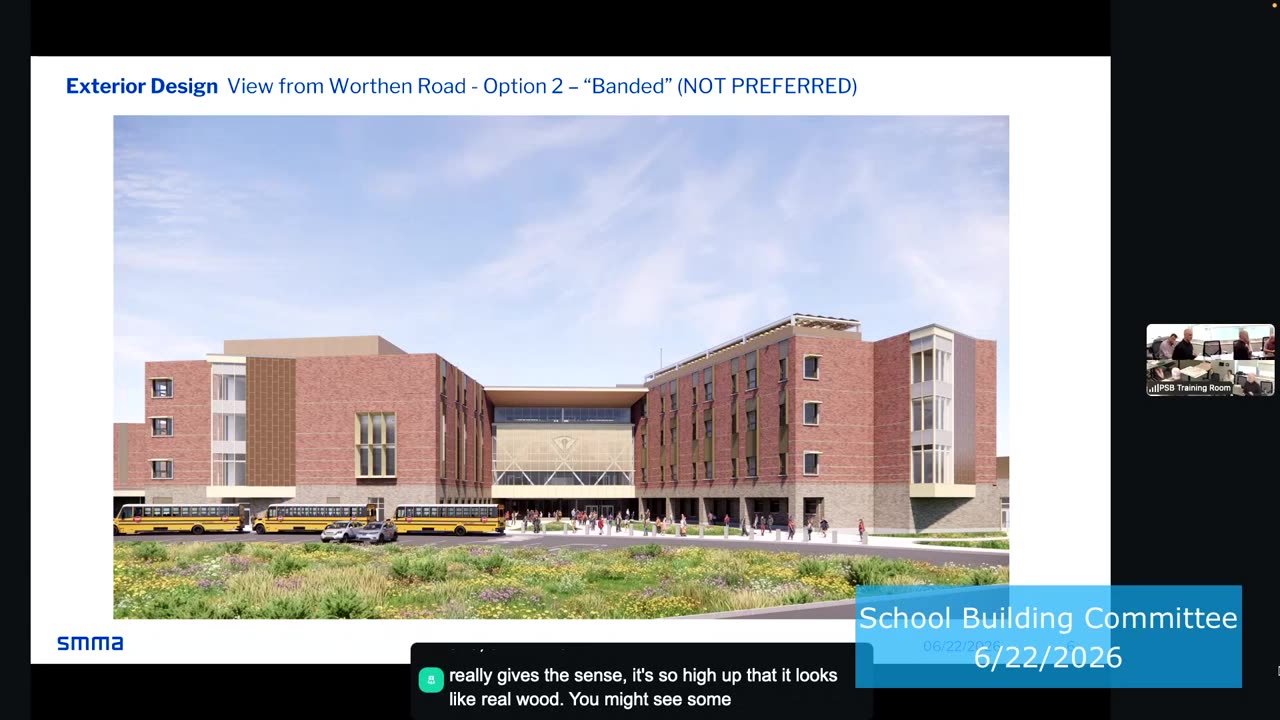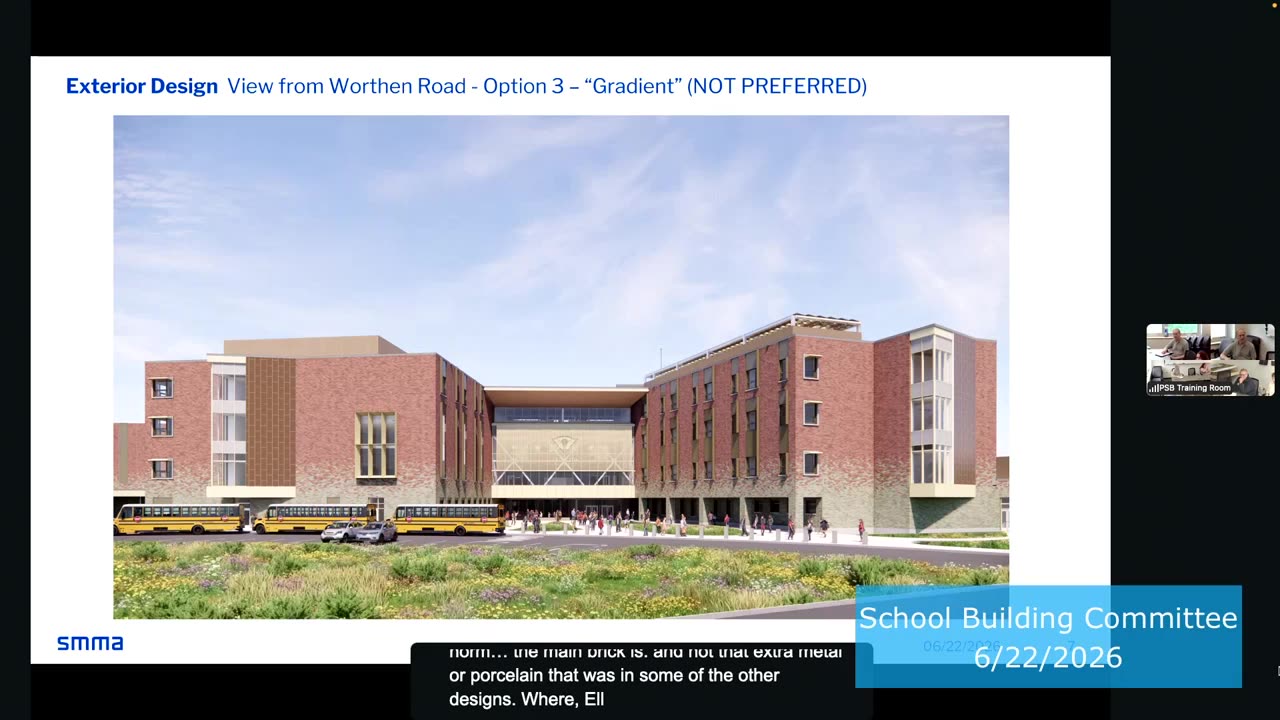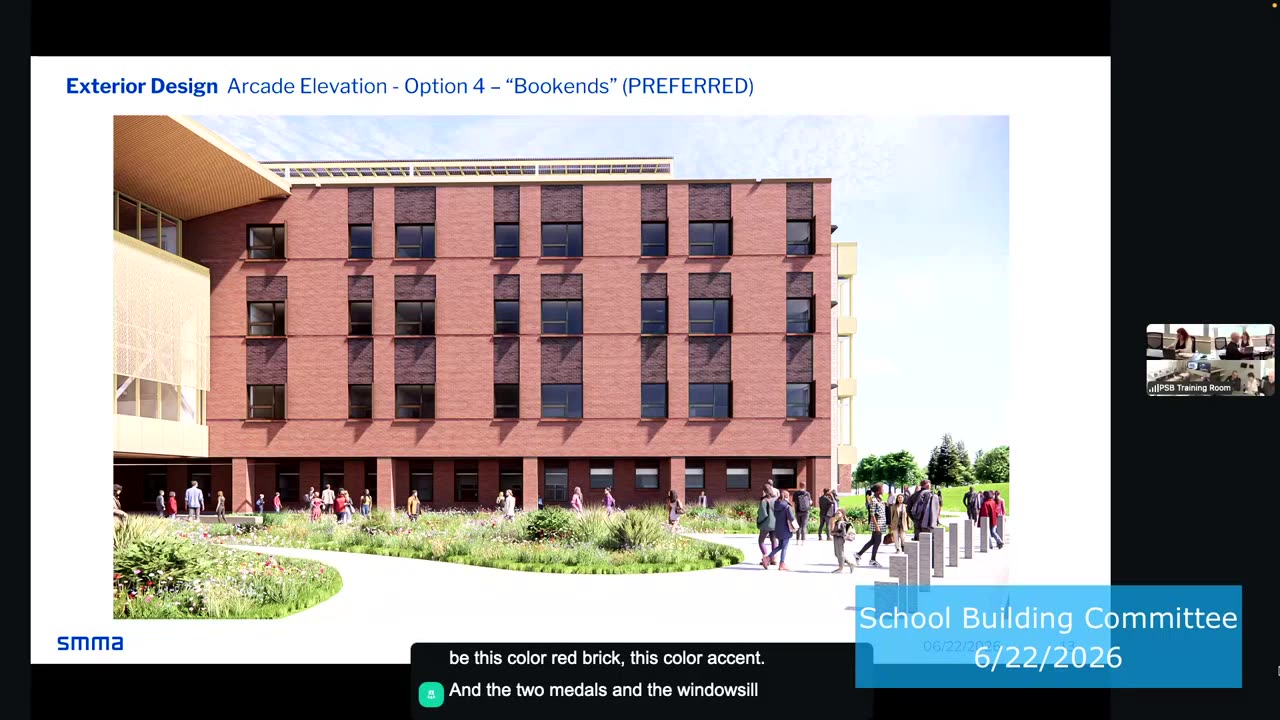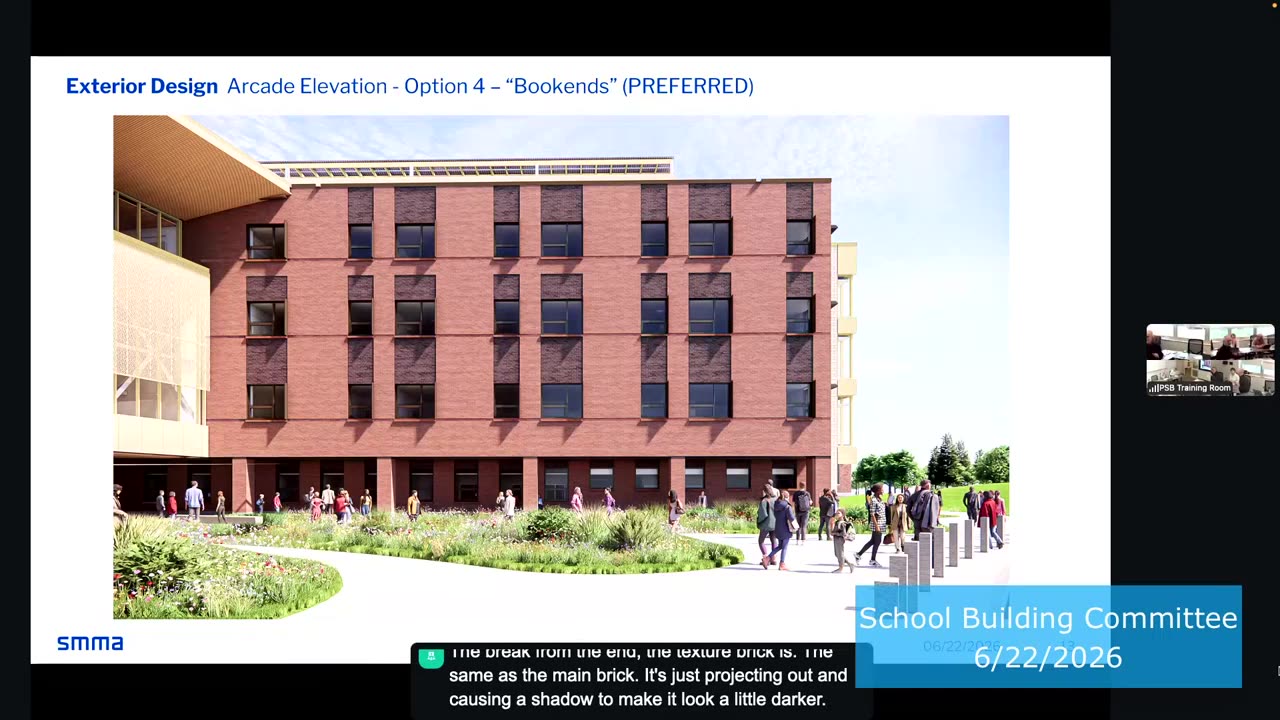
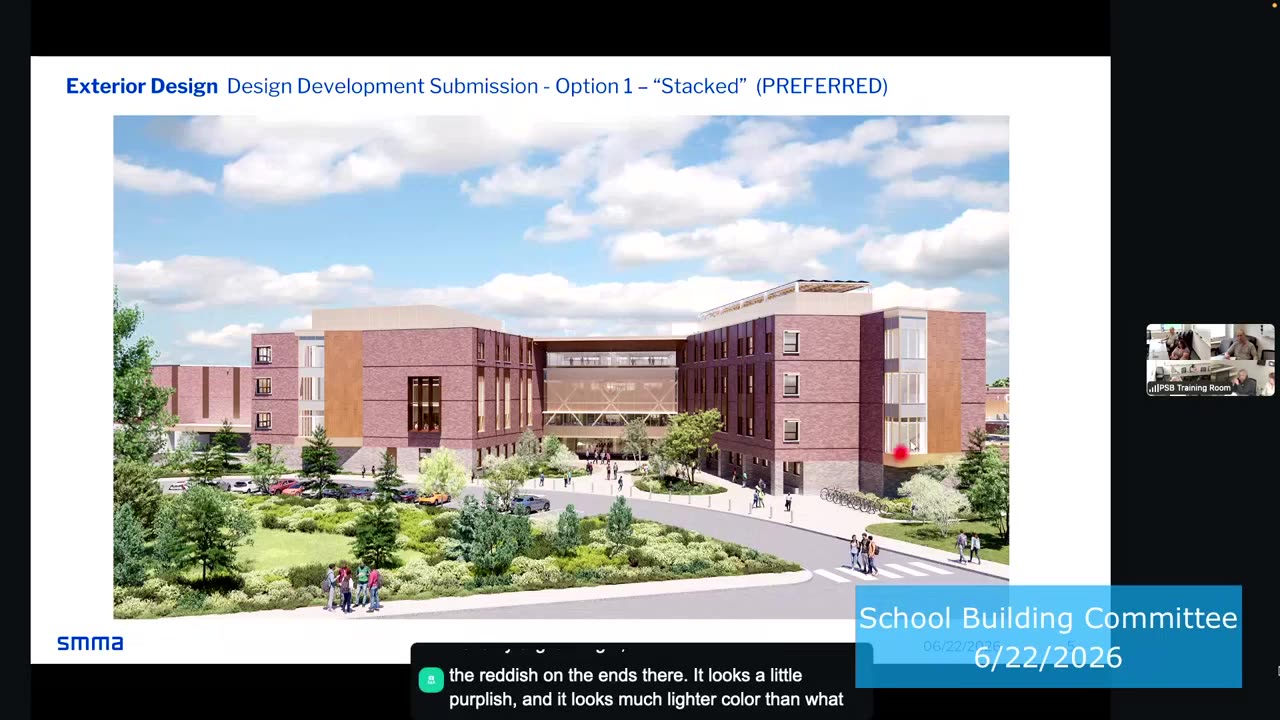
Preferred Stacked exterior design renderingFrame from meeting video▶ 12:04
⚡
Lively discussion: The meeting featured lively discussions and significant public participation regarding the visual character of the new school building.
Public impact
Issues from this meeting with documented community impact.
01
Lexington High School Rebuild Design Phase Completion
Transition from design development to the construction phase, moving toward a Guaranteed Maximum Price (GMP) in 2027. Affected: All Lexington residents and taxpayers
See more
What was discussed
The committee reviewed the successful completion of the design phase and the upcoming transition to the construction phase, including the issuance of the Notice to Proceed.
What happened
The committee acknowledged the project milestones and prepared for the construction launch.
What's next
The project moves toward a GMP in late 2027, with a target school opening in September 2029.
other high impact
Decisions logged
Every recorded vote, with timestamps and dissents.
Selection of design direction for building exterior.
The committee decided to proceed with Option 4, modified with potential color/material tweaks (e.g., different base colors or porcelain tile at stairwells).
Consensus (No formal roll call vote taken as the committee agreed to refine the chosen option).
The committee evaluated five different exterior design options for the building, focusing on brick colors, window patterning (fenestration), and the use of a light-colored base. Members debated between different options for brick texture (referred to as 'quilting'), color tones, and the use of light-colored bases.
Speakers: Brian, Kathleen Lenihan, Dan, Hsing Ming Sha, Carolyn Kosnoff, Joseph Pato, Ksenia Slavsky, Jonathan Himmel, Chuck Vavasos, Andrew, Mark Barrett, Steve Bartha, Mike Cronin, Unidentified speaker
See more
What was discussed
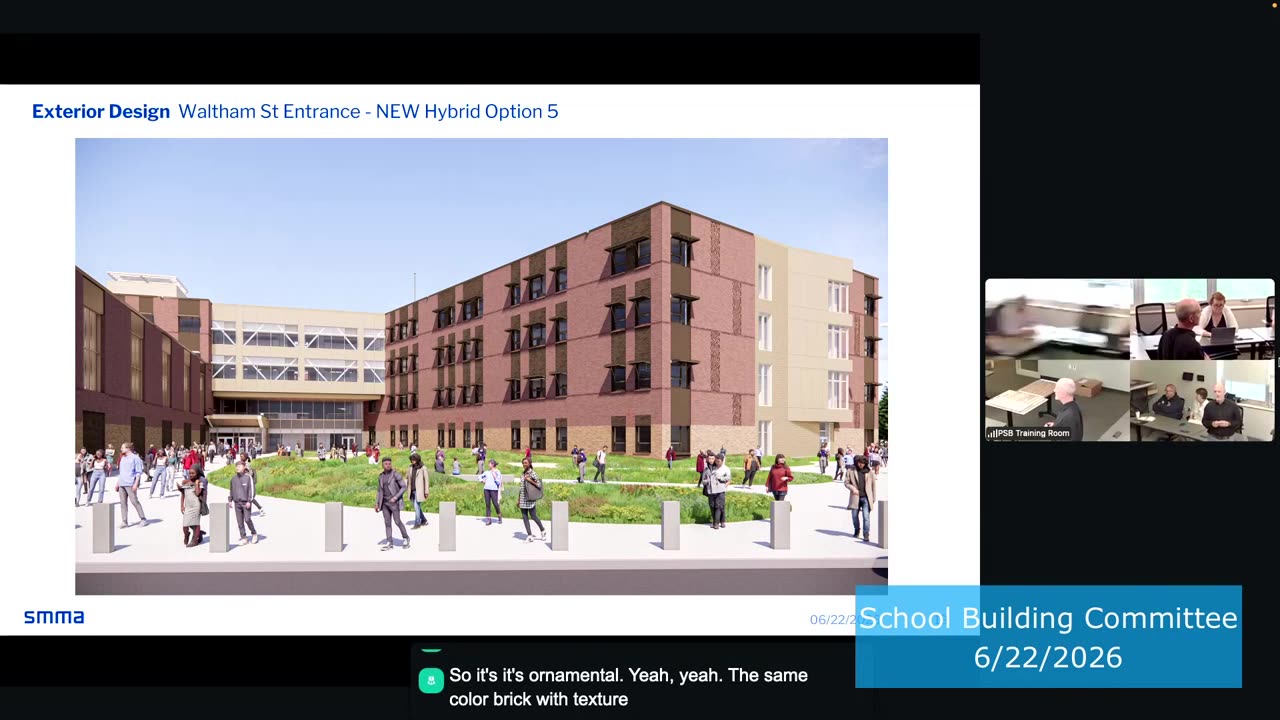
Architect Brian presented five options. Options 2 and 3 (banded and gradient patterns) were presented as non-preferred explorations. Option 1 featured a stacked design with a light base and porcelain accents. Option 4 focused on improved fenestration but lacked the light base. Option 5 was a hybrid attempting to combine the light base of Option 1 with the window patterns of Option 4. Members debated the 'busyness' of the textures, the warmth of the brick, the psychological impact of a light base, and the visual 'truncation' caused by the base on certain elevations. Members debated between different options for brick texture (referred to as 'quilting'), color tones, and the use of light-colored bases. Some members preferred the continuity of Option 4, while others suggested incorporating elements of Option 5 (specifically the Worthen Road view) to create a more inviting entryway. Concerns were raised regarding 'monumentality' and whether certain designs broke up the building's massing effectively.
What happened
The committee reached a consensus to eliminate Options 2 and 3. While opinions were split between Option 4 (no light base) and Option 5 (hybrid with light base), a majority of members expressed a preference for Option 4, though some suggested incorporating elements of Option 5 or Option 1 (such as the porcelain stairwell cladding) into the final design. The committee reached a consensus to move forward with Option 4 as the primary direction, but with specific modifications to the color and material schemes.
What's next
Refine the selected scheme and potentially explore fine-tuning colors and specific material applications (like the textured brick and metal panels) in future sessions. The design team (SMMA) will return with variations of Option 4, including studies on different color ranges, potential porcelain tile at stairwells instead of metal, and different treatments for the base or roadside.
A member provided a comprehensive overview of the project's history, from the initial design phases to the upcoming construction phase.
Speakers: Unidentified speaker
See more
What was discussed
Jonathan Himmel reviewed the 'alphabet soup' of agencies and successful milestones achieved, such as MSBA approvals and the selection of the OPM and AE. He highlighted the transition from design development to the construction phase.
What happened
The committee acknowledged the successful completion of the design phase and prepared for the issuance of the Notice to Proceed (NTP).
What's next
Construction is expected to move toward a GMP in late 2027, with a target opening of September 2029.
The committee discussed how to best handle public inquiries and differentiate between general public comment and technical Q&A sessions.
Speakers: Unidentified speaker
See more
What was discussed
There was a discussion regarding how to guide the public to appropriate channels for technical questions versus general comments, noting that many decisions are already finalized. The committee emphasized using the website, community forums, and abutter meetings for engagement.
What happened
The Chair agreed to review how communication opportunities are presented on the website.
Controversy & dissent
Where the board, the community, or the agenda diverged.
•
Board unity: The board showed spirited debate over specific design aesthetics but ultimately reached a consensus on the primary direction for the building exterior.
Potentially controversial issues
01
Exterior Design and Material Selection
The aesthetic direction of the school—specifically the use of brick textures, color palettes, and the presence of a light-colored base—is a matter of significant public and board interest as it dictates the building's visual impact on the community.
Board position: The board reached a consensus to proceed with 'Option 4' (which lacks a light base) but with modifications to incorporate elements from other options.
Internal dissent
While a consensus was reached, members were split between Option 4 and Option 5. Some members expressed concerns that Option 4 might not sufficiently address the 'monumentality' of the building's massing.
high concern
Community vs. board tension
⚖
Visual Complexity and 'Busyness' Community wants: Several residents expressed that the proposed designs were becoming too 'busy' or 'overwhelming' due to the combination of different textures, colors, and cladding materials (like metal or porcelain). Board response: The board acknowledged the feedback and decided to use the next phase to refine the color ranges and material applications to address these concerns.
⚖
Material Visualization Community wants: Community members noted difficulty in visualizing actual materials and textures based on the digital renderings provided. Board response: The architect explained the limitations of renderings and the board agreed to provide more specific material samples and variations in future sessions.
Ready to share? AI-written accountability posts about this meeting's controversies.
Provide more variation of red brick options and add missing brick panel samples to the presentation materials.
Assigned: Brian (Architectural Team) · Due: Next meeting
Confirm if maintaining porcelain tile accents instead of metal panels remains within the project budget considering recent trade-offs.
Assigned: Brian / Turner (Construction)
Provide variations of Option 4 including a range of colors for mixing/matching, studies on end wall proportions, and a cost comparison for porcelain tile vs. metal at stairwells.
Assigned: SMMA (Design Team) · Due: Next meeting
Review how community engagement opportunities and Q&A processes are communicated on the project website.
Assigned: Hsing Ming Sha (Chair)
Notable statements
I think [Option 5] does a great job of combining different approaches... it needs also to inspire to create joy and make people proud.
— Hsing Ming Sha · Providing a high-level philosophical evaluation of the hybrid design option. ▶ 48:00
Video still
Preferred Stacked arcade elevation rendering▶ 26:16
Tiger brick.
— Joseph Pato · A colloquial term used to describe the variable/random coloring of the water-struck brick samples. ▶ 28:58
Video still
Gradient exterior design Option 3 rendering▶ 21:25
I prefer the brick instead of that [metal/porcelain]... I think this is just too much. Too much other colors, it gets... an overwhelming addition.
— Dan · Commenting on the visual complexity of adding multiple accent materials to the stairwells. ▶ 20:59
I am a little bit perplexed about that because so much of the discussion when we were in the design development was around... wanting to break that [verticality] up... and I just, I don't see how option four... avoids that monumentality.
— Speaker S30 (Andrew) · Expressing concern that Option 4 might not sufficiently address the visual massing of the school. ▶ 1:17:00
It's finally time for construction... we are just at the launchpad, about to issue the crucial NTP notice to proceed.
— Speaker Y (Jonathan Himmel) · Reflecting on the project's progression from design to construction. ▶ 1:36:00
Member positions
4 issues · 2 explicit · 12 inferred · 4 unclear
⚠A split vote in this meeting was recorded without naming the dissenter (e.g. a voice vote). Members whose individual vote could not be confirmed are marked UNCLEAR below — this is not the same as a “yes.” Named votes will be filled in if official minutes record them.
Exterior Design Review: Material and Color OptionsUNCLEAR
Favored Option 5 for its ability to combine approaches and inspire joy.
Adjournment of the meetingYES~
Positions marked ~ are inferred from context and may not reflect the member's explicitly stated position. UNCLEAR means the vote was split but the record did not name how this member voted — it is not a “yes.”
The speaker expressed a preference for having more regular red brick near the stairwells rather than the additional metal or porcelain cladding seen in other designs. They felt the extra colors made the design feel overwhelming rather than an accent.
Key concern
Preference for more brick and less decorative cladding (metal/porcelain) around stairwells to avoid an overwhelming look.
Board response
The board (specifically the architect Brian) explained why the different materials were used to differentiate volumes, and they noted the preference for the discussion.
The architect provided a design rationale and the board acknowledged the preference in the context of the ongoing selection process.
The speaker asked about the difference in sheen between the porcelain tile and the wood-look metal panel. They also inquired about the speckling/texture of the red brick in the renderings compared to previous versions.
Key concern
Visual appearance and texture of materials (sheen and brick speckling) in the digital renderings.
Board response
The architect explained that metal panels have more sheen and that rendering variations are often unintentional due to the rapid pace of design changes.
The technical questions regarding material properties and rendering accuracy were answered by the architect.
The speaker expressed that the textured brick on the end walls looked like 'quilt patches' and felt too busy. They suggested that if a pattern is used, it should be more unified, such as a single strip rather than many small shifts.
Key concern
The 'quilt patch' aesthetic of the textured brick pattern on end walls being too busy/distracting.
Board response
The board members acknowledged the feedback and suggested that this is a detail that can be fine-tuned and 'massaged' in later stages.
The board agreed that the specific application of the texture is a detail that can be addressed in future refinement sessions.
The speaker noted that they liked option four for the main entrance but preferred option one for the view from the athletic fields. They expressed concern that the design was becoming too busy due to constant additions.
Key concern
Complexity and 'busyness' of the design; varying preferences based on different building views.
Board response
The board discussed whether the perceived busyness was caused by the texture pattern and acknowledged the different view preferences.
The board acknowledged the concern and discussed the cause of the 'busyness,' but did not provide a solution to reduce complexity other than moving forward with a chosen scheme.
The speaker mentioned they were only interested in the textured panels for a specific view, implying they might not be necessary for the whole building.
Key concern
The necessity/utility of the textured panels across all elevations.
Board response
The board engaged in a discussion regarding the aesthetic impact of these panels.
The comment was integrated into the broader discussion about the 'quilt patch' texture and where it should be applied.
The speaker expressed support for option five, noting it combines the best aspects of the other schemes. They liked the lighter base for pedestrians and felt the design would inspire joy.
Key concern
Support for the hybrid option (five) and its psychological/aesthetic benefits.
Board response
The board acknowledged the preference during the group round-robin.
The speaker was part of the formal feedback loop used to reach a consensus on the preferred scheme.
The speaker expressed a preference for option four because option five felt too busy. They also mentioned struggling to visualize the actual materials based on the renderings and expressed dislike for the current color scheme.
Key concern
Difficulty visualizing materials from renderings and preference for a less busy option (four).
Board response
The board acknowledged the difficulty in visualization and the preference for option four.
The board acknowledged the preference and the difficulty of the rendering process.
The speaker favored option four because they preferred the verticality of the red brick going down to the granite base. They felt the lighter colored base made the design too busy.
Key concern
The lighter colored base makes the design too busy; preference for vertical continuity of red brick.
Board response
The board acknowledged the preference during the discussion.
The preference was noted as part of the consensus-building for option four.
The speaker expressed appreciation for the architectural team's refinements and suggested that even if there are differences in facades, harmony between elements should be maintained.
Key concern
Ensuring harmony and continuity between different building facades.
Board response
The board acknowledged the feedback and used it to guide the discussion on selecting a scheme.
The speaker's feedback was treated as part of the professional oversight and consensus-building process.
The speaker suggested desaturating the lighter beige color to make it more of a neutral buff to better match the red brick and town stone. They also asked if they could decide on the scheme first and then tweak colors later.
Key concern
Color coordination between the beige/buff elements and the red brick.
Board response
The board agreed that the priority is to decide on the scheme (four vs five) first, and color fine-tuning can follow.
The board explicitly agreed to the speaker's process suggestion of separating the scheme decision from the color decision.
The speaker suggested that the base/arcade area might benefit from a different treatment and wondered if the porcelain tile from option one could be brought back to make the windows stand out more.
Key concern
The lack of visual interest/emphasis on windows in option four compared to option one.
Board response
The board agreed to study a variation that includes the porcelain tile at the stairwells as part of the next steps for option four.
The board formally included the study of returning to porcelain tile in their upcoming action items.
The speaker asked for clarification on how the public can access Q&A opportunities and suggested that technical questions be directed to appropriate channels rather than the public comment period.
Key concern
Clarity of public engagement processes and efficient use of the public comment period.
Board response
The Chair (Hsing Ming Sha) clarified the available channels (website, community forums, etc.) and agreed with the sentiment regarding technical questions.
The Chair provided specific information on how to access information and acknowledged the speaker's point about the purpose of the comment period.
New Hybrid Option 5 Waltham St entrance rendering▶ 35:36
Support coverage
Creating this report cost real money.
MeetingWatch attended, transcribed, and analyzed this meeting on its own dime. If this work is valuable to you, chip in to keep covering Lexington.
Follow Lexington
One email when a new report is published from the School Building Committee — or one weekly digest.
Report composed by grok-4-fast, grok-4.3, gemma-4-26b, grok-4.20-0309-reasoning · analyzed 2026-06-23.
Show me what's happening near me.
MeetingWatch covers communities across the country. Tell us where you are and we'll surface the meetings, votes, and decisions in your town.
Request coverage
We'll let you know when MeetingWatch starts covering your area.
Please add your name and a valid email.
Check your inbox — click the link in our email to finish your request.
Or browse covered communities:
Send feedback
Spotted an error, or have a tip? Let us know — we read every note.
Know where the video for this meeting lives? Paste the link below and we'll add it.
We'll email you a link to confirm — this keeps out spam. We won't share your address.
Please add a valid email and a message.
Check your inbox — click the link in our email to confirm your feedback.
Search MeetingWatch
MeetingWatchStay informed — without the slant.
Hours of public meetings. Zero time to watch them.
MeetingWatch uses AI to attend every public meeting in covered communities —
transcribing debates, logging votes, and surfacing what actually mattered.
No slant. No bias. Just what was said on the record, so you can stay
informed about your town without burning your evenings.
47
Communities covered
1437
Meetings analyzed
4405
Voices logged
Get started in three steps
1
Tell us where you live.
We'll surface the meetings, votes, and decisions in your town first.
One weekly email. Decisions, dissents, and the off-agenda items from every covered community. Unsubscribe in one click.
✓ Subscribed — check your inbox to confirm
3
Support the work.
MeetingWatch is a civic accountability project. Reader contributions cover transcription, hosting, and the cost of attending every meeting — and help grow coverage to more towns.