
Your area Not set — showing everywhere
Meeting report · Affordable Housing Trust
Creating this report cost real money. Help fund coverage →

Affordable Housing Trust — June 18, 2026

The meeting featured a lively debate regarding financial strategies and significant public feedback regarding the burden of administrative requirements.
Date Thursday, June 18, 2026 Duration 2.2h Speakers 13 Public comments 1 Decisions 3 Lively
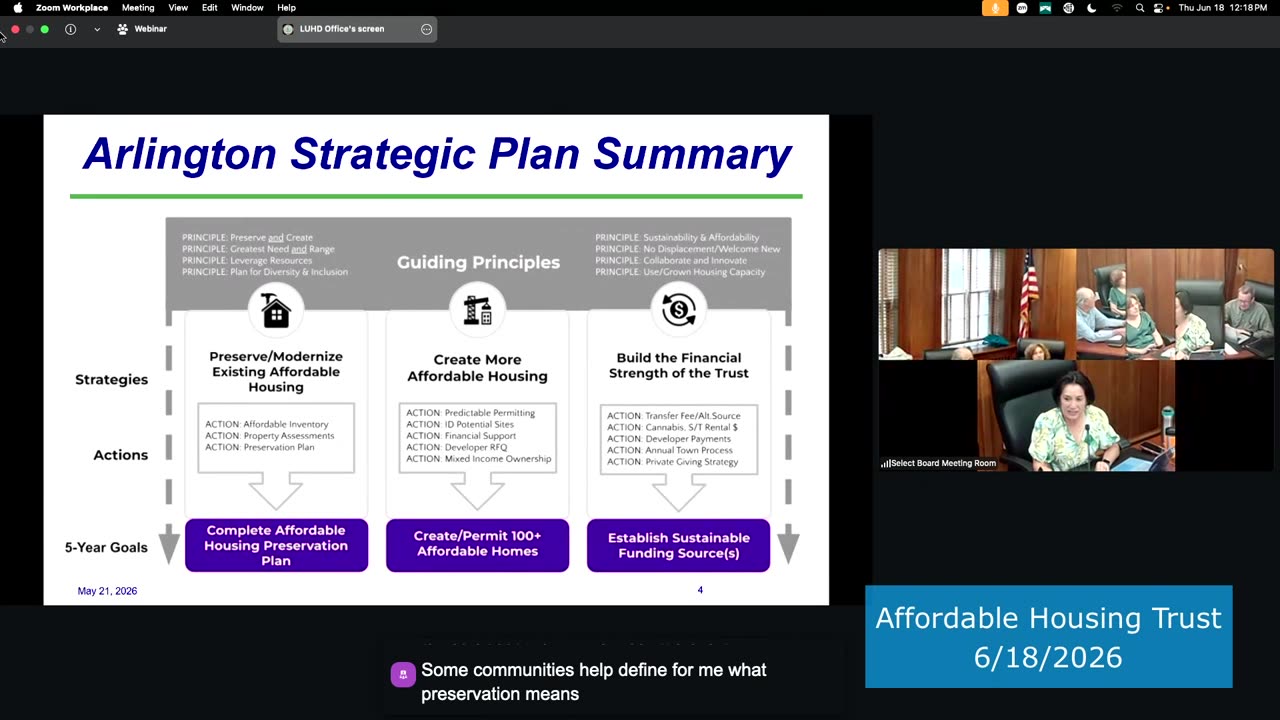
Arlington Strategic Plan Summary slide with guiding principles and 5-year goals Video still
Arlington Strategic Plan Summary slide with guiding principles and 5-year goals Frame from meeting video ▶ 1:11:22

Public ⁠impact

Issues from this meeting with documented community impact.
01

Strategic Housing Development Goals

Long-term impact on the availability and type of housing stock in Lexington. Affected: All residents, particularly those seeking affordable rental or ownership opportunities.
See more
What was discussed

The board worked to define three pillars: Preservation, Creation, and Building Financial Strength. They debated the definition of preservation and how to balance maximizing units through leverage versus acting on smaller, immediate opportunities.

What happened

The board agreed on the three primary pillars and decided to separate high-level goals from a granular internal implementation plan.

What's next

Members are tasked with proposing specific strategies and actions to be reviewed at the next meeting.

zoning change

Decisions ⁠logged

Every recorded vote, with timestamps and dissents.
Approval of two invoices from Bonds and Company for MBTA buy-down work.
The invoices were for $825 and another $825 related to recent MBTA work.
Unanimous (Aye)
Approval of the final version of the commitment letter to Lexhab.
The letter includes a loan of up to $1,000,000 at 0% interest for a mutually agreed-upon term.
Unanimous (Yes: Tiffany, Mark, Linda, a speaker)
Motion to enter executive session under exemption 6.
To consider the purchase or lease of real property regarding MBTA multifamily development buy-downs.
Unanimous (Yes: Tiffany, Mark, Linda, Bill, a speaker)

Topics ⁠discussed

Click a topic to expand quotes and full context.
▶ 01:27 Liaison Reports

Board members provided updates from LexHab, the Select Board, RHSO, and the Housing Partnership Board.

Speakers: Unidentified speaker
See more
What was discussed

Key points included LexHab's difficulty with local ADU bylaws requiring owner residency, RHSO's marketing for the Ready Renter program, and the Housing Partnership Board's involvement in CHAPA's Municipal Engagement Initiative regarding form-based zoning. There was also discussion about the 80 Bedford Street proposal and concerns regarding the historical preservation of properties.

What happened

Members were updated on various organizational activities; no formal decisions were made during this segment.

▶ 11:08 Piper Lane Unit Allocation Dispute

Discussion regarding the Planning Board's refusal to adjust unit allocations for the Piper Lane project to match the developer's revised unit mix.

Speakers: Unidentified speaker
See more
What was discussed

The developer reduced one-bedroom units (from 37% to 20%) in favor of three-bedroom units. The Trust argued for a mix closer to 1-2-3, but the Planning Board maintained the old 2-2-2 allocation, seemingly satisfied by the increased square footage of the remaining units.

What happened

The Trust was unable to convince the Planning Board to change the unit allocations.
▶ 31:29 Funding Application Review
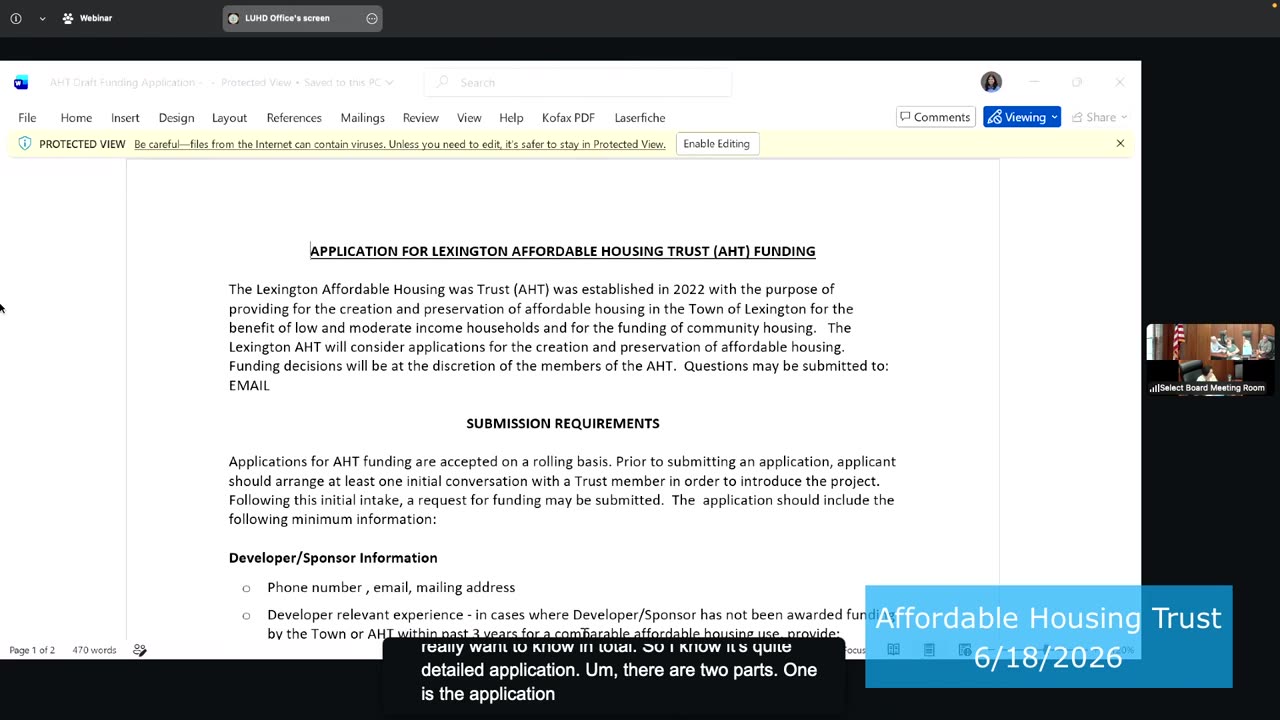
AHT funding application document on screen Video still
AHT funding application document on screen ▶ 30:56

The board reviewed a proposed comprehensive application form and accompanying Excel pro forma spreadsheets for funding requests.

Speakers: Unidentified speaker
See more
What was discussed

The board debated the complexity and 'onerosity' of the application. Arguments were made for a 'pre-app' process to vet projects before a heavy lift, and for ensuring the language covers rehabilitation and potential buy-downs. There was also discussion on whether to require detailed per-square-foot data in the pro formas.

What happened

The board agreed the forms need simplification and refinement. They will not approve a final version today.

What's next

Linda will refine the forms based on the discussed changes; the board will attempt to approve a version at the next meeting.
▶ 1:03:01 Strategic Planning: Goals and Pillars
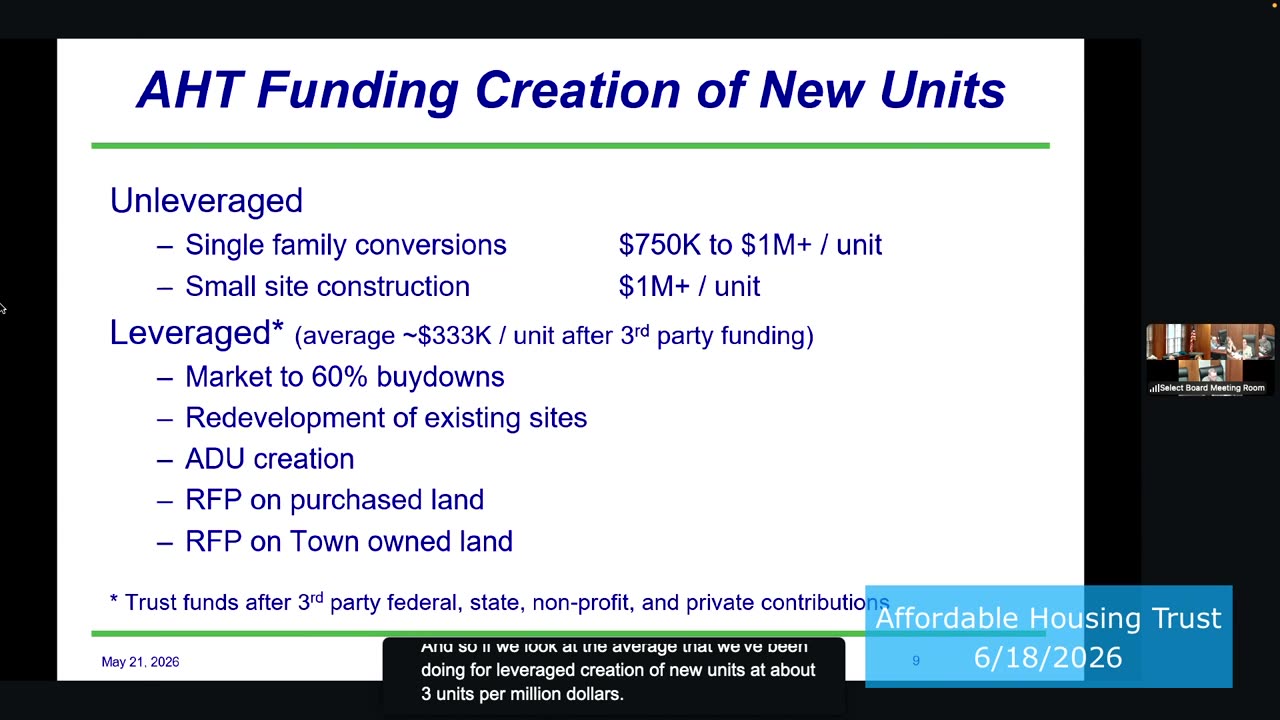
AHT Funding slide: Creation of New Units, leveraged vs unleveraged costs Video still
AHT Funding slide: Creation of New Units, leveraged vs unleveraged costs ▶ 1:05:17

The board engaged in a session to define long-term strategic goals, focusing on preservation, creation, and financial strength.

Speakers: Unidentified speaker
See more
What was discussed

Using the Arlington model, the board identified three key pillars: Preservation, Creation, and Building Financial Strength. Members debated how to define 'preservation' (e.g., managing aging capital needs vs. repositioning single units) and emphasized the necessity of leveraging outside funds rather than relying on unleveraged creation.

What happened

The board reached a consensus on the three primary pillars/goals for the strategic plan.

What's next

Further discussion on developing a formal housing preservation plan.
▶ 1:20:27 Strategic Planning: Leverage vs. Unleveraged Opportunities

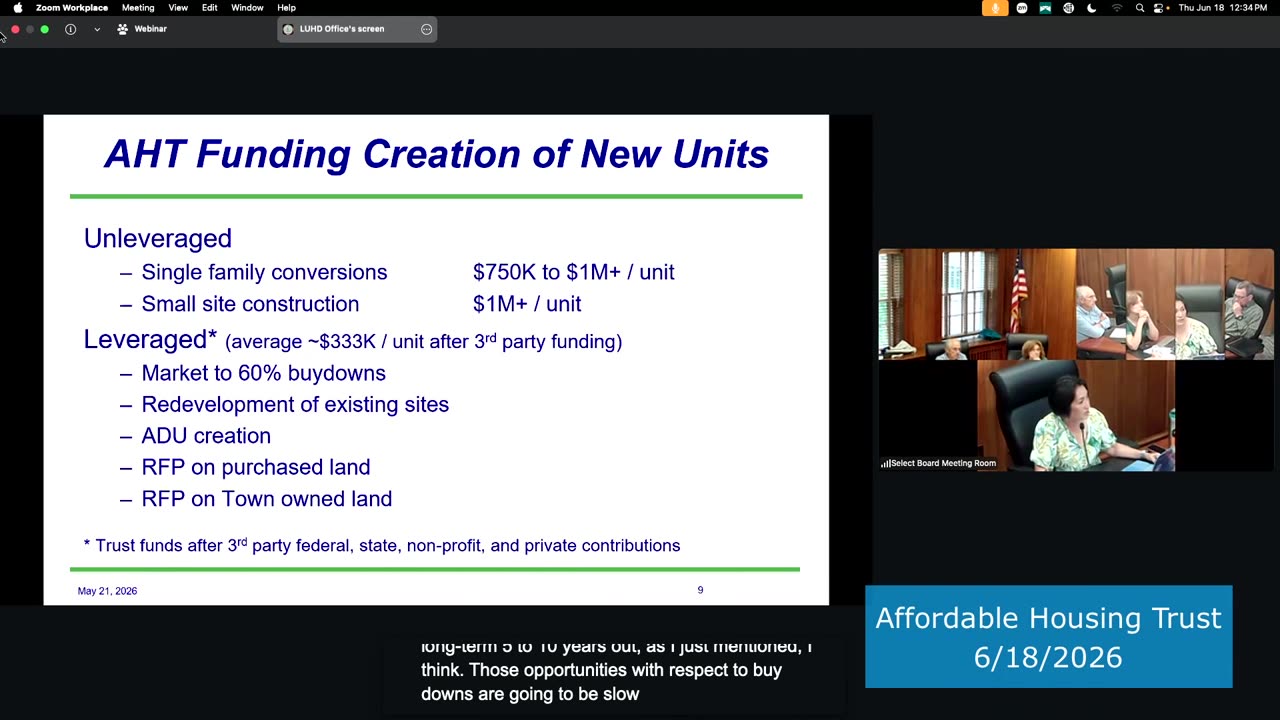
The board debated whether to prioritize high-leverage projects (maximizing units per dollar) or pursue unleveraged opportunities (such as preserving existing affordable housing).

Speakers: Unidentified speaker
See more
What was discussed

a speaker and a speaker argued that while leveraged opportunities create the most units, the town should not wait years for ideal scenarios like an overlay district. a speaker emphasized prioritizing leveraged opportunities when funds are scarce, but suggested considering unleveraged projects (like home buy-downs) when capital is available. There was also a discussion regarding the maximum amount the town should be willing to pay per unit.

What happened

The board agreed that leveraged opportunities should be the priority, but they need to develop a more structured strategic plan to bridge the gap between high-level goals and specific actions.

What's next

Board members will develop specific strategies and actions to be reviewed at the next meeting.

▶ 1:31:00 Strategic Plan Development and Goal Setting
AHT Funding slide: Creation of New Units (leveraged costs detail) Video still
AHT Funding slide: Creation of New Units (leveraged costs detail) ▶ 1:27:58

The board discussed the necessity of distinguishing between high-level goals, strategies, and specific action items to better communicate with stakeholders.

Speakers: Unidentified speaker
See more
What was discussed

a speaker argued that current planning items are 'strategies' rather than 'measurable goals' (which should be SMART: Specific, Measurable, Achievable, Realistic, and Time-bound). The board discussed how to present these to the Select Board by providing high-level goals for approval while maintaining a separate, more granular 'implementation plan' for internal use. They also discussed identifying potential sites, such as 173 Bedford Street, and the importance of being proactive in the real estate market.

What happened

The board decided to strip sub-bullets from the formal goal document presented to the Select Board to maintain a high-level view, while keeping those details in a separate internal action plan.

What's next

Members are tasked with proposing specific strategies and actions under the established high-level goals.
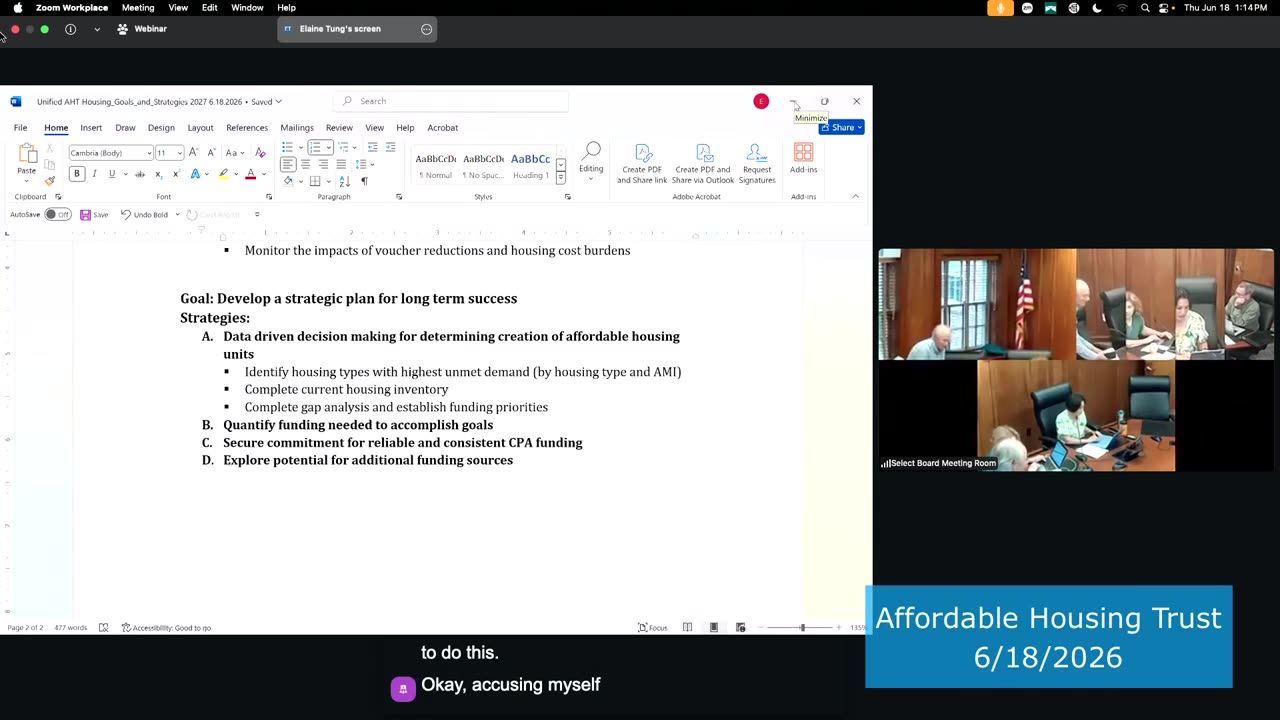
▶ 2:08:01 Lexhab Commitment Letter
AHT strategic plan goals and data-driven strategies document Video still
AHT strategic plan goals and data-driven strategies document ▶ 2:07:47

The board reviewed and voted on the final version of the commitment letter for Lexhab, including specific loan terms.

Speakers: Unidentified speaker
See more
What was discussed

The primary update to the letter involved the funding terms: a loan of up to $1 million at 0% interest for a term to be mutually agreed upon. The board noted that the final term length (potentially 30 years) is still a point of negotiation between the lender and borrower.

What happened

The motion to approve the final version of the commitment letter to Lexhab passed unanimously.

What's next

The signed letter will be routed to Lexhab for their signature.

Controversy & ⁠dissent

Where the board, the community, or the agenda diverged.

Potentially controversial issues

01

Funding Application Complexity

The public argued that the detailed documentation requirements (such as long-term operating budgets) are too burdensome for small developers and the Housing Authority, potentially discouraging applicants.
Board position: The board acknowledged the burden but opted to keep a detailed format while discussing ways to simplify specific lines.
medium concern
02

Piper Lane Unit Allocation

A disagreement exists between the Trust and the Planning Board regarding the mix of unit sizes. The developer moved away from smaller one-bedroom units toward three-bedroom units, which the Trust argued deviates from their preferred allocation strategy.
Board position: The Trust advocated for a different unit mix, but was unable to persuade the Planning Board to change the current allocation.
low concern
03

Strategic Priority: Leverage vs. Unleveraged Projects

The board debated whether to wait for high-leverage opportunities that maximize units per dollar or to act on immediate, smaller opportunities like home buy-downs to prevent missing out on available real estate.
Board position: The board reached a consensus that leveraged opportunities should be the priority, but recognized the need for a more structured plan to address gaps.
Internal dissent
Members expressed differing views on the timing of action; some urged against waiting for ideal scenarios (like overlay districts) while others focused on the necessity of maximizing limited funds.
low concern

Community vs. board tension

Action ⁠items

Who owes what, by when.
Revise the funding application and Excel pro forma spreadsheets based on board feedback (simplifying, adjusting lines, etc.).
Assigned: Linda (a speaker) · Due: Next meeting
Draft a proposal for a 'pre-application' process for potential applicants.
Assigned: Bill (a speaker) · Due: Next meeting
Ensure access to the Affordable Housing Trust email mailbox.
Assigned: a speaker
Submit proposed strategies and actions (under the three main goals) to Raggi.
Assigned: All Board Members · Due: 2026-07-04
Sign and route the Lexhab commitment letter for final execution.
Assigned: a speaker, Tiffany, and Raggi

Notable ⁠statements

I think that [requiring an initial conversation with a trust member] is fraught with problems. — Unidentified speaker · Discussing the potential liability and boundary issues of individual trustees meeting with developers before formal applications. ▶ 35:00
We don't have infinite money... the idea was to create a trust so that other money could be leveraged. — Unidentified speaker · Arguing for a strategic focus on leveraged development rather than unleveraged unit creation. ▶ 1:16:18
I don't want us to be sitting on the sideline not doing things because we're waiting for another [Lowell] Street to occur. — Unidentified speaker · Arguing against waiting for perfect leveraged opportunities and emphasizing the need to act on available opportunities. ▶ 1:25:09
If you have a goal with no date, it's not really a goal. — Unidentified speaker · Discussing the need for the strategic plan to include specific timeframes for achieving housing targets. ▶ 1:33:00

Member ⁠positions

3 issues · 2 explicit · 1 inferred
Present
Approval of two invoices from Bonds and Company for MBTA buy-down work YES ~
Approval of the final version of the commitment letter to Lexhab YES
Motion to enter executive session under exemption 6 YES

Positions marked ~ are inferred from context and may not reflect the member's explicitly stated position. UNCLEAR means the vote was split but the record did not name how this member voted — it is not a “yes.”

Public ⁠comment

What residents said — verbatim, with timestamps.
1
Total speakers
2
Addressed
3
Partial
0
Not addressed
Bob Pressman
Addressed
He noted that some participants in the CHAPA effort believe the content will not be limited strictly to form-based zoning. He provided this as a clarification to the previous discussion regarding the CHAPA Municipal Engagement Initiative. Key concern
Clarification that CHAPA initiative content may extend beyond form-based zoning.
Board response
The board acknowledged the comment with a 'thank you'.
The speaker was providing information rather than a request, and the board acknowledged receipt of the information.
Bob Pressman
Partial
He expressed concern that the Historical Commission's decision to add the Parker Manor condominium to the cultural resources survey would trigger a 21-month demolition delay. He argued that the decision was made without sufficient discussion of the impact on owners and noted that the commission appeared to have a protectionist bias. Key concern
The negative impact of the Historical Commission's vote on condominium owners due to the demolition delay bylaw.
Board response
The board (specifically Elaine Tung) provided additional context regarding the commission's meeting, the removal of public schools from the survey, and the possibility of CPC funding for repairs.
The board provided context and counter-arguments regarding the commission's actions, but the speaker's underlying concern about the 'protectionist' nature of the board and the lack of impact discussion was not resolved.
Bob Pressman
Partial
He raised concerns about the complexity and totality of the proposed funding application packages. He argued that the requirements (such as 10-20 year operating budgets) are too onerous for the types of projects being proposed. Key concern
The new application and pro forma requirements are too burdensome for applicants.
Board response
The board engaged in a lengthy discussion about the necessity of the detail, the potential for applicants to use 'N/A' for non-applicable sections, and the trade-off between detailed applications and quick reviews.
The board acknowledged the burden but ultimately decided to proceed with a detailed version, though they discussed simplifying certain aspects (like removing specific line items) to mitigate the issue.
Bob Pressman
Partial
He questioned how much documentation would be required from the Housing Authority for a pre-development grant. He expressed his opinion that the current proposed requirements are too much for them to provide. Key concern
The application requirements are too high for the Housing Authority.
Board response
The board discussed whether the Housing Authority should be exempt from certain requirements and ultimately decided to keep the language flexible regarding developer experience.
The board heard the concern and discussed it, but did not explicitly waive the requirements for the Housing Authority, instead focusing on how to word the experience requirements.
Bob Pressman
Addressed
He asked if developers in the area were aware of property availability through public means or if they relied on private connections. He suggested that the trust should find ways to connect with owners of large parcels to identify potential sites. Key concern
The need for better strategies to identify and connect with landowners for potential affordable housing sites.
Board response
The board (Elaine Tung) responded that most such properties are not on the market and require being 'ready to move' or 'beating the brush'.
The board provided a direct answer regarding the nature of the real estate market and site identification.
Support coverage

Creating this report cost ⁠real money.

MeetingWatch attended, transcribed, and analyzed this meeting on its own dime. If this work is valuable to you, chip in to keep covering Lexington.

Report composed by grok-4.3, gemma-4-26b, grok-4.20-0309-reasoning, grok-4-fast · analyzed 2026-06-22.