Your area Not set — showing everywhere
Meeting report · Planning Board
Creating this report cost real money. Help fund coverage →

Planning Board — June 16, 2026

The meeting was professional and focused on technical refinements and long-term planning rather than immediate conflict.
Date Tuesday, June 16, 2026 Duration 1.6h Speakers 1 Public comments 1 Decisions 1 Routine
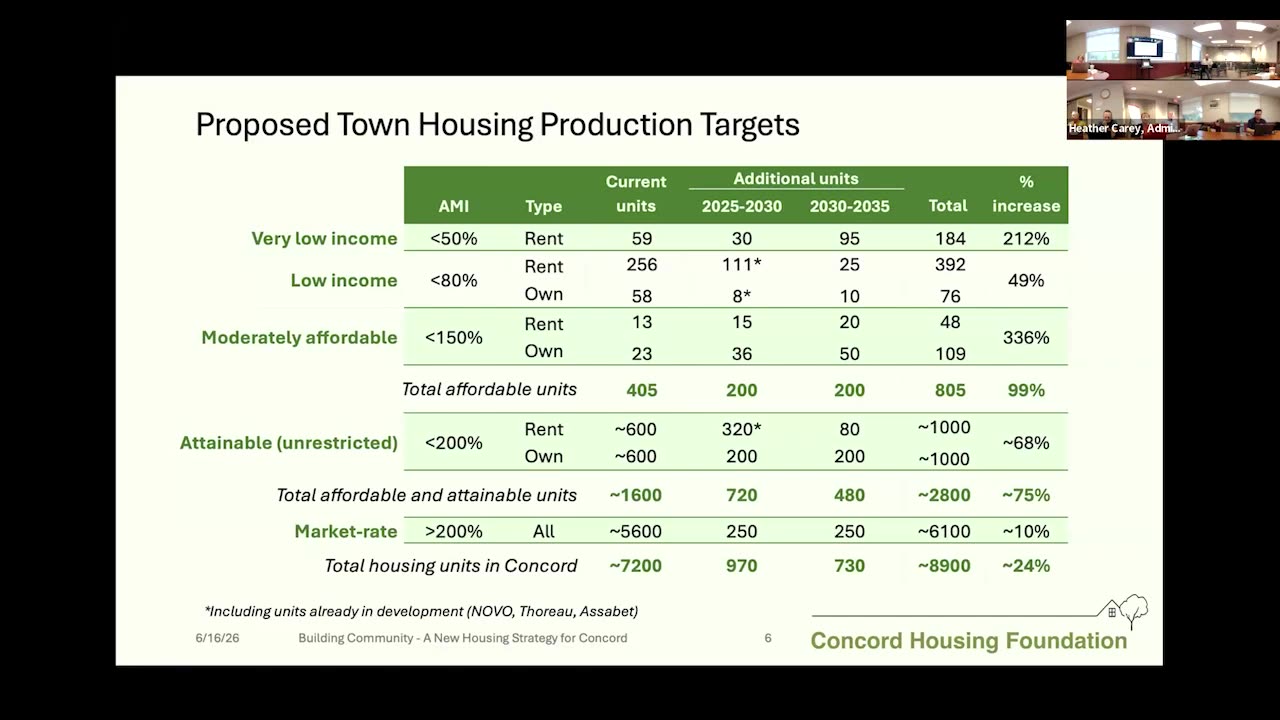
Proposed Town Housing Production Targets table Video still
Proposed Town Housing Production Targets table Frame from meeting video ▶ 15:54

Public ⁠impact

Issues from this meeting with documented community impact.
01

New Housing Strategy (Missing Middle)

Significant potential shift in town demographics and density via new zoning incentives. Affected: All Concord residents, particularly middle-income families and developers.
See more
What was discussed

Matt Johnson presented a strategy to address the 'missing middle' by targeting attainable housing tiers. The Board queried the impact on public safety services, school enrollment, and the economic trade-offs between centralized density and suburban sprawl.

What happened

The Board requested more clarity on definitions and better data presentation before the strategy moves to a housing round table.

What's next

Matt Johnson will circulate an updated document; a housing round table is scheduled for next week.

zoning change
02

Bylaw Recodification and Online Platform

A two-year comprehensive overhaul of town laws and digital access. Affected: Property owners, developers, and town officials.
See more
What was discussed

The Town Clerk proposed a project to consolidate bylaws, remove obsolete rules, and create a searchable online zoning platform. The Board discussed the scope of the project and whether zoning should be included in the initial phase.

What happened

The Board expressed support for the project but requested more information.

What's next

a speaker will meet with the Town Clerk on the 1st to gather more details for the July 1st meeting.

other high impact

Decisions ⁠logged

Every recorded vote, with timestamps and dissents.
Approval of the Planning Board meeting minutes from June 9th.
A roll call vote was conducted following a motion and a second.
Approved (Unanimous)

Topics ⁠discussed

Click a topic to expand quotes and full context.
▶ 00:38 Concord Housing Foundation: New Housing Strategy
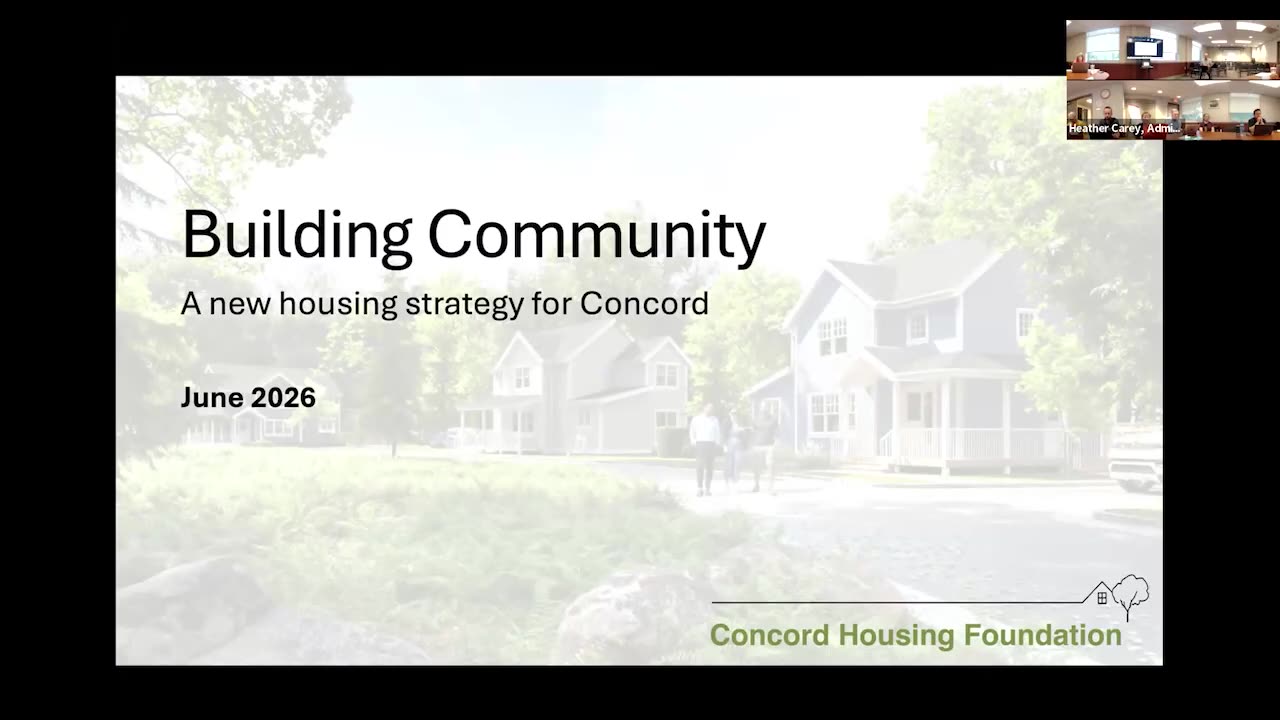
Title slide: Building Community housing strategy Video still
Title slide: Building Community housing strategy ▶ 04:30

Matt Johnson presented a proposed strategy to address Concord's housing crisis by targeting diverse income tiers, including 'attainable' housing.

Speakers: Unidentified speaker, Matt Johnson, Pat Nelson, Robert
See more
What was discussed

Johnson highlighted that rising home values are causing demographic shifts and declining school enrollments. He proposed expanding focus beyond the state-mandated 80% AMI tier to include very low-income and 'attainable' (middle-income) housing through zoning incentives, smaller unit sizes, and utilizing town-owned sites via PRD models or 40Y (starter home) zoning.

What happened

The Board provided feedback on data presentation (e.g., coloring negative budget impacts red), requested more clarity on '40Y' definitions, and asked for empirical methodology regarding school enrollment impacts.

What's next

Matt Johnson will circulate the updated document; the discussion serves as an input gathering phase for a housing round table next week.
▶ 1:05:45 Bylaw Recodification and Online Platform Project

Discussion regarding a proposed two-year project to recodify town bylaws and implement a searchable online zoning platform.

Speakers: Unidentified speaker, Elizabeth, Sue
See more
What was discussed

The Town Clerk intends to issue an RFP for a consultant to consolidate individual bylaws, remove obsolete rules, and resolve contradictions. The project involves a two-step process: an analysis/recodification phase followed by the implementation of an online platform where users can search zoning requirements by address. The project is expected to take 1.5 to 2 years. There was discussion regarding potential overlaps with existing recodification work, how to manage zoning changes during the transition period, and whether the zoning bylaw should be included in the initial analysis phase.

What happened

The Board expressed support for the project; no formal vote was taken at this stage.

What's next

a speaker will meet with the Town Clerk on the 1st to gather more information and will share it with the board. The Board will await further information from the meeting on July 1st.

▶ 1:08:50 2026-2027 Planning Board Goals and Projects

Review of the draft memo outlining upcoming board goals, including MCI Concord development and subdivision rule updates.

Speakers: Unidentified speaker
See more
What was discussed

Key upcoming projects include the MCI Concord master plan and zoning development, and an update to the subdivision rules and regulations (which haven't been updated since 2007). The discussion touched on the limitations of subdivision rules regarding what the town can legally mandate versus what is purely administrative.

What happened

The board reviewed the draft memo and minor typos were noted.

What's next

A final memo will be presented at the next meeting for a formal vote.

▶ 1:08:39 Zoning Bylaw: Definition of Basement

The Board discussed the need for a clearer legal definition of 'basement' to prevent loopholes regarding Floor Area Ratio (FAR).

Speakers: Unidentified speaker, Elizabeth
See more
What was discussed

The Building Commissioner is researching definitions (e.g., from Belmont) to address cases where structures appear to be one story but are actually multi-story 'walk-out' basements that currently bypass FAR limits. The Board discussed the relevance of ceiling height and how much of a basement is above ground.

What happened

The Board agreed that a clearer definition is needed to close potential loopholes.

What's next

The Building Commissioner will research other communities and provide a recommendation with pros and cons.

▶ 1:18:18 Zoning Bylaw: General Corrections and Improvements

A proposal was introduced to clean up the zoning bylaw, addressing typographical errors, ambiguities, and formatting issues.

Speakers: Unidentified speaker, Elizabeth, Sue
See more
What was discussed

The Board discussed a draft 'general corrections warrant article' aimed at tidying the bylaw. Discussion touched on how to handle corrections that do not require Town Meeting approval versus those that do, and how the document is formatted for review (using gray highlights, bold italics, and strike-throughs).

What happened

The Board decided to review the draft offline rather than attempting a full review during the meeting due to time constraints.

What's next

Board members are to review the 'Draft General Corrections Warrant Article' offline; the item will return to the July 28th meeting.

▶ 1:22:25 55 Wallace Street Section 106 Historic Review

Notification regarding a required historic review for a wireless project at 55 Wallace Street.

Speakers: Unidentified speaker
See more
What was discussed

The project involves a wireless installation that also requires a special permit application to the Board of Appeals. The board discussed potential conflicts with a nearby solar expansion and battery storage project, but concluded there appeared to be no overlap in the easement areas.

What happened

The board decided they do not need to comment or act as a consulting party, deferring to the Historical Commission.

What's next

The applicant will likely submit a special permit application to the Board of Appeals soon.

▶ 1:28:00 Transportation and Regional Transit Updates

Updates on the MCI Concord survey, Route 2 rotary concepts, and a potential new regional shuttle service.

Speakers: Unidentified speaker
See more
What was discussed

The Town Planner discussed a proposal to reallocate MBTA assessment funds to the LRTA to implement a fixed-route shuttle connecting Acton, Maynard, and Concord. Board members noted that such transit is critical for reducing car dependency at the MCI Concord site.

What happened

Information was shared regarding upcoming public meetings and the survey process.

What's next

The Transportation Advisory Committee (TAP) will meet on July 7th at 9:30 a.m.

▶ 1:40:17 General Bylaw Recodification Project

The Board was briefed on an upcoming town-wide effort to recodify all general bylaws into a single, searchable online platform.

Speakers: Unidentified speaker, Elizabeth, Sue
See more
What was discussed

The Town Clerk intends to issue an RFP for a consultant to consolidate individual bylaws, remove obsolete rules, and resolve contradictions. The project is expected to take 1.5 to 2 years and will include the implementation of an online searchable platform.

What happened

The Board expressed support for the project and discussed whether the zoning bylaw should be included in the initial analysis phase.

What's next

The Board will await further information from the meeting on July 1st.

Controversy & ⁠dissent

Where the board, the community, or the agenda diverged.

Potentially controversial issues

01

Concord Housing Foundation: New Housing Strategy

The proposal seeks to expand housing diversity to include 'attainable' middle-income tiers through density increases and zoning changes like 40Y. This affects property values, school enrollment, and town character, making it a topic of high interest for residents concerned about demographic shifts and municipal costs.
Board position: The Board showed strong interest and provided critical feedback, requesting better data methodology and clearer definitions to ensure the strategy is transparent and economically sound.
high concern

Community vs. board tension

Action ⁠items

Who owes what, by when.
Email the updated Housing Strategy presentation to Board members.
Assigned: Matt Johnson · Due: Immediate
Meet with the Town Clerk to get more information on the bylaw recodification project.
Assigned: a speaker · Due: The 1st of the month
Review Sue's edits and present the final draft of the 2026-2027 goals memo to the board.
Assigned: a speaker · Due: Next meeting
Review the 'Draft General Corrections Warrant Article' offline.
Assigned: Board Members · Due: 2026-07-28
Research basement definitions in other communities and present recommendations to the Board.
Assigned: Building Commissioner
Coordinate with the Town Clerk and Attorney General regarding minor bylaw edits and the status of recent amendments.
Assigned: Elizabeth
Send out an email with a link to the MCI Concord Master Plan survey.
Assigned: Town Staff/Planner · Due: Tomorrow

Notable ⁠statements

We've got a sort of a barbell type of demographic. We've got wealthy people earning over 250% of AMI moving into town, and we have the few affordable units at the opposite very low the low-income tier, and nobody in between. It's called the missing middle. — Matt Johnson · Explaining the lack of housing for middle-income residents in Concord. ▶ 09:54
The subdivision rules and regs are mostly a town staff level as far as how utilities get installed... the state subdivision control law is very specific and it's very limited. — Unidentified speaker · Explaining the legal scope and limitations of updating subdivision regulations. ▶ 1:12:20
The goal is to get this out of the way while we can [before things heat up in the fall]. — Unidentified speaker · Discussing the timeline for passing general zoning bylaw corrections. ▶ 1:23:34
If we're trying to cut down on the cars, it's going to have to be part of it [the MCI Concord development]. — Board Member · Discussing the necessity of the proposed regional shuttle service. ▶ 1:34:00

Public ⁠comment

What residents said — verbatim, with timestamps.
1
Total speakers
1
Addressed
0
Partial
0
Not addressed
Matt Johnson
Addressed
Presented the Concord Housing Foundation's 'Building Community New Housing Strategy' to address the town's housing crisis and demographic shifts. He proposed targeting a wider range of income tiers, including 'attainable' housing, through zoning changes and utilizing town-owned sites. Key concern
The need to update housing strategies to include middle-income ('attainable') residents and leverage new opportunities like MCI Concord.
Board response
The board members engaged in an extensive Q&A session, asking for clarification on economic impacts, zoning mechanisms (40Y, PRDs), and data methodology.
The board engaged deeply with the presenter, providing feedback on how to improve the presentation, clarify terminology, and suggesting specific items to include in future discussions (like zoning changes for surplus sites).
Board Member (unnamed)
Addressed
Asked about the impact of new housing on municipal services such as police and fire departments, specifically regarding property tax impact. Key concern
The financial impact of new housing on public safety services.
Board response
The presenter responded that the impact is very small relative to school costs and provided a rough estimate of the per-unit property tax impact.
The presenter directly answered the question with specific context regarding police and fire service costs.
Board Member (unnamed)
Addressed
Inquired if the financial impact of housing differs based on whether development is centralized or located at the edges of town (sprawl). Key concern
The infrastructure costs associated with housing sprawl.
Board response
The presenter noted that while sprawl has costs (water mains, road damage), it is difficult to quantify in comparison to police and fire.
The presenter acknowledged the validity of the concern and discussed the known costs of sprawl versus the difficulty of precise quantification.
Board Member (unnamed)
Addressed
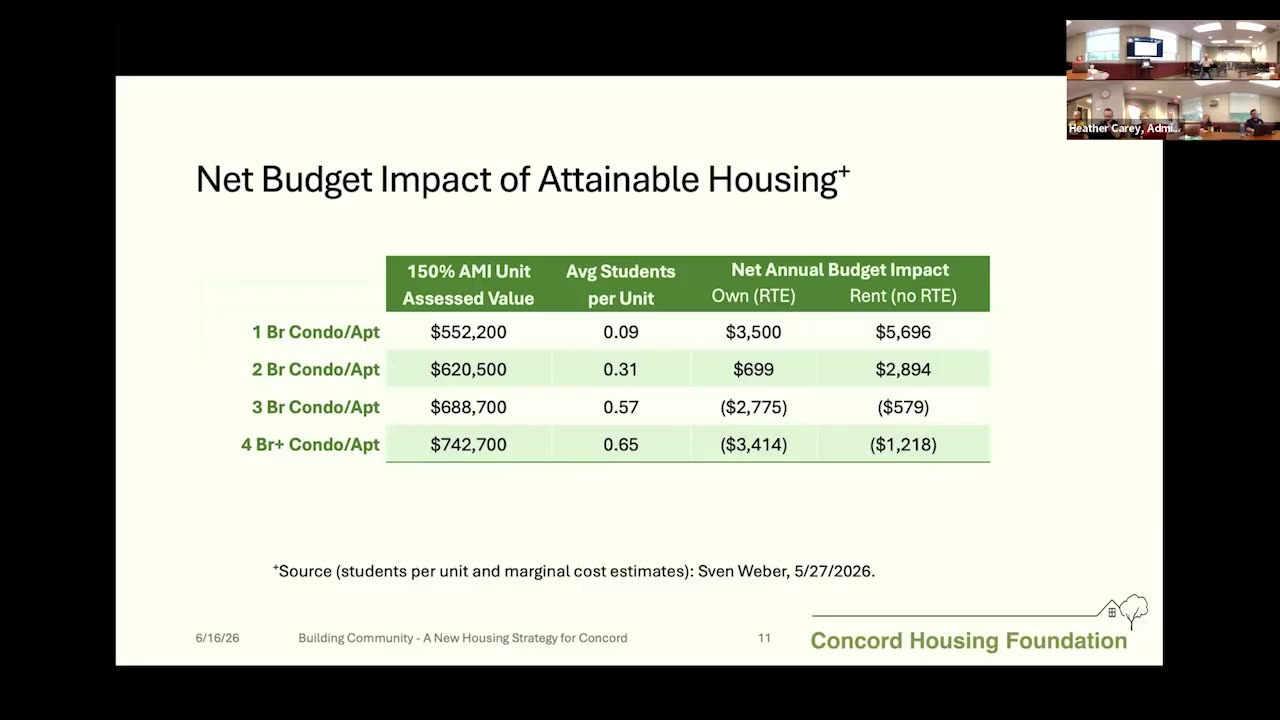
Requested clarification on why there were negative numbers displayed on one of the presentation slides regarding attainable housing. Key concern
Data accuracy/clarity in the presentation.
Board response
The presenter clarified that the '-' was actually a 'squiggle' (formatting error) and not a negative number.
The presenter corrected the misunderstanding immediately.
Board Member (unnamed)
Addressed
Asked if the cost of attainable housing is driven by density and smaller unit sizes, and questioned if market demand would simply drive prices up regardless. Key concern
The mechanisms that ensure housing remains 'attainable'.
Board response
The presenter explained that in Concord, attainable units tend to be smaller and denser, and there is a limit to what people will pay for them.
The presenter explained the economic relationship between unit size, density, and price limits.
Board Member (unnamed)
Addressed
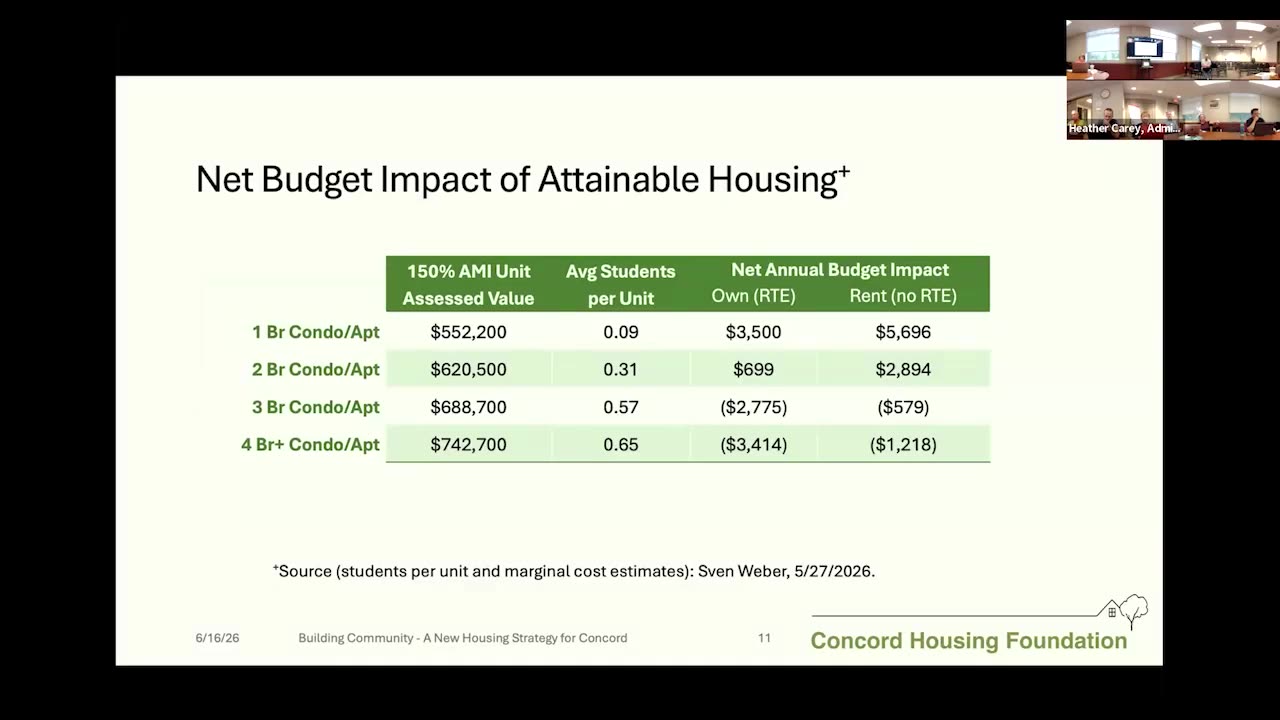
Asked why there were no four-bedroom houses listed in the ownership category on the provided charts. Key concern
Data completeness in the presentation.
Board response
The presenter explained that the RSO (Residential Special Overlay) does not include that specific category.
The presenter provided a specific technical reason for the absence of that data point.
Board Member (unnamed)
Addressed
Inquired whether incentivizing Planned Residential Developments (PRDs) on town-owned sites would require a change to the existing zoning bylaws. Key concern
The regulatory feasibility of using PRDs for 'missing middle' housing.
Board response
The presenter suggested that while 40Y zoning is an option, they could use existing PRD bylaws with density bonuses if the town owns the site.
The presenter discussed different regulatory paths (40Y vs. existing PRD bylaws) to achieve the goal.
Pat Nelson
Addressed
Requested a better explanation of '40Y' zoning and asked for more clarification on the methodology used to estimate school enrollment declines. Key concern
Need for clarity in definitions and data methodology to prevent public skepticism.
Board response
The presenter acknowledged the need for more explanation and agreed to make the presentation clearer (e.g., using red text for negative impacts).
The presenter accepted the feedback and agreed to refine the presentation/document for clarity.
Board Member (unnamed)
Addressed
Asked if the intent of proposed zoning changes was to lower land costs by providing greater density. Key concern
The economic objective of zoning changes.
Board response
The presenter explained that higher density allows the per-unit land cost to be divided among more units.
The presenter explained the economic logic of density in relation to land costs.
Board Member (unnamed)
Addressed
Suggested that the presentation should include real-world examples, pictures, and stories of 40Y housing to help the public visualize and accept the concept. Key concern
Public perception and communication of new housing models.
Board response
The presenter and other board members agreed that visual and narrative examples would be helpful for future presentations.
The presenter agreed with the suggestion to improve future communication.

From the meeting

Net Budget Impact of Attainable Housing table Video still
Net Budget Impact of Attainable Housing table ▶ 19:47
Net Budget Impact of Attainable Housing table Video still
Net Budget Impact of Attainable Housing table ▶ 31:05
Support coverage

Creating this report cost ⁠real money.

MeetingWatch attended, transcribed, and analyzed this meeting on its own dime. If this work is valuable to you, chip in to keep covering Concord.

Report composed by grok-4.3, gemma-4-26b, grok-4-fast, grok-4.20-0309-reasoning · analyzed 2026-06-22.